Get all your news in one place.
100's of premium titles.
One app.
Start reading
Digital Camera World
Hillary K. Grigonis

“We’ve learned not to trust bright blobs in images.” This is one of the most photographed planetary systems, but a faint planet still played hide-and-seek in more than a decade's worth of photos

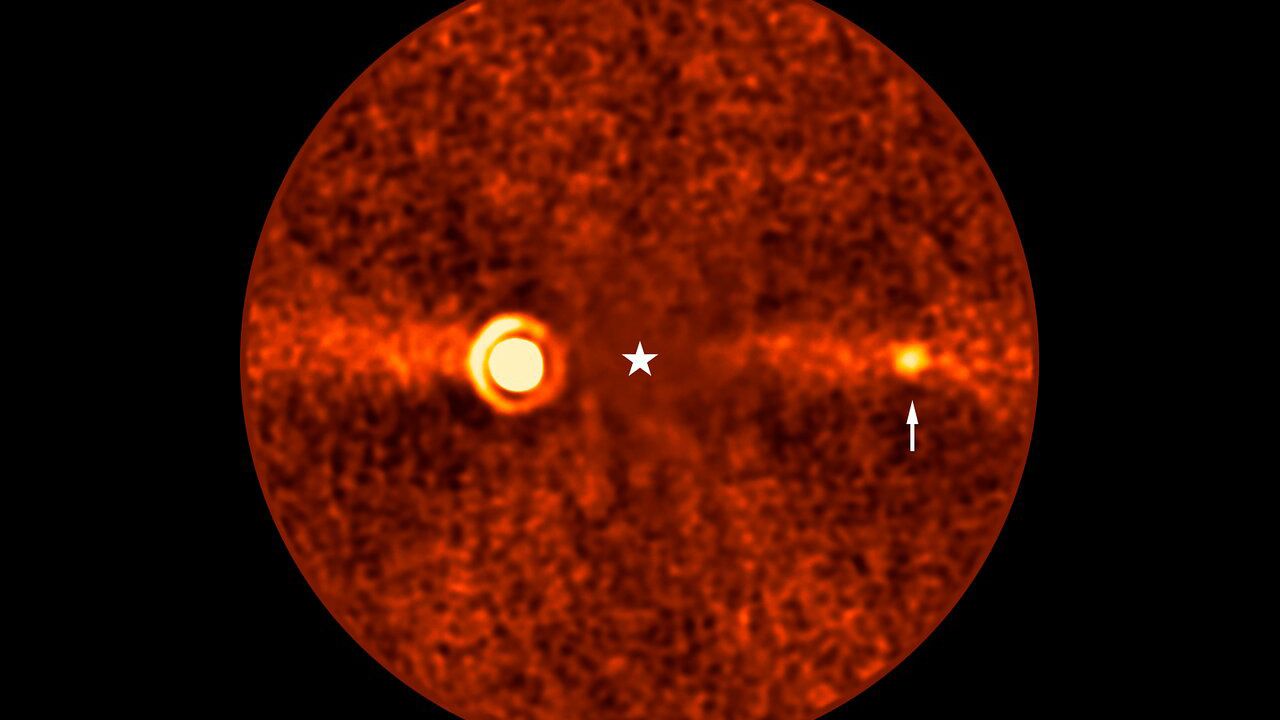
This image, taken with ESO’s Very Large Telescope (VLT) shows Beta Pictoris d, a new planet found orbiting the star Beta Pictoris. The star is at the centre of the frame, and was subtracted when processing the data, revealing the environment around it. The new planet, indicated with an arrow, is the third one found around this star. The other two are Beta Pictoris b –– the bright source to the left, and Beta Pictoris c, orbiting much closer to the star and not seen here. The image was taken with the ERIS instrument at the VLT. Based on its infrared brightness and colour, the new planet appears to be a gas giant, about 2.4 times more massive than Jupiter. The diffuse horizontal band in this image is a debris disc around the star, seen here edge-on, the leftover material of planetary formation.

Beta Pictoris, located about 63 light-years away from Earth, is one of the most photographed planetary systems outside of our own – yet despite all the data coming from that part of the sky, a faint planet remained hidden. After researchers noted a bright spot in new images, the newly discovered planet was spotted in images dating back over 11 years.

“We weren’t looking for a new planet, explained lead researcher Aidan Gibbs. “We were trying to understand one we already knew existed. Then, this telltale signal appeared in the data where we didn’t expect it.”

Researchers were looking at Beta Pictoris b with the James Webb Telescope’s Near InfraRed Spectrograph when they spotted another bright spot in the image where they had expected to see dust: a planet now named Beta Pictoris d.

An artist's rendering of what Beta Pictoris planetary system may look like from space, with the new Beta Pictoris d on the right (Image credit: NASA, ESA, CSA, STScI, Ralf Crawford (STScI))

When researchers went back over older images, they spotted evidence of the planet in images that had been taken more than a decade ago.

Beta Pictoris d is estimated to be about twice the mass of Jupiter, so why is the newly discovered planet so good at playing hide and seek? Beta Pictoris d is very dim. Researchers believe it’s one of the dimmest exoplanets ever to be photographed from Earth. The planet also has the widest known orbit in the system compared to the other two known planets, which puts it just inside the system’s debris disk.

Using Webb, the researchers were able to capture a near-infrared spectrograph and a traditional image of the discovery.

"There was an unexpected bright source of light within the Integral Field Unit imaging, but we've learned not to trust bright blobs in images," Jean-Baptiste Ruffio, a principal investigator of the Webb Observations and research scientist at the University of California, San Diego, said. “They can be instrumental artifacts or other structures in the debris disk. By obtaining a spectrum at the same time as the image, we were able to quickly confirm our suspicions.”

(Image credit: NASA, ESA, CSA, STScI; Science: Aidan Gibbs (UC San Diego), Jean-Baptiste Ruffio (UC San Diego); Image Processing: Alyssa Pagan (STScI))

A separate study using the European Southern Observatory Very Large Telescope confirmed the planet’s existence, noting that Beta Pictoris d is 100 times fainter than the first planet discovered in the same system.

The ESO research team also combed through past data, finding faint evidence of Beta Pictoris d hidden in the glare of Beta Pictoris b, dating back 11 years

“Planet d, it seems, has been playing a game of hide-and-seek with us for over a decade and only now can we say ‘found you,’” said Jaybe Bixby study co-author and astronomer at the University of Oxford, United Kingdom.

In traditional imaging, a planet must be bright enough not to be overshadowed by the brightness of any neighboring objects, and the brightness of Beta Pictoris b meant the neighboring planet remained undetected for several years.

While the discovery of Beta Pictoris d is new, researchers had their suspicions – the mass and shape help explain the shape of Beta Pictoris’ debris disk.

You may also like

Take a look at the best cameras for astrophotography.

Sign up to read this article
Read news from 100's of titles, curated specifically for you.

Already a member? Sign in here
Related Stories
Top stories on inkl right now
One subscription that gives you access to news from hundreds of sites
Already a member? Sign in here
Our Picks
Fourteen days free
Download the app
One app. One membership.
100+ trusted global sources.