Get all your news in one place.
100’s of premium titles.
One app.
Start reading
The Times of India
The Times of India
National
Priyanka Dasgupta | TNN

West Bengal: After chance discovery, 1950s’ nitrate-base film negatives to undergo 4K transformation

KOLKATA: Reviewing the original negatives of a Bengali film at the state government’s film vault that resulted in inspiring Kishore Kumar-Mehmood's rip-roaring comedy ‘Padosan’ has led to an interesting find by the head of the National Film Archive of India (NFAI).

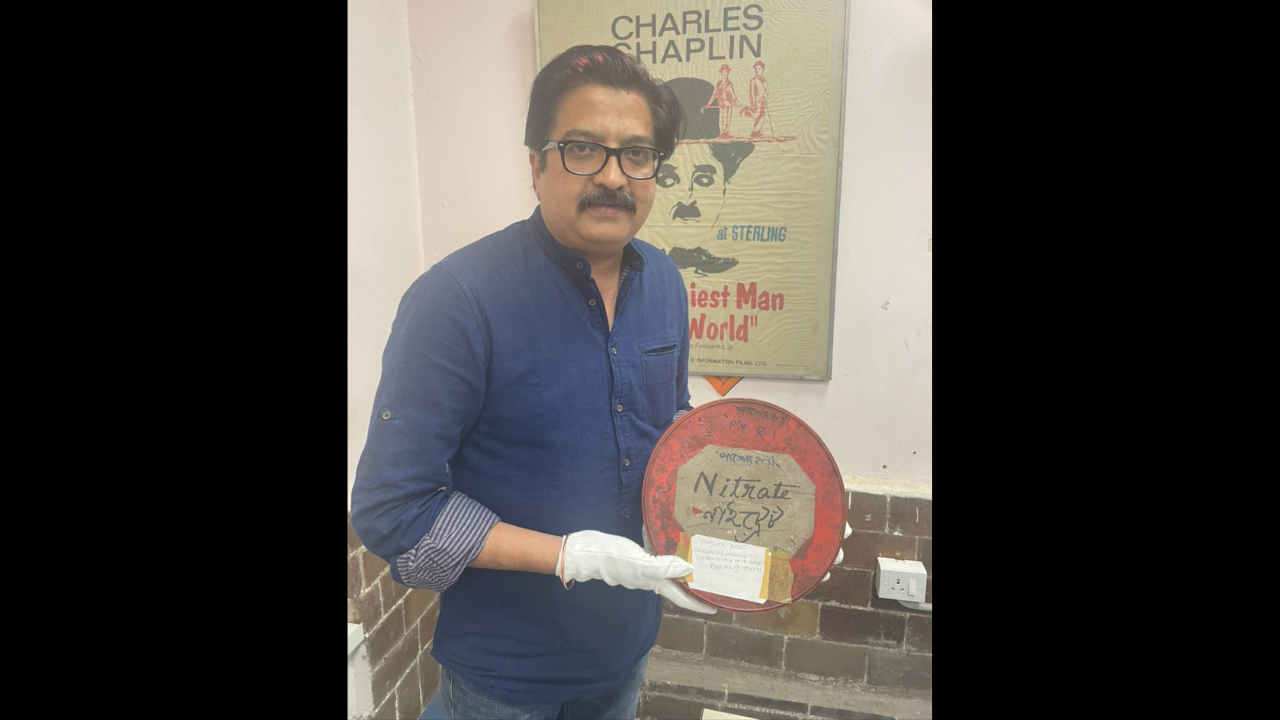
Out of 14 cans of negatives, 2,230ft length of the film is in nitrate. In today’s age, discovery of nitrate base is considered a big development in the archival world. Since this is an extremely rare find with huge archival value, the negatives have been transported from Kolkata to the Pune archives for preservation. Work on 4K digitization of this film will begin very soon.

The nitrate negative

Director Sudhir Mukherjee’s ‘Pasher Bari’, which had catapulted Sabitri Chatterjee to fame and gave Bhanu Bandyopadhyay his first hit, was based on Arun Chowdhury’s short story by the same name. Elated with the news, Sabitri described this as a “great” find. “This is very good news,” she told TOI. Bhanu Bandyopadhyay’s son Gautam considers this to be an excellent move.

“This was my father’s first hit. In 2003, I had tried to get in touch with director Sudhir Mukherjee to see if it could be restored. I am so happy that this work is finally getting done,” Gautam said.

The romantic comedy was made under the banner of Production Syndicate. A young Sabitri, who at that point in time spoke with a heavy Bangal accent, was considered for the protagonist’s role. Initially, her accent was a cause for concern. Later, the makers returned to cast her in the film. The simple love story of a man who solicits the help of his friend to woo the girl-next-door became a huge success.

Currently, a very hazy print of the film is available online. “This is a very rare film element that has a partial nitrate and partial acetate base. There are not many examples where filmmakers used both acetate and nitrate for the same film. Before the 1950s, nitrate used to be the film base. This was slowly eased out post the 50s because of its unstable nature,” said NFAI’s director Prakash Magdum.

It has been decided that preserving these negatives would be best done at NFAI since it has separate nitrate vaults. “Physical inspection of the film revealed that the nitrate film stock was manufactured in the UK in 1950. We will soon be taking it up for 4K digitization,” he added.

Sign up to read this article
Read news from 100’s of titles, curated specifically for you.
Already a member? Sign in here
Related Stories
Top stories on inkl right now
One subscription that gives you access to news from hundreds of sites
Already a member? Sign in here
Our Picks
Fourteen days free
Download the app
One app. One membership.
100+ trusted global sources.