Get all your news in one place.
100’s of premium titles.
One app.
Start reading
Motorsport
Motorsport

WEC 2025 BoP analysis: Porsche

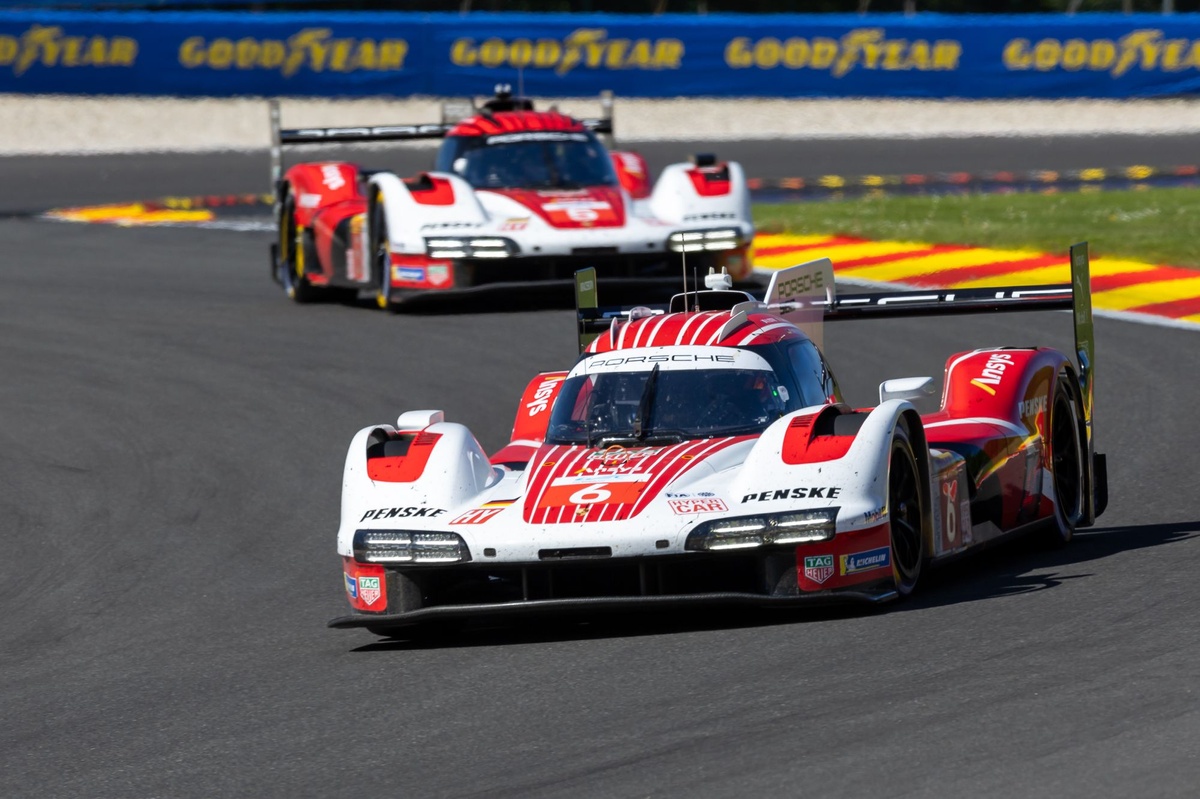
The Porsche 963 is the fastest LMDh car in the field before any Balance of Performance changes Throughout the 2025 World Endurance Championship, the only Hypercar based on a Multimatic chassis had the least favorable power-to-weight ratio in the critical range below 250kph among all LMDh prototypes.

This alone demonstrates that Porsche Penske Motorsport has pushed the LMDh concept to its absolute limit like no other manufacturer, which is also reflected in their success in the IMSA SportsCar Championship.

The subsequent WEC exit is all the more regrettable. In the middle of the 'Golden Era' of sportscar racing, which otherwise moves from one success to the next, it feels completely off.

For the WEC, Porsche is a bitter loss. Any other departure, with the exception of Ferrari, would have been easier for the FIA and ACO to swallow than Porsche’s.

The main reason is that Porsche sees no further perspective for a fair convergence between the LMH and LMDh concepts following its narrow Le Mans 24 Hours defeat against Ferrari.

This is particularly explosive given that the Hypercar regulations promised all manufacturers a "guaranteed equal playing field."

In Porsche's eyes, this is not the case because Ferrari has possibilities with its LMH challenger that is structurally impossible for LMDh cars.

Consequently, Porsche pushed hard for a unification of the regulations after Le Mans. Once it became clear that such changes were unrealistic before 2030, Porsche pulled the plug on the WEC as IMSA remains dominated by the LMDh platform.

The Heavy burden of the world title

Having won the 2024 Drivers' World Championship, Porsche started the 2025 season in Qatar and Imola with the second-worst power-to-weight ratio behind Toyota. The results reflected this handicap.

To general surprise, Porsche suffered the same 'Toyota fate' before Spa: despite even worse results than the Japanese manufacturer, the power-to-weight ratio of the Porsche 963 deteriorated further—albeit less severely than that of Ferrari and Toyota. So, in the Ardennes, Porsche was again without any chance of challenging for the victory.

Superhuman performance at Le Mans

#4 Porsche Penske Motorsport Porsche 963: Felipe Nasr, Nick Tandy, Pascal Wehrlein (Photo by: Marc Fleury)

After three races, the Porsche 963s had collected a mere seven championship points. The German brand was clearly willing to make this sacrifice for a win at Le Mans, with its ambitions underlined by a third works entry.

Below 250kph, the 963 was rated at 2.037 kg/kW—the second-worst value behind the Peugeot 9X8. Above 250 kph, however, the Porsche was granted an exceptionally strong rating of 2.009 kg/kW.

Yet, it wasn't enough against the superior Ferrari 499Ps. Thanks to a monumental performance by the #6 Porsche, the elusive first victory for Roger Penske was within grasp.

Had Kevin Estre, Laurens Vanthoor, and Matt Campbell won the race, their victory would have been on par with Audi's legendary 2008 triumph, but without the help of rain.

It was one of the most remarkable drives even seen at Le Mans. Objectively, Porsche stood no chance against Ferrari.

Without the Prancing Horse, the #6 Porsche would have won the race by two minutes, despite a Safety Car deployment at the halfway point. Over a 24-hour distance without safety cars, the #6 would have lapped the entire field, including its own sister cars.

Nevertheless, after a perfect drive, Porsche fell short by just 14.084 seconds—the second-closest finish without team orders since 2011. This left Porsche Penske Motorsport traumatised.

Seeing Ferrari win with a far-from-perfect job by the factory cars and a gearbox issue on the winning privateer 499P, while the #6 delivered a nearly perfect race, was a bitter pill to swallow.

"In the end, we have to say that the number 6 drove an almost perfect race, as the Ferraris had a few issues, including penalties", Porsche Motorsport boss Thomas Laudenbach said after the race. The frustration that Ferrari still took the victory can be read between the lines.

This perceived lack of opportunity was ultimately the primary reason for the withdrawal, even outweighing economic concerns.

Politically, Porsche tried everything to achieve a swift unification of the car concepts. When it became apparent that this would not happen until the next decade, Porsche pulled the plug.

A sensational win in Austin and a bitter finale

For Sao Paulo, the Porsche received a sub-250kph BoP of 2.102 kg/kW. While worse than in Qatar and Imola, it was better than the first three races when compared to its immediate competitors (excluding Cadillac).

Consequently, Porsche was right at the front, though ultimately unable to beat the superior Cadillacs in Brazil.

Surprisingly, Porsche received the harshest BoP hit of all hypercars for Austin, but the weather rendered the BoP irrelevant.

Once again, Porsche proved it had become the benchmark for maximizing opportunities in the WEC. It was the only manufacturer to match Ferrari's pace in the rain, and Kevin Estre secured the victory at the final restart with a robust overtake.

By Fuji, the Porsche's power-to-weight ratio was nearly on par with Ferrari and Toyota. Despite the BoP, the #6 Porsche fought for the win after starting from the penultimate grid position, eventually finishing third.

The fact that Porsche could still fight for podiums despite a significantly worse BoP than in the season opening races shows that the factory Penske team achieved massive gains during the car's third year.

However, this progress was reflected in the BoP for Bahrain. With a power-to-weight ratio of 2.222 kg/kW below 250kph, the Porsche was, for the first time, the least favorably rated Hypercar of all.

In the race, Porsche made the wrong strategy call after the first safety car, leading to one of the worst days in the entire program's history.

LMDh project head Urs Kuratle even called it the worst day ever for the programme outright. Instead of attacking Ferrari for the drivers' championship, Porsche lost second place in the manufacturers' standings to Toyota.

"In the end, it was probably more a discussion about kilos and kilowatts than about tires," Kuratle said after the race.

Without Porsche, something will be missing in the WEC. Other manufacturers will join in the next two years, but none can replace the glamour and myth of Porsche. As it stands, a comeback is likely not going to happen before 2030.

Sign up to read this article
Read news from 100’s of titles, curated specifically for you.
Already a member? Sign in here
Related Stories
Top stories on inkl right now
One subscription that gives you access to news from hundreds of sites
Already a member? Sign in here
Our Picks
Fourteen days free
Download the app
One app. One membership.
100+ trusted global sources.