Get all your news in one place.
100's of premium titles.
One app.
Start reading
Barchart
Barchart
Ian Cooper

Weakness Is an Opportunity for Long-Term ASML Stock Investors

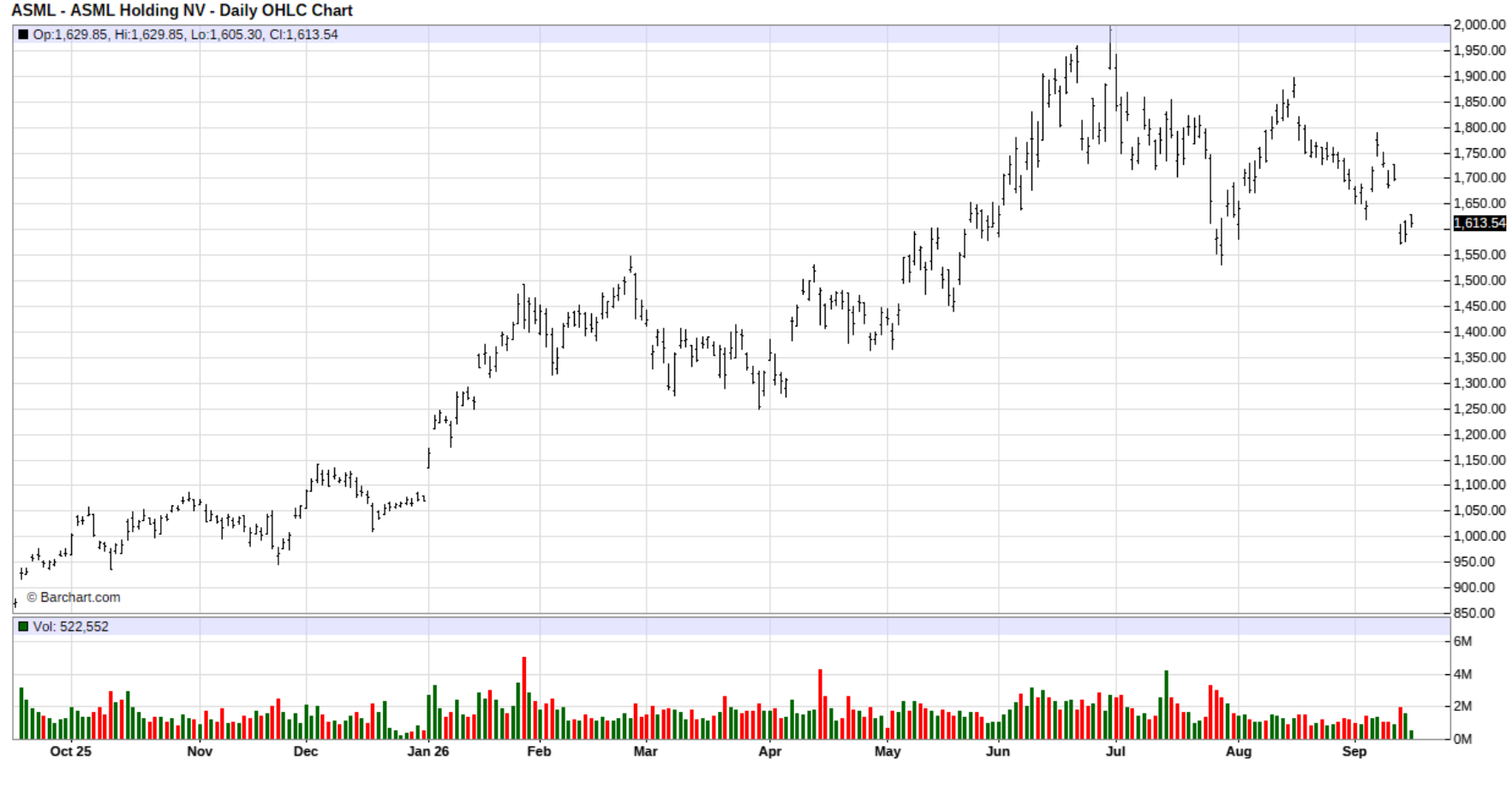
The U.S. has between 3,000 and 4,700 active data centers, with plans to build another 1,500. Globally, there are about 11,800, with plans to add about 100 gigawatts of new capacity by 2030. All of which creates substantial opportunity for beaten-down stocks such as ASML Holding (ASML). However, to run all of those data centers, the world needs advanced AI chips. Today’s most advanced data-center AI processors, manufactured on 4nm, 5nm, and certain 7nm processes, depend heavily on ASML’s lithography technology. And as the industry moves toward 2nm production, that dependence on ASML’s EUV systems will become even more important.
www.barchart.com

Some of those companies include Samsung Electronics (SMSN.L.IX), Taiwan Semiconductor Manufacturing (TSM), and Intel (INTC). All of which are moving forward with ASML’s High-Numerical Aperture extreme ultraviolet lithography systems, better known as High-NA EUV. In short, AI must have powerful chips to run. And those chips are becoming much harder to manufacture, with ASML producing the machines that make their production possible.

Weakness Is Also an Opportunity

That all makes ASML even more attractive moving forward.

Granted, there are calls for the AI industry to slow down from Anthropic CEO Dario Amodei, which sent ASML down more than $102 a share. But I believe that weakness will be short-lived. Along with Amodei, OpenAI CEO Sam Altman and Elon Musk believe he’s right. “I agree with Dario that we need to pace the frontier,” Altman posted on X. “Committing to having independent evaluators with employee-like access is a great idea, and we will do the same.” Musk wrote, “Dario is right.” But is it likely to happen? Probably not, especially with President Trump rejecting the idea of slowing down and China’s pushback against the slowdown idea.

So, What Exactly Is High-NA EUV?

ASML’s existing EUV lithography equipment already plays an important role in producing many of today’s most advanced semiconductors. High-NA EUV is the next major step forward. The technology is designed to print smaller and more complex patterns onto silicon wafers with greater precision. This could allow chipmakers to fit more transistors onto each chip. If that happens, we could see faster performance and greater computing power.

In addition, AI models are becoming larger and more demanding. As a result, technology companies need increasingly powerful data centers filled with advanced processors. At the same time, operators are searching for ways to limit electricity consumption and control costs. High-NA technology could help chipmakers address both challenges.

Samsung reportedly plans to begin using High-NA systems to manufacture memory chips in 2028. Intel, meanwhile, is already using High-NA systems in its foundry manufacturing operations. TSMC plans to use High-NA technology in 2030 using today’s six-inch photomasks. TSMC’s participation is crucial for ASML. The Taiwanese chipmaker is the world’s leading semiconductor foundry and produces chips for many of the biggest technology companies. That makes TSMC one of ASML’s most important customers.

In addition, we have to remember that the AI industry cannot move forward without the equipment needed to manufacture increasingly advanced semiconductors. That is what makes ASML’s position so valuable. Plus, high-NA EUV could become one of the top technologies behind the next generation of AI processors, memory chips, and other semiconductors. Even better, commitments from some of the industry’s biggest chip manufacturers strengthen ASML’s long-term outlook.

Earnings Have Been Strong

In its most recent quarter, ASML Holding’s Q2 EPS of €7.59 beats by €0.60. Revenue of €9.33 billion (+21.3% Y/Y) beats by €400M. Moving forward, the company said it now “expects full-year 2026 total net sales of between €43B and €45B (midpoint at €44B), compared to the prior forecast range of €36B and €40B (midpoint at €38B),” as noted by Seeking Alpha. It also expects gross margin to be between 54% and 56% as compared to its prior forecast of 51% to 53%. For the third quarter, “ASML expects total net sales to be between €11B and €12B (midpoint at €11.5B). The company anticipates a gross margin between 55% and 57%,” it added.

What Do Analysts Say About ASML Stock?

Overall, ASML has a consensus “Hold” rating on Wall Street. Of the 27 analysts covering ASML stock, 22 have a “Strong Buy” rating, two have a “Moderate Buy” rating, and three have a “Hold” rating. The mean target price of $2,350.75 implies a potential upside of 56%. Meanwhile, the high price target of $2,859 implies a potential upside of 77% from here. Bank of America reiterated its “Buy” rating with a €2,452 price target.

“The announcements are consistent with our High-NA adoption assumptions (5 tools this year, 6 next and 20 by 2030),” Bank of America analyst Didier Scemama said, as also quoted by Seeking Alpha. “While the announcements do not change our forecasts, they increase confidence that the ecosystem is aligning around a common High-NA roadmap. Intel's production experience demonstrates that customers can use the technology with existing mask formats today, while the TSMC-ASML-Samsung initiative establishes a longer-term path to capture the full productivity benefits of High-NA.”

www.barchart.com
On the date of publication, Ian Cooper did not have (either directly or indirectly) positions in any of the securities mentioned in this article. All information and data in this article is solely for informational purposes. For more information please view the Barchart Disclosure Policy here.
Sign up to read this article
Read news from 100's of titles, curated specifically for you.
Already a member? Sign in here
Related Stories
Top stories on inkl right now
One subscription that gives you access to news from hundreds of sites
Already a member? Sign in here
Our Picks
Fourteen days free
Download the app
One app. One membership.
100+ trusted global sources.