- Ford CEO Jim Farley warns that letting Chinese EVs into America could have big consequences.
- Farley says that "we should not let them into our country" over the potential impact to U.S. manufacturing.
- Meanwhile, both Europe and Canada are seeing an influx of Chinese EV imports.
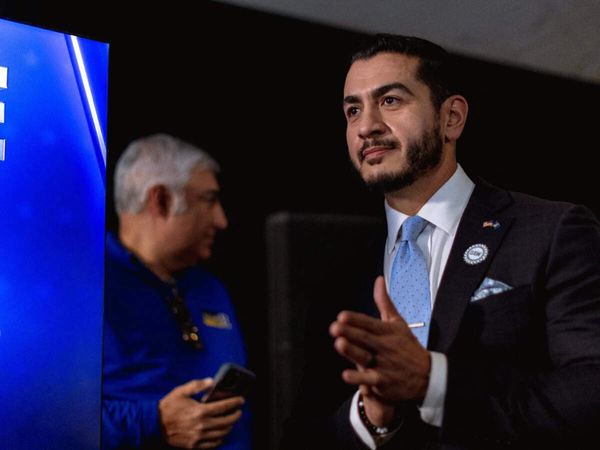
Ford CEO Jim Farley loves driving Chinese EVs, but he's also clearly worried about what could happen if they could more easily enter the U.S. market. In a recent interview with Fox News, the CEO said Chinese EVs shouldn't be allowed on U.S. streets due to the "devastating" impact they would have on the auto industry.
"We should not let them into our country," he said. "Manufacturing is the heart and soul of our country. For us to lose that to those exports would be devastating for our country."

Farley echoed concerns we've heard before from the auto industry and U.S. government—under both the Biden and Trump administrations, I'll add. The thinking is that China has heavily subsidized its auto industry and created a glut of manufacturing capacity.
"There's no way this is a fair fight," he said.
China has well over 100 companies that build electric cars. Many of those companies—like BYD and Xiaomi—are able to build cars cheaper than American manufacturers and, in many cases, with more features. This has unlocked an aggressive price war in China. Increasingly, those cars are spreading to Europe and Canada as both become more receptive to Chinese imports and as China's industry looks to new markets.
"Their local market is 29 million, their capacity in their country for making cars is over 50 million," said Farley. "They have enough capacity in China to cover all the manufacturing and all the vehicle sales in the United States."
Farley also noted the "cyber and privacy" risk of Chinese vehicles, calling out that they have cameras that can "collect a lot of data." The U.S. government agrees. Under the Biden administration, the U.S. set rules banning Chinese-sourced connectivity technology in cars for that exact reason.
Ford's CEO also commented on Canada's new policy which will allow a small number of Chinese imports at a lower tariff rate. "I sure hope we don't let them come across the border," he said.
This isn't the first time that Farley has publicly advocated against allowing for Chinese imports. And there's a growing chorus on both sides of the aisle sounding alarm bells. In March, the leaders of five auto industry lobbying groups also sent a letter to the president and Treasury Secretary Scott Bessent, urging the administration to keep Chinese car companies out of the U.S. due to "economic and national security risks." Last month, Republican Senator Bernie Moreno called Chinese vehicles a "cancer" and vowed to erect even steeper barriers against them.
And earlier this month, a group of Democratic lawmakers sent a letter to President Trump, arguing that allowing Chinese car companies to set up factories in the U.S. would "confer an insurmountable economic advantage impossible for American automakers to overcome, and it would trigger a national security crisis that could never be reversed." (Trump himself may be the odd one out here; in January, he invited Chinese firms to build in the America so long as they employ Americans.)
But here's the thing: This kind of protectionism does leave American car buyers without the world's best car technology.
While other countries are getting battery swapping, megawatt charging, and wild party tricks, domestic automakers are talking about stripping out the radio and going back to crank windows just to lower prices. Some healthy competition could clearly be beneficial, but to Farley's point, if it causes an extinction-level event for U.S. automakers, where does the line get drawn?
Farley has his eye on the Chinese as a benchmark. Even if the cars won't be sold in the U.S. anytime soon, his and other global automakers increasingly need to compete with them across the globe.
"Ford has to do our part to make our vehicles fully competitive with the Chinese and I think we have with our new affordable EVs coming out, made in Kentucky," he said.