
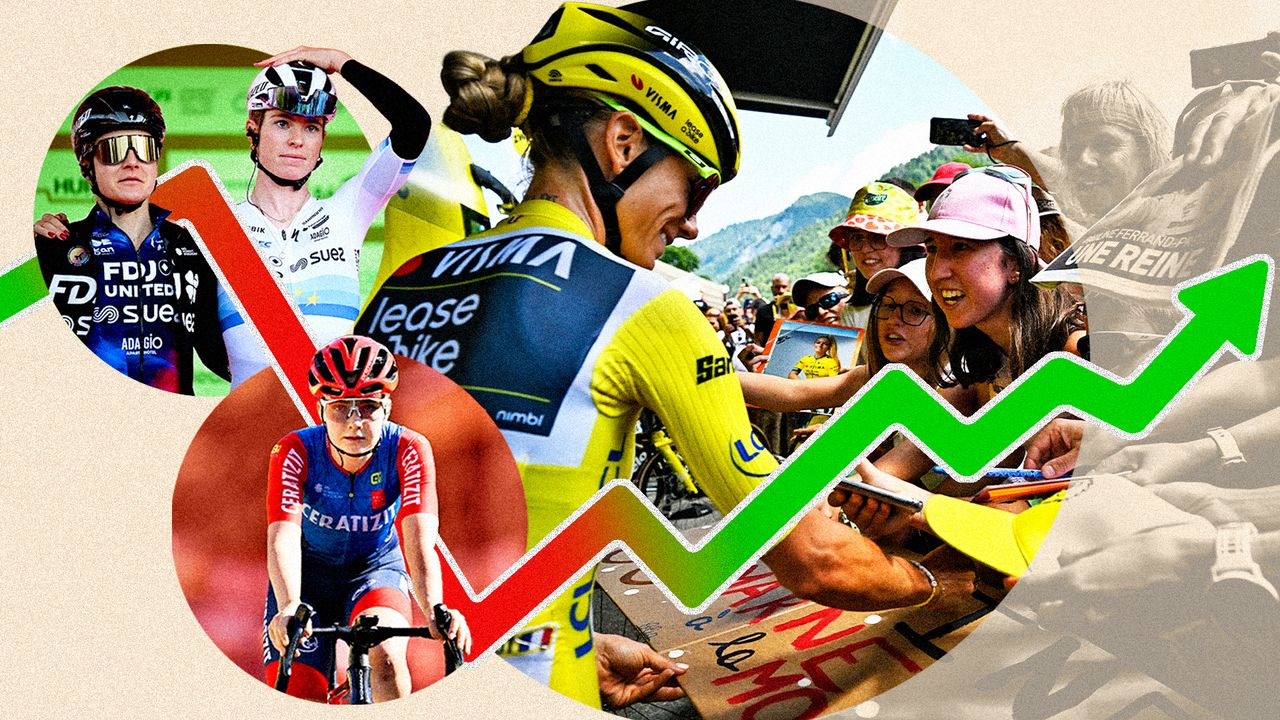
"I have never won such a big race," said cyclist Cédrine Kerbaol in 2024, beaming in a post-race interview. She had just won a stage of the Tour de France Femmes after a 15km solo attack, making history as the event's first-ever French stage winner, and securing her team Ceratizit-WNT Pro Cycling's most prestigious victory. "It's crazy."
A lot can change in a year. Kerbaol left for EF Education-Oatly at the end of the season, activating a get-out clause after the team had some hiccups registering for their WorldTour license. Then, in September 2025, Ceratizit Pro Cycling's general manager Claude Sun was forced to close the team he'd spent more than a decade building. "It's your baby," he tells Cyclingnews. "You've got a good relationship with all the riders – it's like your family. And from the sports point of view, it's not a good thing."
The irony is that women's cycling has never been bigger: the Tour de France Femmes avec Zwift is broadcast in 190 different countries, with 7.7 million viewers watching the final stage last year, according to France TV. There is more money, more professionalism. The Women's WorldTour level was introduced in 2020, the average WorldTour team budget has risen to €4.67 million, and the UCI's minimum salary requirements are almost in line with the men's. But with costs soaring, teams like Ceratizit are struggling to stay afloat. Is women's cycling becoming a victim of its own success?
Sun, who was previously sales manager for the B2B cutting and machining tools company, launched the team, then known as WNT, in 2014. The aim was to promote the business – diluting the brand's masculine image by sponsoring a women's team – and, he says, to "develop new talent, very important for us, and have an international team." In 2019, the team moved from Sheffield to Germany, signing riders like Kirsten Wild, Clara Koppenburg and Lisa Brennauer. It joined the WorldTour in 2024, and, over its 11 seasons, achieved 65 road victories – 13 in the WorldTour – and four Olympic medals, hardly poor results.
The Ceratizit Group had made a 10-year commitment to sponsor the team, intending to extend it. But after the pandemic, the company closed two factories in Germany, making 600 redundancies, which made it impossible to justify continued sponsorship of the cycling team. "We never [planned to stop]. It was the economic situation," says Sun. "The question was: what can we do with the team?"

Sun approached five different teams in 2024 and 2025 – including Lotto, Ineos Grenadiers, Cofidis and Decathlon – to discuss a potential merger. He initially targeted men's teams without a women's counterpart, as well as Lotto, with whom Ceratizit shared Orbea as a bike sponsor.
"I was very optimistic, because we had a WorldTour team which was number 10 worldwide at the time," says Sun. "But unfortunately, the economic situation for the men's teams was the same… They had no budget, or no interest in women's [cycling], because the costs have exploded."
For a year and a half, Sun contacted potential title sponsors, only to receive the same answer. "We always thought we'd find a solution… We had so many discussions," he says. "It was always the same: no budget."
Sun is not alone in having to close his team in the last 12 months. US-based Continental team Cynisca announced a "strategic hiatus" last year after falling short of its $1 million sponsorship goal, while Arkéa-B&B Hotels folded both its men's and women's teams at the end of 2025.
"In my opinion, the development of women's cycling over the last four years was too fast," says Sun. "I can imagine that the UCI wanted to achieve the same level [as men] for women: teams, culture, budget. But they forgot one thing: the sponsor. The sponsors give the money. The sponsors pay the UCI… When the budget increases, the sponsors have to pay. I know, because I was the sponsor."
Rising costs, but not rising investment?
It is a perfect storm: a combination of rapidly multiplying costs and revenue from sponsorship unable to keep up. In 2014, Sun had a budget of €400,000 for the team. By the time Ceratizit closed in 2025, this had risen to €3.2 million, an increase of 700 per cent. And it still wasn't enough. According to Sun, it costs around €5 million a year to run a women's WorldTour team now; the average had been €2.4 million in 2022. "It's like in a company: you've got the same turnover, but your personnel costs double. If you do not find a new sponsor or increase your budget somewhere, you've got a big issue."
Cycling's problem, of course, is its dependence on sponsorship. Approximately 85 per cent of an average team's revenue comes from its sponsors. With costs ballooning, teams have two options: persuade their sponsors to pay more, or find more sponsors. This is easier said than done. At the team's inception, Sun says the return on investment was 1:10, meaning the sponsor earned €10 for every Euro invested. Now, though, he believes this has fallen to 1:7. "The sponsor's value has not increased by 100 per cent [since 2022]," says Sun. "In terms of the money to pay for a team, you've got only the sponsorship. This is dangerous."
For team managers, it is outgoings like travel, accommodation, staff, food and, increasingly, altitude camps, which have risen most. Holding a WorldTour licence carries its own price tag, and new rules are making it even more expensive: as of this season, there is an obligation to compete in more races – including all three Grand Tours – with teams only able to skip one of the remaining 24 WorldTour races. This means more riders, more transport, more staff, more bikes – and more money.
For some teams, the costs attached to a WorldTour licence are simply too high to compete in what was once every team's target league. Last year, Basque outfit Laboral Kutxa-Fundacion Euskadi were the 15th-ranked team in the world – enough to earn a WorldTour license – but decided to remain a ProTeam, despite its long-held goal of joining the WorldTour.
"Three years ago, we set up a budget to be a WorldTour team. Today, we have that budget, but the reality is that it's not enough to be a top WorldTour team," general manager Aitor Galdos told Cyclingnews in November. "We're keeping our current category."

Likewise, rising salaries in the sport are rightly hailed as a step toward gender parity. The majority of women's WorldTour riders now earn between €80,000 and €100,000 a year, with Demi Vollering rumoured to earn up to €1 million. The introduction of big agents to women's sport is inflating salaries further, managers say.
"It's good for the rider," says Sun. "But the development of the riders' agent is a big issue, because they smell money. It's like if you have a lake with some fish in it, and everybody wants to have the same fish. If you take the same fish for two or three times more money, the agent can take the money, 10 per cent, but the fish will not go faster."
Without the budget to pay larger salaries, it is harder to retain talent, with some riders trading leadership at a smaller team in favour of a higher-paid domestique role elsewhere. Kerbaol, for example, terminated her Ceratizit contract a year early to join EF Education-Oatly, despite it being – at that point – a step down from the WorldTour to ProTeam level, though likely for a higher salary.
Unlike sports like football, there are no transfer or development fees for teams that have invested in and developed young riders. As a result, the ever-increasing gap between the richest "superteams" at the top of the WorldTour, like Lidl-Trek, SD Worx-Protime and UAE Team ADQ, and those at the bottom, like Ceratizit, is widening. "The bigger teams are becoming bigger, and the smaller teams are in difficulties," says Sun. "In my opinion, the small women's teams have no future anymore. Financially, you cannot survive in the WorldTour."
Pragmatic decisions to survive
FDJ United-Suez finished last season as the top-ranked women's team, and, with riders like Demi Vollering, Juliette Berthet (née Labous), Évita Muzic and Elise Chabbey, is now one of the sport's 'superteams'. But they too are under pressure. The team is understood to have a budget of around €5 million, compared to the €7 to €8 million budgets of the richest teams. For over a decade, manager-owner Stephen Delcourt has factored in an annual budget increase of between 5 and 10 per cent – but in the last year alone, his costs have increased by 29 per cent.
"We are like a start-up without funds," he says. "We play with money that we don't have in our pockets. That's dangerous. The consequence is that we have 15 WorldTour spots, and only 14 [teams] apply. We need to analyse that. We go too fast because we have no rules. There is space for the big teams, but for the others, there is no place."
Like Sun, Delcourt has been struck by the rise in personnel costs, with participation in the WorldTour calendar becoming increasingly expensive. Race organisers typically subsidise travel for teams to compete in races. But one of the problems, says Delcourt, is that despite having similar expenditure, this contribution is much smaller for women's teams. For the Santos Tour Down Under, men's teams received €60,000, while women's outfits were paid only €25,000, despite participation costing FDJ €31,000.
"How can we continue in 2026 to have a difference like this?" he asks. "In cycling, we pay to work. When we go to Paris-Roubaix or Flèche, the cost of the travel is more expensive than the fees I get back."
As a result, Delcourt has had to make pragmatic, budget-conscious decisions about the coming season. He has slimmed his team down from 18 to 16 riders, and is planning a reduced racing calendar with more focused goals. "There is a budget decision and a sport decision," he says. "I really feel that if [costs] continue to increase at 29 per cent, I need to be calm and not go too fast. And with the new UCI rules, I want to be careful."

Nevertheless, the sport's growing profile and FDJ United-Suez's roster of star riders have helped to entice new sponsors. When the team signed Vollering in 2024, it led to high-profile collaborations with both Nike and Specialized, which replaced long-term partner Lapierre as the team’s bike sponsor and is understood to contribute to Vollering’s salary. And mid-season last year, FDJ United-Suez signed new deals with aparthotel brand Adagio and insurance company Gan Assurances. As a team, they seem to regularly add new sponsors. Interest in sponsoring women's teams is booming, says Delcourt, but it remains harder than ever to close partnership deals.
"When we started the team in 2006, it was hard, because nobody knew [about women's cycling]. Now, it's easier to gain the attention of bigger brands because we have visibility, we have numbers – and we are number one in the world. It is hard to conclude the deal now, because of the worldwide economy. Everybody is afraid that tomorrow Trump will put a tax on Europe. I feel that everybody wants a women's team – everybody wants to be involved in my team, especially – but they say they need to wait."
Zwift is one of women's cycling's most prominent sponsors, funding both Canyon-SRAM and Fenix-Premier Tech as well as races like Paris-Roubaix and the Tour de France Femmes, which represents the company's single biggest marketing investment. It is keen to encourage other potential sponsors to follow suit. "We want to be a part of the solution, says Kate Veronneau, director of women's strategy. "We recognise that the sport is growing really fast, and we want to ensure that more investors are coming to the table, so we try to share as much as possible that this has been a positive move for us on so many levels – not just pure return on investment, but on sentiment, on brand value, on who we are and our community feeling good about being Zwifters."
The sponsorship landscape has changed since Zwift started supporting Canyon-SRAM in 2016, and Veronneau says return on investment has increased. Athletes are no longer as accessible, but audiences are bigger than ever. "The way that the sport is growing, and the increase of fans just means more exposure for us, and that we're reaching bigger global audiences," says Veronneau. "To see how much further those sponsorship dollars go now, because more people have access and visibility into women's cycling – that's seen all of us get a lot more return on investment."
On the surface, the sport appears to be thriving – thanks in part to companies like Zwift. But while some teams are buoyed up by the wave, others are borne down under it, unable to stay afloat. Sun has terminated his contracts with his sponsors, shut down his facilities, and is in the process of selling off Ceratizit's old stock.
"This is not negative," he says, listing the team's achievements. "We had 70 different riders, we've got good contact with all of them, we love them, and we pushed women's cycling. Perhaps our time is over. It's not a bad thing. It was a good time. The future will tell us what will happen next."