
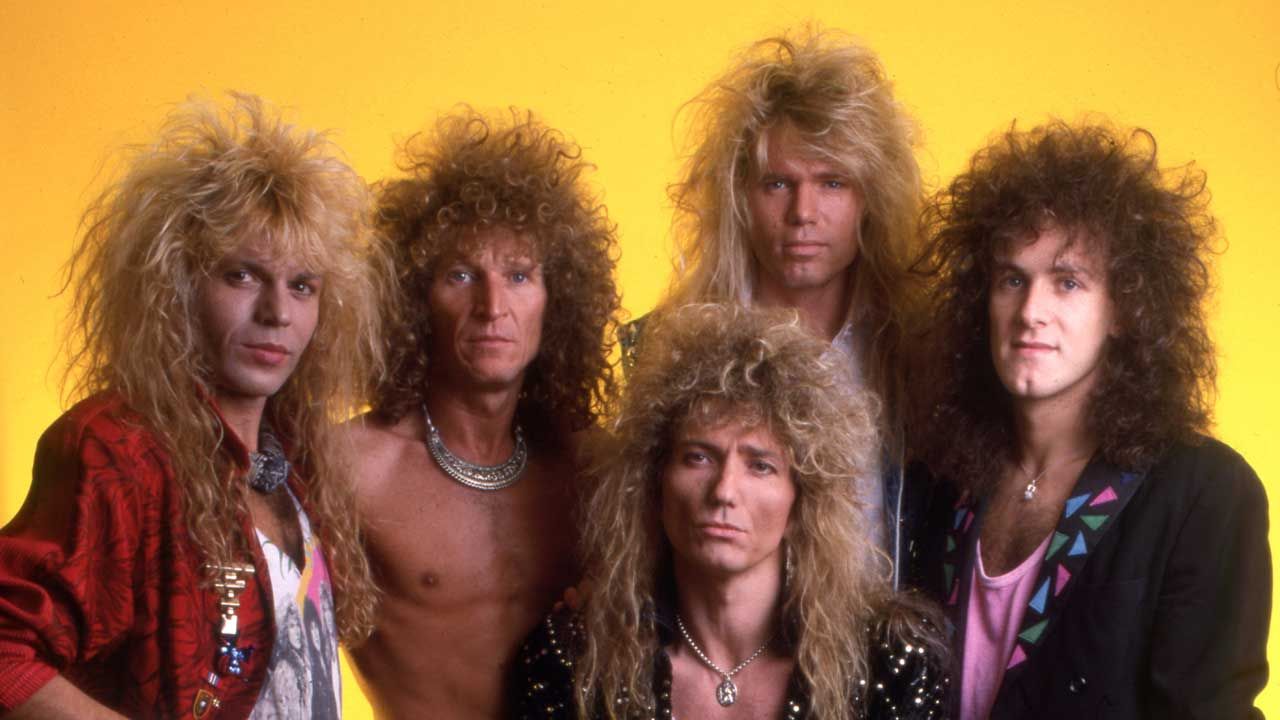
With more pomp than the Last Night Of The Proms, 1987 is David Coverdale at his preening, self-important best. A huge success in America, this was Whitesnake at their most stylised; their videos glowed with an iridescent gleam, the light reflecting off the band’s teeth enough to scar an unprotected retina.
David was always a looker, although no one could have foreseen the almost eerie transformation that took place between 1984’s Slide It In and 1987. In America, the album was simply called Whitesnake – this, David seemed to be saying, is a new beginning. For some Whitesnake fans, however, it was also the end.

“I wanted Whitesnake to be leaner, meaner and more electrifying,” Coverdale says. “I felt that we’d done extraordinarily well. We’d made six albums in just a few years. We did fabulously on those albums, but I really felt that we were flogging a dead snake. For me, I felt it was time for a change. I didn’t want to stay in the same old traditional blues and pop scenario. It was simply my choice as an artist. I wanted to pursue another direction. That was my whole modus operandi. The reason I invited [guitarist] John Sykes into the band was to actually afford that transition, or someone of that style and it happened to be Sykes. And that was it.”
A former member of both NWOBHM stars Tygers Of Pan Tang and the Thunder And Lightning-era incarnation of Thin Lizzy, John Sykes was a prodigious six-string maestro and an entirely different kind of guitarist from the musicians that David had worked with previously in Whitesnake.
With a line-up completed by bassist Neil Murray and drummer Aynsley Dunbar, Whitesnake decided to record the new album at Little Mountain Studios in Vancouver, Canada. The recording process was a lengthy and arduous one, not least because David fell ill with a serious sinus infection, which prevented him from singing for long periods and eventually led to a major operation, but the album was slowly pieced together, including the return of Here I Go Again and Crying In The Rain, both tracks that originally appeared on Whitesnake’s 1982 album Saints And Sinners.
On 1987, the former was transformed from surly blues rock strut to an impossibly glossy radio-metal anthem, replete with a suitably over-the-top guitar solo from guest musician Adrian Vandenberg, whose own titular band had had a big hit with the ballad Burning Heart in the US in 1984.
“Recording Here I Go Again for the second time wasn’t my idea, to be honest,” states Coverdale. “I very rarely like to go back on any level. But on that occasion, it paid off, and huge! We had a bunch of hits with that song in different forms.
"Of course, John Sykes fucking hated it, which is why Adrian was featured on there. He didn’t play one of his better solos on there. It was metal meets country and western! There were two guitarists that I really wanted to work with. One was Michael Schenker, and Adrian, of course, who I’d met. It was our destiny to work together.”
Released in the first week of April, 1987 was an instant and massive success. Whitesnake – with a new lineup of appropriately hirsute touring musicians in place – swiftly became a regular fixture on nascent music television channel MTV with the glossy, high-budget promo clips for the album’s biggest songs, Still Of The Night, Here I Go Again, and the ultimate power ballad, Is This Love, all of which featured David’s wife-to-be Tawny Kitaen.
Chiming perfectly with the glamour and bombast that seemed to be universally popular during the 80s, Whitesnake’s music and endearingly unsubtle visual approach led to sales for 1987 of over eight million copies in the US alone.
With the sound and the look, Coverdale had hit on something. It was loud and powerful, suggestive of the classic vibes of Led Zeppelin and Deep Purple (Crying In The Rain and Still Of The Night), but it was also soulful and chart-friendly (Is This Love and the dusted-off Here I Go Again). It was an album for its time, packaged and produced and just-so, but also organic and meaningful. It even took its title from the year of release, so well did it capture the zeitgeist. After a 15-year hiatus, David Coverdale was once again in the right place at the right time.
Despite his plans to head onwards and upwards, Coverdale was in no way prepared for such a phenomenal level of success. “We had a plan but, Jesus Christ, are you kidding?” he laughs, looking back. “My whole plan was to hopefully make an album that sells a bit more than the last one and hopefully I’ll sing a bit better, it all sounds a bit better and we’ll get to the point quicker in the lyrics. We already had a fabulous relationship with radio after we’d laid the foundation with the Slide It In record, but MTV was an entirely new kettle of fish, and they just took to the band hugely. I guess we had all the elements that they wanted.
"So we had a five-year, unbelievable relationship with MTV and it worked out very, very well for us and in essence it helped us to make that transition that I wanted and then it all became astonishingly successful.”
This feature originally appeared in Classic Rock Presents: The 100 Greatest Rock Albums Of All Time, published in September 2017.