Dirty cooking fuels are back on the global agenda, after the first ever high-level event was held during the UN General Assembly (22 September).
Leaders gathered to tackle one of the world’s biggest silent killers: dirty cooking fuels.

Clean cooking is defined as fuels and equipment that significantly limit or avoid the release of pollutants harmful to human health.
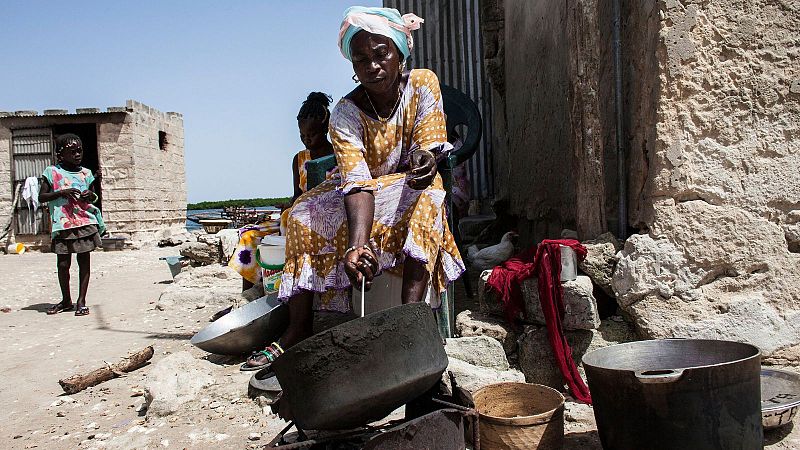
In Africa, where four in five people cook over open fires and basic stoves, it is the second leading cause of premature deaths among women and children. Globally, there are an estimated 2.5 million premature deaths each year from household air pollution.
The International Energy Agency (IEA), along with the governments of Norway and Kenya, convened the event.
"Nearly four in five households in Sub-Saharan Africa still lack access to clean cooking. Women bear the greatest burden, risking their health to provide a cooked meal for their family. Access to clean cooking has become a national development priority, and several countries in Africa are reporting rapid progress. Let us seize on this momentum to support investments at scale," said Norwegian Prime Minister Jonas Gahr Støre.
Despite the scale of the problem, IEA chief Fatih Birol says that Europe can help solve it with relatively little money. As he wrote in a landmark report in 2023, “The barriers to delivering on the promise of clean cooking for all are not technical.
“What is encouraging and disturbing, in equal measure, is that this huge environmental, economic and human challenge could be solved with relatively modest investment.”
How could clean cooking help mitigate climate change?
Lack of access to clean cooking is a cross-cutting issue: entrenching people in poverty, stealing women’s time, inflicting respiratory and cardiovascular disease, and increasing planet-heating emissions.
Cooking with ‘dirty’ fuels like charcoal, firewood, coal, kerosene and agricultural waste generates high levels of pollution. In the case of wood from forests, it also eats into valuable carbon sinks.
“There is a real climate benefit here,” Dr Birol said in 2024, of the transition to clean cooking. “I think this could play a very important role to keep the lungs of the world in Africa.”
The IEA’s report situated the problem within different national contexts. Switching to ‘clean’ cooking fuels like liquified petroleum gas (LPG) and electric hot plates will increase emissions by a certain amount in the short-term, depending on a country’s power system.
However, taking into account the reduction in methane and other greenhouse gas emissions from the incomplete combustion of fuelwood and charcoal in basic stoves - plus forests saved - the IEA foresees a net reduction of 1.5 gigatons of CO2 equivalent by 2030. That’s an enormous amount: roughly the same as the amount of CO2 emitted by planes and ships in a year.
How much money is being invested in tackling dirty cooking fuels?
The 2024 Summit on Clean Cooking in Africa hosted in Paris by the IEA and partners was attended by 60 countries and mobilised more than $2.2 billion (€1.9 billion) in new financial commitments.
Since then, the IEA has tracked the delivery against those commitments and more than a third of the pledged funding has been deployed to projects across 28 African countries, while more than 120 new clean cooking policies have been introduced.
According to the IEA, the pace of people gaining access to clean cooking in Africa is now 30 per cent higher than the average over the past five years, despite headwinds from the disruptions to energy flows through the Strait of Hormuz.
Why Europe should take the lead on encouraging clean cooking
“In addition to it being ethical, there are some other co-benefits for Europe,” Dr Birol said in 2024.
If Europe does not offer support, he suggests there are “other countries around the world who said they would do it with… maybe some other agendas.”
Steps to increase the social and economic prosperity of Africa will help to address immigration too, he suggests, and save money in the long run dealing with the instability that energy poverty creates.
“I believe Europe has all the means to do it,” he told Euronews.
The IEA estimates that only $4 billion (€3.7 bn) of annual investment is needed to ensure all African households have access to clean cooking technologies by 2030.
“We can solve this problem in Africa,” Dr Birol concludes.
Cleaning up the clean cooking carbon credits market
One important source of funding comes from the cookstove carbon credits market.
Credits are bought by companies and governments in industrialised countries wanting to offset their own emissions by financing clean cooking projects in non-industrialised countries.
But, as with the wider carbon market, investigations have found serious issues with some of these schemes. One recent study found that cookstove projects that generate carbon offsets are overstating their climate benefits by 1,000 per cent on average.
“We don’t want these very important credits that are essential to help solve this issue go the same way as large hydro credits in the past,” Dan Wetzel, head of tracking sustainable transitions unit at the IEA, told a press briefing before the event.
The Clean Cooking Alliance has been leading efforts to tighten up the market, with new methodologies set to be endorsed at the summit.
“Carbon credits are part of this solution, but it is not the main part,” Dr Birol says. “We are going to announce that we are only allowing the good quality of carbon credit schemes to be considered here because we know that there are some misuse of carbon credit schemes around the world.”