Get all your news in one place.
100's of premium titles.
One app.
Start reading
Bangkok Post
Bangkok Post
Comment

Water makes the world go round

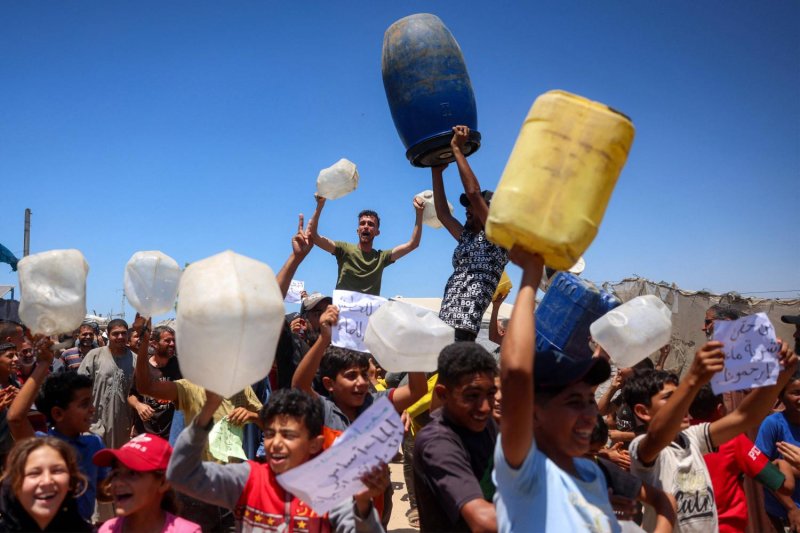
File photo dated May 25 shows people displaced by conflict raising water containers as they protest against a severe water shortage in Khan Yunis in the southern Gaza Strip. (Photo: AFP)

The past few months have offered a stark reminder of the importance -- and precariousness -- of water supplies. The Gulf Cooperation Council countries, which together supply roughly 62 million people with drinking water drawn almost entirely from the sea, have seen their desalination plants targeted by drones and missiles in a geopolitical conflict they did not create.

Meanwhile, insufficient rainfall in Central America has been lowering water levels in the Panama Canal for years, creating tension between local demand for fresh water and transit through a vital shipping artery. This is the same crisis seen from opposite ends: in Panama, a shortage of fresh water constrains maritime trade; in the Gulf, maritime conflict imperils drinking water. Water is, in the strictest sense, a security issue, but the world has yet to govern it as one.
The consequences of inadequate water management are far-reaching. Diseases related to unsafe water and sanitation pose a major public-health risk and are a leading cause of death among children under five globally. Water is also a vital agricultural and industrial input: around 90% of global freshwater withdrawals support economic activity, with the remaining 10% going to households.

The economic costs of water-related natural disasters are growing as such events become more severe and frequent because of climate change. Droughts cost the world an estimated US$307 billion annually, accounting for 15% of all disaster-related economic losses. Floods caused US$651 billion in damage between 2000 and 2019. Water pollution, meanwhile, continues to erode economic growth across entire regions. In 2016, the World Bank projected that growth rates in the most vulnerable regions could decline by as much as 6% of GDP by 2050 because of water-related losses.

Water also plays a crucial role in global trade, with around 80% of the world's merchandise trade by volume travelling by sea. The world's most important chokepoints -- the Strait of Hormuz, the Panama Canal and the Suez Canal -- have all been disrupted in recent years. In 2023, prolonged drought forced Panama to begin rationing access to its waterway. Daily transit fell by roughly one-third by early 2024 and shipping rates spiked across the Pacific. While this year's closure of the Strait of Hormuz was not a water-related disruption, it reinforces the message that water is an essential strategic variable in global logistics.

Water-related risks continue to rise. United Nations researchers now warn that many regions are approaching "water bankruptcy" -- when water systems can no longer realistically return to their historical baselines because of depletion, pollution and damage to water-related natural capital such as wetlands. The Carbon Disclosure Project estimates that companies already face hundreds of billions of dollars in water-related risks, most of which could be mitigated at a fraction of the potential cost.

The good news is that water resilience is not a technological mystery. The solutions are known: better infrastructure, planning and governance. They are highly cost-effective: every dollar invested in water and sanitation infrastructure, for example, generates US$4 to US$12 in economic returns through avoided health costs and higher productivity.

What has been missing is the strategic attention needed to deploy these solutions at scale. Part of the problem is visibility. Economists have long observed that resources are managed most effectively when their value is visible. Yet, unlike energy and emissions, water use is only beginning to be measured and disclosed.

This helps explain why, despite growing scarcity, water continues to be priced as if it were abundant. In France, the same resource costs from €0.02 (US$0.023) per cubic metre for irrigation to roughly €4 for treated household water -- a 200-fold spread that bears no relation to scarcity or economic value. It also explains why water is only starting to shape investment decisions, risk assessments and corporate strategies, as well as economic policy and political decision-making.

The lag is also evident globally. At the G8 summit in Évian in 2003, leaders warned of water insecurity's economic and geopolitical consequences. Yet, 23 years later, water remains one of the few strategic resources without a Bretton Woods of its own, relying instead on a patchwork of agreements and institutions. With roughly one-fifth of global water consumption embedded in goods consumed outside the countries where they are produced, this is a major blind spot. Research on the globalisation of virtual water flows has shown that, when water is properly accounted for as a factor of production, the classical patterns of comparative advantage that organise global trade no longer hold: water-scarce countries export water-intensive goods to water-abundant ones, subsidised by an unpriced and dwindling input.

World Trade Organization rules are already being adapted to account for carbon intensity, so one might hope water intensity is next. But action depends on translating long-standing awareness of water-related risks into institutions, incentives and investment decisions that match the scale of dependence.

Abundant, predictable water supplies supported economic growth, industrialisation and global trade for more than two centuries. But the days when water could be taken for granted are over. Water is a strategic asset in its own right and must be treated with the same seriousness as energy, trade and finance.

The question now is how quickly governments, businesses, investors and institutions can integrate this understanding into their everyday decisions. The countries and companies that excel over the next two decades will be those that treat water as the precious resource it is. ©2026 Project Syndicate

Esther Crauser-Delbourg, co-founder and CEO of Water Wiser, teaches water economics at HEC Paris. Bertrand Badré, a former managing director of the World Bank, is chair of the Project Syndicate Advisory Board, CEO and founder of Blue like an Orange Sustainable Capital, and author of Can Finance Save the World? (Berrett-Koehler, 2018).

Sign up to read this article
Read news from 100's of titles, curated specifically for you.
Already a member? Sign in here
Related Stories
Top stories on inkl right now
One subscription that gives you access to news from hundreds of sites
Already a member? Sign in here
Our Picks
Fourteen days free
Download the app
One app. One membership.
100+ trusted global sources.