To help you understand the trends surrounding AI and other new technologies and what we expect to happen in the future, our highly experienced Kiplinger Letter team will keep you abreast of the latest developments and forecasts. (Get a free issue of The Kiplinger Letter or subscribe.) You'll get all the latest news first by subscribing, but we will publish many (but not all) of the forecasts a few days afterward online. Here's the latest…
Artificial intelligence holds huge promise for the U.S. military for both offensive measures and deterrence. That's why the Pentagon is racing to put AI in the battlefield and the office. With a yearly budget nearing $1 trillion, it's a massive tech shift.

The AI arms race
The global AI arms race leverages an unprecedented commercial AI boom. Large language models powering top AI tech are ideal for the military, since they are a general-purpose technology that can process vast amounts of data, reason and generate usable insights. Users interact with the AI in plain English, making adoption far easier. And vast U.S. tech spending has powered AI advances. The most cutting-edge models are being built by Anthropic, Google and OpenAI.
AI is already being used extensively in battle: By Israel in Gaza. Ukraine against Russia. Now the U.S. against Iran. These conflicts are a testing ground for many new AI tools. Ukraine even launched a product-development war program, known as "Test in Ukraine," where foreign military tech companies can get real-time data from combat conditions. In Iran, the U.S. is using AI to screen incoming data and help identify targets.
The big concern is competition with China, the second-largest AI spender. China is rapidly deploying AI to its military, adding electrical capacity at a rapid clip and providing $200 billion in state-backed AI capital. But China's top tech firms spent only 15% to 20% of what U.S. tech giants invested on AI in 2025, according to Goldman Sachs. This year, Alphabet, Amazon, Meta and Microsoft will unleash nearly $700 billion of capital expenditures to build AI.
America's focus on speed
Hence the Department of Defense's AI strategy: Speed wins. "Military AI is going to be a race for the foreseeable future, and therefore speed wins," according to the agency's AI strategy document. "We must accept that the risks of not moving fast enough outweigh the risks of imperfect alignment." Aggressive timelines, slashed red tape and updated procurement rules aim to speed up adoption and use.
The effort includes top-secret projects marked by urgency and little public oversight. Units that don't adopt AI quickly enough could see funding reviewed or pulled. The Pentagon also wants the latest AI models deployed to soldiers and civilian workers within 30 days of public release, a rapid pace of adoption that highlights the strategic imperative of accessing the most cutting-edge commercial tech.
"We must accept that the risks of not moving fast enough outweigh the risks of imperfect alignment."
Pentagon AI strategy document
Since December, the agency's 2.8 million personnel have had access to Gen.AI.mil, a chatbot powered by Google Gemini for unclassified work. The chatbot has been used by more than 1 million employees so far, while plans for a similar chatbot for classified work is underway. Google also introduced AI agents that can autonomously do work, such as drafting white papers, preparing briefings and processing data-heavy documents.
The Pentagon wants AI models without constraints. The feud with Anthropic, which erupted into a federal ban and now a legal fight, highlights the ongoing tension. The concern is that an AI system will suddenly refuse an urgent question or command because of the guardrails built into the AI model itself, even if the order is lawful.
Military AI's growing uses
The many combat AI uses include mission planning, target assessments and weapon systems tracking. AI can generate insights by fusing a vast array of data, including satellite imagery, video, radar, radio transmissions, cyber intelligence, social media activity, real-time news, field reports, troop locations and historical info.
"Defense and intelligence workflows that once required weeks of manual analysis can automatically detect threats and generate response plans by processing satellite imagery, sensor data, and historical patterns at unprecedented scale," says Amazon about its government AI cloud computing platform. Meta says its AI model powers a chatbot that enables special operations forces "to generate intelligence reports 18 times faster and process video footage nine times quicker."
AI-enabled drone swarms could pilot themselves, making decisions autonomously. Automated drone software updates could deal with new enemy radar systems, turning intel into weapons in "hours not years." AI could fend off cyber threats. Instead of weeks of manual analysis, AI surveillance could create instant insights.
The growing list of non-warfare uses include training, supply chain management, regulatory compliance, drafting policies, summarizing meetings, parsing contracts. In-depth research reports created in minutes will save hours or days of work. AI could even be used to assess and help modernize aging U.S. military IT systems, a major problem for 30 years that threatens to stall or hinder the AI transformation.
Introducing combat chatbots

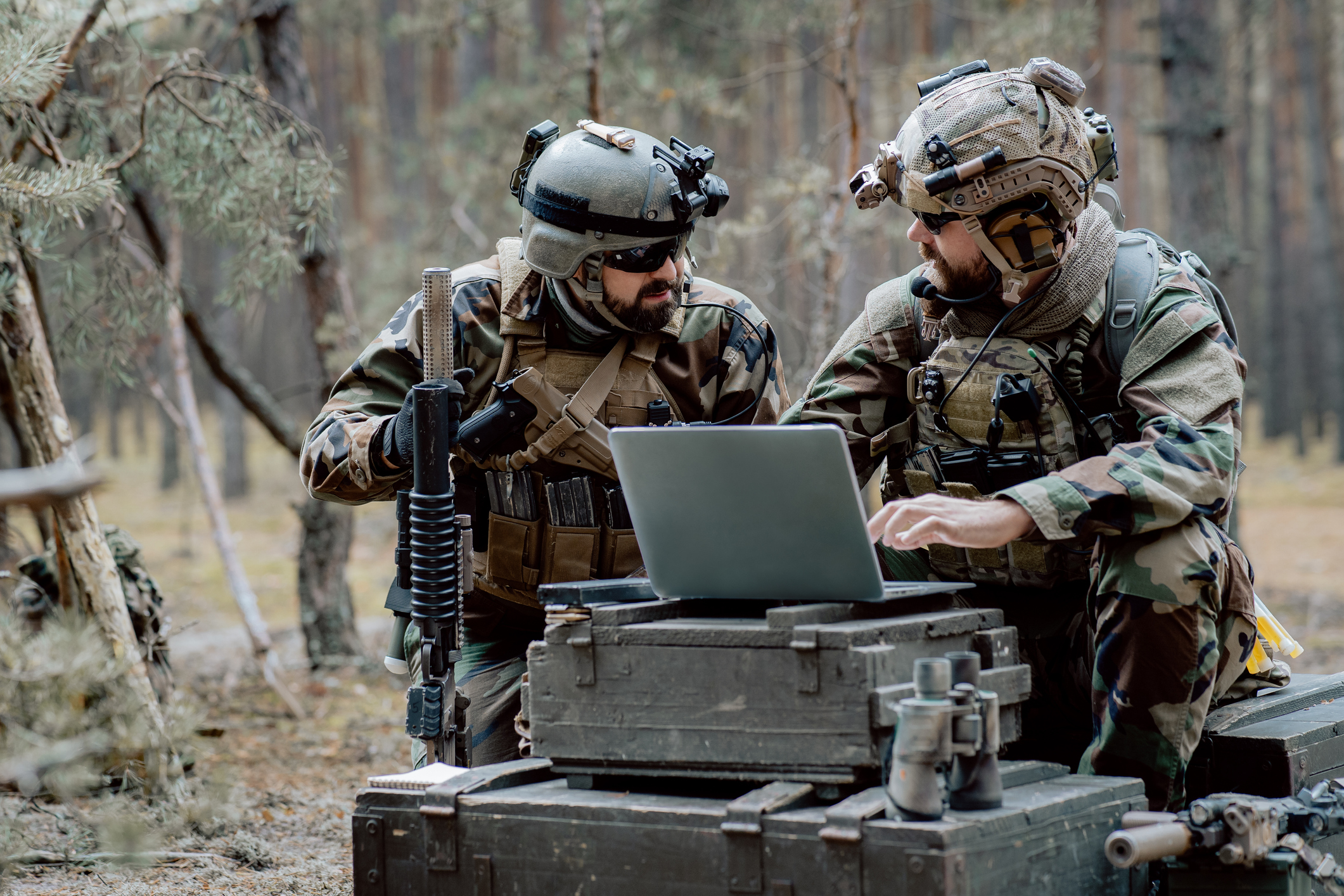
Here's how an AI chatbot conversation could happen on the battlefield. On a laptop computer, a soldier sees an alert for an "anomalous activity" on an AI platform built by Palantir, a leading military AI vendor. The chatbot, which is scouring data and real-time info, says satellite imaging has detected that enemy activity could be nearby. The soldier types: "Show me more details." The chatbot says when images were taken, what they could be and shows a map.
The soldier could then ask about options to provide a higher-resolution image. After being provided two choices, such as a surveillance drone or more satellite imaging, the chatbot says, "How would you like to proceed?" The soldier picks the drone and the choice is sent up the chain of command to be approved by a commander. The new imaging shows a tank that is a potential threat.
The soldier then writes, "Generate three courses of action to target this equipment." Three options come with details, such as time required, equipment used, distance to target, personnel needed and more. After probing each option and getting more details, the soldier asks for a summary of the plan. A commander gives final approval.
The military sets permissions for these AI tools, saying what AI can and can’t do, and what data can be accessed. Records are stored for analysis. The guidance and guardrails are evolving fast, and Congress has yet to step in to set the rules for military AI.
The Pentagon's expanding efforts
The Pentagon has groups and initiatives laser-focused on rapid adoption of AI for combat and faster use of emerging commercial AI tech. Two major organizations are the Chief Digital and Artificial Intelligence Office (CDAO), which aims to accelerate adoption of AI for combat, and the Defense Innovation Unit, which aims to make faster use of emerging tech.
The Army's Project ARIA, or Army Rapid Implementation of Artificial Intelligence, focuses on autonomous agents, an AI app store for the battlefield, upgrading supply chain management and more. "Project ARIA represents a fundamental shift in how the Army develops and deploys technology," according to the Army's announcement. "By partnering directly with top AI firms, the Army is delivering solutions in months rather than years."
Project Maven looks to use AI to process battlefield data to speed decision-making. The Replicator initiative aims to use AI to fly thousands of autonomous drones. Thunderforge is an AI wargaming project. Rapid Capabilities Cell is an AI incubator.
Rising defense spending on AI

Military spending on AI will soar in coming years, with AI-related contracts for large tech companies, start-ups and traditional contractors. For example, Palantir has a 10-year, up-to-$10 billion Army contract. Shield AI, maker of AI pilot software, is part of a group receiving a U.S. Air Force contract worth up to $950 million. Anduril, which builds autonomous systems, has a $642 million, 10-year contract with the U.S. Marine Corps for an AI counterdrone system.
Anthropic, OpenAI, Google and xAI each received contracts worth up to $200 million for AI chatbot tech. Scale AI has a five-year, up-to-$100 million contract to label and annotate data for AI. Other start-ups receiving contracts include Rebellion Defense, webAI, EdgeRunner AI and Legion Intelligence. Hundreds of smaller vendors have received small contracts.
Even though AI start-ups are rapidly gaining ground, large firms are gearing up for bigger demand, too. For example, Amazon is investing up to $50 billion to expand AI cloud computing for the government. Meta is supporting national security uses with its open-source AI model Llama, which is easier to modify and can be used on devices without an internet connection. Lockheed Martin, RTX, Northrop Grumman, General Dynamics and Boeing use AI for internal operations and manufacturing, plus include AI in their products.
The world faces new risks
AI brings many risks and rapid adoption is likely to enhance the hazards. The tools need to have guardrails with continued testing and monitoring, since AI can produce mistakes, biases, data leaks, cyber threats and other problems. There's even the growing concern that AI-induced psychosis becomes a national security threat. Meanwhile, the Pentagon’s willingness to experiment and fail while it moves fast is sure to spur more scrutiny over defense spending on new tech.
Expect a much bigger debate over human vs. machine decision-making related to AI’s ability to automate all sorts of processes. And eventually, a discussion of AI arms control, echoing the nuclear age. "The emergence of nuclear weapons prompted the development of nonproliferation regimes that reshaped arms control beyond traditional use-based restrictions," writes Scott Sullivan, a professor of law at the U.S. Military Academy at West Point and the Army Cyber Institute, in a recent article. "Military AI may demand a similar shift."
These trends point to tremendous change as the U.S. military and its defense industrial base "is beginning a once-in-a-century transformation to modernize its military," says a report by researchers at the Wharton School of the University of Pennsylvania.
Still, there are some things that won't change. AI will help militaries fight their wars, but the decision on whether to start or join a war will still be a fully human choice of political leaders.
This forecast first appeared in The Kiplinger Letter, which has been running since 1923 and is a collection of concise weekly forecasts on business and economic trends, as well as what to expect from Washington, to help you understand what’s coming up to make the most of your investments and your money. Subscribe to The Kiplinger Letter.