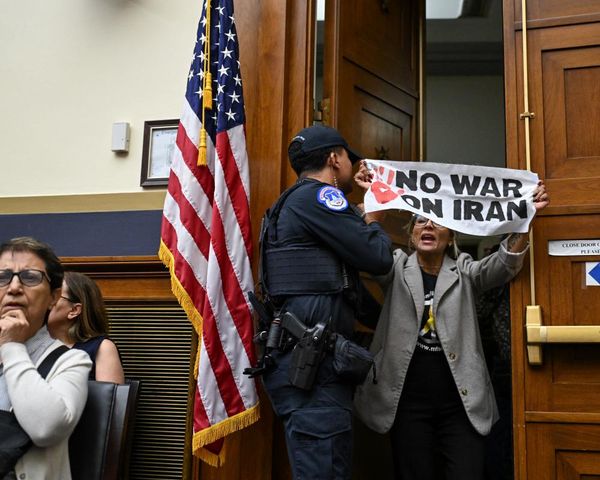
Lawmakers who oppose President Donald Trump’s military campaign against Iran will have a chance to weigh in next week, but they may not be able to successfully rein him in.
Both chambers of Congress were already expected to vote next week on war powers resolutions aimed at constricting Trump’s ability to launch military strikes against Iran. The start of the military operation early Saturday morning added more urgency to the votes.
“The Senate should immediately return to session and vote on my War Powers Resolution to block the use of U.S. forces in hostilities against Iran,” Sen. Tim Kaine, D-Va., the lead sponsor of the Senate resolution, said in a statement Saturday. “Every single senator needs to go on the record about this dangerous, unnecessary and idiotic action.”
Kaine’s resolution, which he introduced with Sen. Rand Paul, R-Ky., last month, would mandate the president “remove the United States Armed Forces from hostilities within or against Iran, unless explicitly authorized by a declaration of war or a specific authorization for use of military force.”
A procedural vote on the resolution could happen as soon as Tuesday, according to a source familiar with the situation.
Under the 1973 War Powers Resolution, Kaine can force a vote on a motion to discharge the measure from the Senate Foreign Relations Committee, which only needs a simple majority to advance. But it’s unclear if his resolution can meet that threshold.
Last month, a Venezuela war powers resolution sponsored by Kaine received five GOP votes for the motion to discharge, enough to advance the resolution. But after a pressure campaign from the Trump administration, two of those five Republicans flipped in a subsequent procedural vote, enough to quash the measure.
When it comes to Iran, the politics are trickier, with at least one Senate Democrat signaling he’s on board with the strikes.
“President Trump has been willing to do what’s right and necessary to produce real peace in the region,” Sen. John Fetterman, D-Pa., said Saturday on social media. “God bless the United States, our great military and Israel.”
Last year, the last time the Senate voted on an Iran war powers resolution, the motion to discharge fell short 47-53, with Fetterman voting against it and Paul the only Republican “yes.”
A couple of Senate Republicans have expressed some discomfort at the new military campaign, but it’s unclear if they will support the war powers resolution next week.
Sen. Thom Tillis, R-N.C., posted on social media that he expects “all members of Congress will soon be briefed about Operation Epic Fury and determine whether a broader scope and further military action requires an authorization by Congress.”
Sen. Bill Cassidy, R-La., who voted in support of an Iran war powers resolution in 2020, said on social media that “presumably” the strikes were justified.
“The President’s decision to attack Iran presumably was based upon a clear and present danger to the United States, and a planned execution that does not put the United States in a forever war,” Cassidy wrote. “We pray for the safety and success of our servicemen and servicewomen.”
Another GOP senator who voted for that 2020 resolution, Todd Young of Indiana, also weighed in Saturday in support of a full briefing.
“No one wants more conflict in the Middle East, but Iran can never have a nuclear weapon. I look forward to Congress being fully briefed on the operation and included in discussion about any next steps,” Young said. “The American people will have questions pertaining to the nature of threats, risks to our troops and homeland, and objectives sought. Their questions must be answered.”
House efforts
Meanwhile, the House is also expected to vote next week on a war powers resolution sponsored by Rep. Thomas Massie, R-Ky., with Rep. Ro Khanna, D-Calif., the lead co-sponsor.
The language of Massie and Khanna’s resolution is similar to the Senate’s, but as a concurrent resolution, it would not get a presidential signature and likely would not have the force of law — though supporters of the resolution dispute that it would not be binding.
Either way, the vote will put lawmakers on record, and the measure’s backers see it as a way to send a message to the president. Still, it may not have the votes for adoption with Republicans holding a whisker-thin 218-214 majority.
At least one Republican besides Massie, Rep. Warren Davidson, R-Ohio, said before the strikes he was ready to support the resolution if he did not get a classified briefing. On Saturday morning, Davidson reposted his earlier comment on social media, adding “as I said earlier this week.”
But several Democrats who are staunch supporters of Israel have indicated they may oppose the war powers measure, including Reps. Josh Gottheimer of New Jersey, Jared Moskowitz of Florida and Greg Landsman of Ohio.
In a statement Saturday, Gottheimer said that “confronting the Iranian threat is essential to America’s national security and to global stability. The world is safer because of the courage and skill of our service members.”
Still, Gottheimer said he expects an “immediate classified briefing” on the strikes and their aftermath, including what’s being done to protect U.S. citizens.
“Congress and the appropriate committees must be fully briefed on the strategy ahead to secure American interests, protect our allies, and create the conditions for a safer and freer future for the Iranian people,” he said.
Consultations
Lawmakers are certain to scrutinize when and how information about the strikes was provided to top Hill officials, and how much the administration now plans to read in the rest of Congress on its Iran strategy. That in turn could influence the war powers votes of lawmakers who may be on the fence.
On Tuesday, Secretary of State Marco Rubio briefed the Gang of Eight, the shorthand term for Republican and Democrat leaders of the House and Senate, as well as the top Democrats and Republicans from each chamber’s Intelligence Committees.
White House Press Secretary Karoline Leavitt said in a post on social media Saturday that prior to the attacks, Rubio “called all members of the gang of eight to provide congressional notification, and he was able to reach and brief seven of the eight members.”
A White House official told reporters separately that the Armed Services committees were briefed Saturday morning after the strikes commenced. That didn’t assuage the concerns of Sen. Jack Reed, D-R.I., the ranking member on Senate Armed Services.
“President Trump has chosen the path of war while diplomacy was still within reach. That is a decision with consequences that will outlast this presidency,” Reed said in a statement. “I am calling for an immediate briefing and will use every authority available to conduct rigorous oversight of these operations.”
Senate Majority Leader John Thune, R-S.D., said in a statement that administration officials would soon provide an all-senators briefing on the Iran situation. That’s something that could provide cover potentially for any wavering senators to vote to table the war powers resolution, on grounds that they needed more information.
Who is briefed and when on impending military actions is a matter of some debate under the terms of the 1973 War Powers act.
The law says the president “in every possible instance shall consult with Congress” before hostilities commence, and afterwards “shall consult regularly with the Congress until United States Armed Forces are no longer engaged in hostilities or have been removed from such situations.”
In the absence of a declaration of war, once U.S. troops are deployed the president is required to submit a written report to congressional leaders, within 48 hours, outlining why troops were deployed; the appropriate constitutional and statutory authorities justifying the action; and the “estimated scope and duration” of U.S. troops’ involvement.
The president also “shall provide such other information as the Congress may request” regarding the military operations.
A separate statute governing covert activities also lays out procedures for informing Congress, as the Congressional Research Service explains.
The fiscal 1981 intelligence authorization law established the modern notification requirement, generally requiring the Intelligence panels to be kept in the loop on “all intelligence activities which are … carried out for or on behalf of, any department, agency, or entity of the United States.”
Amendments in the 1991 intelligence authorization law added a presidential “finding” requirement if such covert action is determined “necessary to support identifiable foreign policy objectives of the United States and is important to the national security of the United States.” Such findings are to be delivered, in writing, “as soon as possible” to the Intelligence panels.
Under the 1981 law, if the president determines “it is essential to limit prior notice to meet extraordinary circumstances affecting vital interests of the United States, such notice shall be limited to” the chairs and ranking members of the Intelligence committees and the top four congressional leaders — the so-called Gang of Eight.
The 1991 amendments kept the basic Gang of Eight limited notification structure, but added that the president can include other members “of the congressional leadership” in such briefings, though that’s not required.
Separately, the fiscal 2014 defense authorization law requires the Defense secretary to notify the congressional defense committees, in writing, of any “sensitive” military operations within 48 hours of the operation.
Savannah Behrmann and Peter Cohn contributed to this report.
The post War powers votes unlikely to rein in Trump after Iran strikes appeared first on Roll Call.