Get all your news in one place.
100’s of premium titles.
One app.
Start reading
The Guardian - UK
The Guardian - UK
Business
Graeme Wearden

UK motor fuel prices rise since Middle East conflict began, and energy bills could jump 10% in July – as it happened

Cars being refueled at a petrol station forecourt in London, Britain, this week.
Cars being refueled at a petrol station forecourt in London, Britain, this week. Photograph: Neil Hall/EPA

Closing post

Time to wrap up

Fears are growing that the Middle East crisis will hit UK living standards, as the conflict keeps energy prices elevated.

The Resolution Foundation predicted this morning that the Middle East crisis could trigger an energy price shock that more than wipes out the £300 rise in living standards a typical working-age household could otherwise expect this year, a leading thinktank has warned.

It said a “decent” one-off increase in average living standards in 2026 and a bumper rise for lower-income households could be reversed by rising oil and gas prices as the Iran conflict disrupts supplies.

However, if the recent jump in energy prices persists, the foundation said all the gains could be wiped out.

While the effect may not be as large as the increase caused by the Russian invasion of Ukraine, which sent the cost of food, oil and gas soaring, a rise this year in oil and gas prices could add a percentage point to UK inflation and £500 on typical annual energy bills, it said.

Cornwall Insight predicted that the UK’s energy price cap could rise by 10% in July.

The RAC flagged that petrol and diesel prices have already risen this week.

European stock markets have rallied on a report claiming Iran is engaging in a “secret outreach” to end the war in the Middle East, after several days of heavy losses on indices around the world.

The New York Times reported that a day after the attacks began, operatives from Iran’s Ministry of Intelligence indirectly contacted the CIA with an offer to discuss terms for ending the conflict.

Officials briefed on the backchanneling are, however, sceptical – at least in the short-term – that either the Trump administration or Iran is really ready for an off-ramp, the report said. There are also questions over whether any Iranian officials could negotiate a ceasefire agreement, as Israeli strikes have taken out many senior figures.

The report helped push up the UK’s FTSE 100 share index by 1% in late trading, with the pan-European Stoxx 600 index up 1.6%.

UK households face the prospect of bills “whiplash” if the energy cap soars this summer, warns Richard Neudegg, director of regulation at Uswitch.com.

Responding to Cornwall Insight’s forecast that bills could rise 10% in July, Neudegg says:

“This prediction is a stark reminder of why relying on the price cap leaves customers exposed to global events.

While it’s still far too early to say with certainty what the price cap will be in July, if these predictions ring true, the majority of households could see a significant jump in household energy bills, driven by the situation in the Middle East.

Energy markets remain sensitive to major events, especially when they involve key gas transport routes.

These early forecasts come only days after Ofgem announced that the price cap will fall by £117 for the average household in April, so many households could feel whiplash with the potential changing direction of bills.
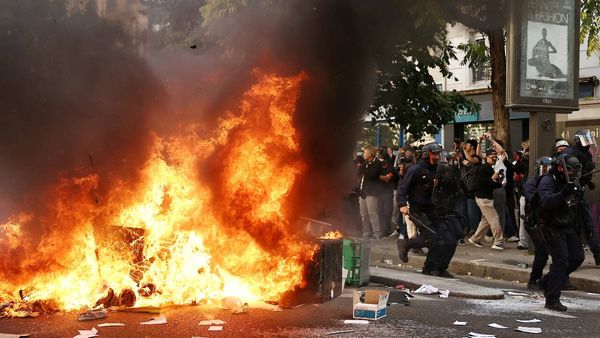
RAC: Fuel prices rising following outbreak of Middle East conflict

UK fuel prices are rising following the outbreak of the Middle East conflict, the RAC reports.

The RAC, which represents UK motorists, reports that both diesel and petrol prices have risen this week – an early example of how the turmoil in the energy markets can hit households.

RAC head of policy Simon Williams says:

“The average price of petrol has increased by nearly 2.5p a litre since Saturday and diesel by more than 3p on the back of oil surging above $81 a barrel - a price not seen since January last year. Providing oil stays around this level the average price of petrol shouldn’t really rise to more than 136p. Diesel, however, is increasing at a faster rate.”

Wall Street’s main indices have opener calmly, as investors welcome the NYT’s report that Iranian operatives secretively reached out to the U.S. to pursue talks to end the conflict.

The S&P 500 share index is up 0.17% in early trading.

However, the Dow Jones Industrial Average is down 70 points or -0.14% at 48,431 points, with oil produer Chevron down 2%.

Maritime and port workers: how is the Middle East conflict affecting you?

The conflict in the Middle East is disrupting shipping across the region, including in the Strait of Hormuz, one of the world’s busiest maritime routes.

Maritime traffic through the strait, the narrow channel linking the Persian Gulf with the Gulf of Oman, has effectively been closed since strikes on Iran began. Some vessels have been diverted or delayed and ports and shipping companies are dealing with heightened security concerns and uncertainty.

Meanwhile, at least six major cruise ships, each carrying thousands of tourists, are anchored in or close to harbours across the region, their passengers confined to the ships

We would like to hear from maritime workers, port staff and shipping crews about how the situation is affecting your work. Click here to take part.

Bessent: global 15% tariff likely to start this week,

As if we didn’t have enough to worry about… US Treasury Secretary Scott Bessent has suggested that President Donald Trump’s recently announced 15% global tariff will likely be implemented sometime this week.

Bessent was asked about CNBC about the discrepancy between the 15% level that Trump had promised and the current rate of 10%, and if Bessent knew when a change to the higher level would occur.

“That’s likely sometime this week,” Bessent said.

The current 10% global tariff began at the start of last week, after the US supreme court ruled that Trump’s sweeping “liberation day” tariffs were illegal.

It will take time for the volatility in the energy market to settle down, points out Professor Costas Milas, of the Management School at University of Liverpool:

There is a lot of talk about rising energy prices and their inflationary impact or even depressionary impact on UK growth. But wild volatility regarding energy prices also matters.

Even if the war is settled (as Trump claims within...4 weeks), GDP growth will take a hit. First, Trump cannot “write a program” to settle a war within an arbitrary deadline, and second, it will take time for energy volatility to settle. The sooner, of course, the better.

Energy price cap could rise 10% in July, following gas cost surge

Britain’s energy price cap could rise by 10% this summer if the surge in gas prices this week doesn’t reverse, consultancy Cornwall Insight estimates.

Cornwall has raised its forecast for the July–September Default Tariff Cap to £1,801 per year for a typical dual‑fuel household.

That would be an increase of £160 or 10% on April’s cap announced last week.

Dr Craig Lowrey, principal consultant at Cornwall Insight, says:

“Looking at the April cap, the role of wholesale prices as a determinant of bills had eased given the impacts of policy costs and network costs. However, this latest forecast puts the role of wholesale markets firmly back in the spotlight and illustrates how exposed UK households remain to international market movements.

“While the rise is eye‑catching, any immediate concern should be tempered. We are still early in the assessment period for the July cap, and what happens in the energy markets over the next three months will be the key factor, rather than this spike alone.

“Events like this reinforce the case for greater home-grown renewable generation. Reducing the UK’s reliance on volatile global gas markets is the most durable way to protect households from future price shocks.”

Legendary investor, the late Charlie Munger, argued there are only three ways a smart person can go broke: liquor, ladies and leverage.

Investors in South Korea learned that lesson today, as the market suffered a terrible slump, wiping 12% off the Kospi index.

Bloomberg reports:

As South Korean stocks crashed Wednesday afternoon, panic spread through Seoul’s financial district. At the small downtown office of Mirae Asset Securities, scores of clients hurriedly lined up to get their money out.

Some in the crowd had snapped up stocks on leverage — part of the mania that had turned the market into a national pastime and made the Kospi the world’s top-performing benchmark — and they were now desperate to unload them as the war in Iran rocked the global economy. They gestured and shouted to get the attention of Mirae employees who could help them sell the positions they couldn’t unwind online. As they waited for help, their phones flashed ever-growing losses — the Kospi was down 8%, then 10%, then 12% — added to their angst.

Shipping through the strait of Hormuz still appears heavily disrupted today.

Reuters estimats that at least 200 ships, including oil and liquefied natural gas tankers as well as cargo ships, remained at anchor in open waters off the coast of major Gulf producers including Iraq, Saudi Arabia and Qatar, based on data from the MarineTraffic platform.

Brent crude futures turn negative after report Iran sought talks with us to end war

Brent crude oil prices have also turned negative.

Brent crude has slipped back to $81.33 per barrel, down from almsot $84.50, following this morning’s report that Iran had reached out to the US about talks to end the conflict.

The US secretary of state for war, however, doesn’t sound like he’s ready to stop the conflict, judging by these Reuters snaps:

  • 04 Mar 2026 13:07:08 - HEGSETH: WE ARE PUNCHING THEM WHILE THEY ARE DOWN

  • 04 Mar 2026 13:07:40 - HEGSETH: MORE WAVES COMING WE ARE JUST GETTING STARTED

The London stock market is continuing to claw back some of its losses from earlier this week.

The FTSE 100 share index is now up 84 points, or 0.8%, at 10,567 points.

Metlen Energy & Metals (+4.4%), the industrial and energy company, is the top riser, followed by copper producer Antofagasta (+3.9%).

Gas giant QatarEnergy declare force majeure on LNG supplies

As feared, QatarEnergy has declared force majeure on shipments of liquefied natural gas.

The move, which frees QatarEnergy from existing supply contracts, comes after attacks on its production facilities on Monday that forced a pause to LNG production.

Container ship reports strike by projectile in Strait of Hormuz

A container ship has reported being hit by a projectile in the Strait of Hormuz north of Oman on Wednesday, according to the UK Maritime Trade Operations.

The ship said the strike had caused a fire in its engine room, but no environmental impact had been reported, UKMTO added.

Pedro Sanchez has risked the ire of the unpredictable Donald Trump with his firm stances that Spain is “not going to be complicit in something that is bad for the world”.

Trump’s threat to halt trade with Spain has prompted the EU to remind the US president that the deal they signed last year on tariffs still stands as a matter of good faith. If it is breach the bloc will react, it said on Wednesday hinting at retaliatory powers at its disposal.

It would be impossible for Trump to halt trade with any single country such is the global nature of supply chains.

But he does have, in his own words, a series of “powerful and obnoxious” tariff options that are outside the scope of the supreme court ruling 10 days ago which struck out his reciprocal tariffs.

He has constantly threatened, for example, sectoral tariffs on pharmaceuticals made in the EU and sold in the US, something that keeps Irish leaders awake at night.

Although Spain’s pharma sector is not as high profile politically as Ireland’s, it is also vulnerable.

In 2024 Spain exported $1.15bn pharmaceutical products in 2024 including medicines, sera and other blood products.

Trump could also attack a country’s legislative canon if he felt it was prejudicing American companies such as tech sector, something we know he feels strongly about.

He is currently invoking section 122 of the 1974 Trade Act to impose a global 10% tariff on foreign imports but pharma tariffs would be available to him under a different law, section 232 of the 1962 Trade Expansion Act.

He is currently threatening eight sectors under Section 232.

But he has three other laws he can draw on - here’s the explainer.

Gas prices are dropping

UK and continental European gas prices have fallen back today – a relief for households, politicians and central bankers alike.

The UK’s month-ahead gas contract is down 10.5% today at 126p per therm, down from 141p per therm last night.

The benchmark Dutch contract is down almost 12% at €47.8 per Megawatt hour.

Updated

Some UK lenders have paused plans for mortgage rate cuts, according to a financial information website, amid wider economic and global uncertainties as the conflict in the Middle East unfolds.

Moneyfacts said swap rates, which are used by lenders to price mortgages, have been rising in recent days, PA Media reports.

The website said it was aware that some lenders, which it did not name, had already reconsidered planned rate reductions.

Despite some lenders pausing plans to reduce rates further, figures from Moneyfacts indicated some mortgage rates were still heading in a general downward direction on Wednesday.

  • The average two-year fixed-rate homeowner mortgage rate on the market on Wednesday morning was 4.82%, down from 4.83% on Tuesday.

  • The average five-year fixed-rate homeowner mortgage rate on the market on Wednesday morning was 4.94%, falling slightly from 4.95% on Tuesday.

US stock index futures are slightly higher, as investors assess the NYT’s report that suggested Iranian operatives had reached out to the US with an offer to discuss terms for ending the conflict.

The S&P 500 share index is on track to rise 0.4%, the futures market suggests.

NIESR: Middle East crisis could push UK interest rates up

Interest rates in the UK could rise back up above 4% if the war in the Middle East causes energy prices to stay higher for longer, a think tank has warned.

The National Institute of Economic and Social Research (NIESR) said that if the energy shock from the conflict persists for one year, then the Bank of England would be forced to push up borrowing costs from the current rate of 3.75%.

The think tank analysed two “What if?” scenarios for the energy market. Both cases involve oil prices rising a further 30%, equivalent to $100 a barrel, and gas prices rising a further 50%, equivalent to $70 a barrel equivalent.

In the first scenario, the analysis assumes the impact is transitory and energy prices begin to normalise after one quarter. In this case, NIESR said a temporary jump in energy prices would lead to a 0.3 percentage point (pp) increase in inflation alongside a “negligible impact” on GDP for 2026. It said central banks around the world would most likely understand the shock to be temporary and “look through” the impact.

[This, incidentally, is how BoE policymaker Alan Taylor argued central banks should act, on Monday]

However, in the second scenario, NIESR examined what would happen if the rise in oil and gas prices persisted for one year before normalising at a slower rate. It says this would lead to a 0.7pp increase in inflation in 2026 and 0.5pp increase in 2027 and dampen GDP growth by 0.2% in 2026. It says this rise in inflation would cause the Bank of England to increase rates by 0.8pp, which at the current rate of 3.75% would see it increase to 4.5%.

“If the shock persists, the Bank of England could be forced to raise interest rates back above 4%,” NIESR said.

Ed Cornforth, an economist at NIESR, said:

“The conflict in the Middle East will have material implications for the economic outlook. The Bank of England will have to contend with a shock to global energy prices, with the question of persistence hanging over their heads. This will cause problems for Rachel Reeves as financing costs increase, putting further pressure on an already precarious fiscal outlook”.

Updated

UK engineering firm John Wood Group has been fined more than £12m for publishing
inaccurate information in its financial results.

The Financial Conduct Authority has ruled that John Wood’s accounting judgements were “inappropriately influenced” by its desire to maintain previously stated financial results, after some projects performed poorly.

This caused the Aberdeen-based company to publish inaccurate information in its full-year 2022 and 2023 financial results and its half-year 2024 results, the FCA says.

John Wood is now being taken over by Sidara, in a deal that could complete on March 10.

US consumers may already be feeling the impact of the Iran war:

IFS: UK government may face demands for energy support

IFS director Helen Miller, presenting the thinktank’s take on yesterday’s Spring forecast, warns that if the Middle East conflict continues, the government will “undoubtedly” face a clamour to protect households from the worst of any resulting jump in energy bills - which it should think twice about caving in to.

“We have become accustomed in recent times to governments propping up household incomes when bad shocks come along,” she says.

“While there can obviously be benefits to this, protecting household incomes in this way is not costless. This kind of government support is a key reason that debt has been rising in recent years. And, partly because bad shocks keep coming along, and partly because we are aiming only to stabilise debt in the better times, debt keeps rising over time. That can’t go on for ever.”

Aside from highlighting the consequences of an extended conflict, Miller praised Rachel Reeves for making Tuesday’s statement such a non-event.

But Miller reiterated that to meet her self-imposed fiscal rules by the end of the parliament, the chancellor has pencilled in very tight spending plans in the run-up to the next general election.

Before then, Miller said, “the government will have to decide whether they do in fact think they have the ‘right plan’ or whether they want to raise more taxes so that they can top up spending plans further.”

Markets rally on report of Iran's "secret outreach" to end conflict

European stock markets have suddenly turned higher, and the US dollar is weakening, following a report that Iranian operatives have made an offer to discuss terms for ending the war.

The New York Times is reporting that a day after the attacks began, operatives from Iran’s Ministry of Intelligence reached out indirectly to the C.I.A. with an offer to discuss terms for ending the conflict.

Officials briefed on the outreach are, the NYT says, “skeptical — at least in the short term — that either the Trump administration or Iran is really ready for an offramp”.

The NYT says:

The offer, which was made through another country’s spy agency, raises critical questions about whether any Iranian officials could put into place a cease-fire agreement with the Tehran government in chaos as its leaders are methodically picked off by Israeli strikes.

The offer was described on the condition of anonymity to The New York Times by Middle Eastern officials and officials from a Western country.

The report has driven the UK’s FTSE 100 share index up by 60 points, or 0.56%, with mining companies and airlines now leading the risers.

The pan-European Stoxx 600 share index is up 1.2%, and Wall Street futures are higher too.

The US dollar, which has been strengthening as investors have sought out a safe haven asset, is now down 0.25% today.

Oil has slipped back too, with Brent crude now up just 1.5% at $82.67 a barrel.

Updated

Goldman Sachs raise oil price forecasts

Goldman Sachs have hiked their forecast for the oil price in the second quarter of this year, in light of the Middle East conflict.

The bank has raised its second-quarter 2026 average price forecast for Brent crude ​oil by $10 to $76 per barrel and for US crude (WTI) by $9 ‌to $71, Reuters reports.

[Brent crude is currently trading at just over $84/barrel, up from around $71/barrel a week ago]

In a research note, Goldman have also published estimates of how much the oil price might rise, if the strait of Hormuz is closed:

They estimate:

  • $15 for a full one-month closure if there are no offsets (e.g., utilization of spare pipeline capacity, releases of strategic petroleum reserves)

  • $12 in the event of a full one-month closure if all estimated spare pipeline capacity, 4 million barrels per day (mb/d), is used

  • $10 for a full one-month closure if all estimated spare pipeline capacity is used and global strategic petroleum reserves are released for one month at a 2 mb/d pace

  • $4 for a partial, one-month closure of 50% if all estimated spare pipeline capacity is used

  • $1 for a partial, one-month closure of 25% if all estimated spare pipeline capacity is used

Updated

UK service sector firms keeping cutting jobs as costs rise

UK service sector companies continued to raise their prices, and cut staff numbers, last month – even before they’re hit by the energy shock.

The latest poll of purchasing managers at services firms has found that staffing numbers decreased for the seventeenth successive months in February, and that there was “another robust uplift in prices charged”.

Tim Moore, economics director at S&P Global Market Intelligence, says:

“February data pointed to a solid reduction in employment numbers, despite a sustained recovery in business activity. Job losses reflected ongoing efforts to focus on boosting productivity and mitigate sharply rising input costs.

Higher payroll costs were widely cited as leading to a strong pace of overall input cost inflation. Greater food prices and technology costs were also reported in February. This contributed to another robust increase in prices charged by service providers, with the pace of inflation little-changed from January’s five-month high.”

On the upside, though, service providers recorded a further upturn in business activity during the month.

The S&P Global UK Services Purchasing Managers’ Index (PMI) fell slightly to 53.9 last month from January’s five-month high of 54.0, but still a level suggesting the economy was expanding.

Although Rachel Reeves is (or possibly was) doing better against her fiscal rules, headroom is still relatively low in historic terms…

There were three sources of bad news in yesterday’s assessment of the UK economy from the Office of Budget Responsibility, reports Resolution Foundation’s research director James Smith.

1) Growth: the latest forecasts are, once again, weaker than those presented in November. For the decade to 2028, the OBR is forecasting the weakest growth in a century, if you ignore the Covid-19 pandemic and the second world war

2) Unemployment: the new projections show unemployment rising over 5.3%, which would be the highest in over a decade. Younger people are being hit hardest by this.

3) Migration: Net migration is coming in weaker than expected in November.

EU hits back at Trump's threat against Spanish trade

The EU has hit back at Donald Trump’s threats to halt all trade with Spain over its decision not to allow the US use its military bases for Iran bombing missions.

The EU said it expected the US president to “honour” its bloc-wide tariff deal concluded last year but hinted at the possibility of retaliatory measures if Trump did isolate Spain in a revenge move.

“The Commission will ensure that the interests of the European Union are fully protected. We stand in full solidarity with all Member States and all its citizens and, through our common trade policy, stand ready to act if necessary to safeguard EU interests,” said trade spokesperson Olof Gill, adding:

“Trade between the European Union and the United States is deeply integrated and mutually beneficial.

“Safeguarding this relationship, particularly at a time of global disruption, is more important than ever and clearly in the interest of both sides.

“The EU and the United States concluded a major trade deal last year. The European Commission expects the United States to fully honour the commitments” undertaken in the joint statement of last August.

The EU is continuing to honour its part of that deal, allow many US goods into the bloc tariff free, even though the US supreme court ruled Trump’s 15% tariffs on EU goods were illegal.

The Resolution Foundation are presenting the findings of their analysis of yesterday’s spring statement now – it’s being streamed here.

Resolution’s CEO, Ruth Curtice, starts by saying it was not a usual forecast, explaining:

We had no new policy announcements from the chancellor. We certainly had no rabbits out of the hat. We had no red box. We had no red book from the Treasury, and I can confirm that the Two Chairmen pub, where the Treasury tend to gather afterwards, was also much quieter than usual.

Curtice adds that the “quite surreal” statement from the chancellor was overshadowed by world events, but there are three reasons to care about it.

  1. This was an attempt from the Chancellor to shift how fiscal policy is done in the UK, moving to just one fiscal event in the autumn,

  2. The OBR’s latest assessment of the economy shows the underlying trends in the economy, even if things are about to change. And there was a “reasonable improvement” in the fiscal position.

  3. Then the Chancellor did spend some money. It’s just that she already told us she was going to spend it (including on Send support)

The market turmoil hasn’t prevented a UK autonomous vehicle software company winning new funding.

Oxa, based in Oxford, has raised $103m (£77m) – including $50m (£37m) from the UK’s National Wealth Fund.

Oxa plans to use the funds to develop Industrial Mobility Automation, and its physical AI and robotics technology, as well as pushing on with its global expansion plans.

UK minister for industry, Chris McDonald, said:

“Oxa is a great example of UK excellence in digital technologies that are transforming the global automotive sector, and this investment will boost productivity and improve freight efficiency at home and abroad.

With advanced manufacturing and digital technologies being central to our Modern Industrial Strategy, we’re supporting firms like Oxa to strengthen the UK’s position as a global leader in connected and automated mobility.”

The FTSE 100 couldn’t sustain its early rise.

The UK’s blue-chip share index is now down 22 points, or 0.2%, at 10,461 points, with airlines, banks and housebuilders among the fallers.

European markets are a little brighter, though; Germany’s DAX was up 0.26% in early trading, with France’s CAC just 0.07% higher.

Kathleen Brooks, research director at XTB, says:

Until there is a pause in this conflict and free flowing oil around the world, it is hard to see how markets can stage a meaningful recovery. We expect stocks and bonds to remain nervous and driven by headline risk.

The dollar has been king during this crisis, however, it is pulling back slightly today, and G10 currencies are clawing back some recent losses. This is likely to be temporary, especially if the oil price remains to the upside.

UK government bond prices are recovering a little of yesterday’s losses.

This has pushed the yield, or interest rate, on UK two-year, 10-year and 30-year gilts down by around 3 basis points (0.03 percentage points). A small move, but one that suggests slightly less panic in the bond markets today.

Bond yields tend to rise when inflationary pressures are building. And investors still see little chance of a Bank of England interest rate cut this month – it’s a 28% chance, according to the money markets today.

After two days of heavy losses, Britain’s stock market has opened calmly.

The FTSE 100 share index is up 84 points, or 0.17%, in early trading to 10,502, as investors return to the fray after London’s worst day in eleven months yesterday.

Thousands more Britons stranded in the Middle East are returning home on Wednesday as airlines ramp up their flights from the region, PA Media report.

Emirates is operating seven flights from Dubai to the UK while Etihad has two Abu Dhabi departures.

Virgin Atlantic will operate a flight from Dubai to London Heathrow.

British Airways has not restarted its usual flying programme from the region, but will run an evacuation flight to Heathrow from Oman capital Muscat, which it does not usually serve.

The UK Government has said it will charter a repatriation flight from Muscat “in the coming days”, but it has been reported there will be no major evacuation of the 130,000 British nationals who have registered their presence in the Middle East.

The Joseph Rowntree Foundation, the anti-poverty charity, have calculated that there will be limited growth in disposable incomes this parliament…

…and the growth may actually be over!

Oil up despite Trump offer to escort oil tankers through strait of Hormuz

The oil price is climbing again, as Donald Trump’s offer to have the US navy escort tankers through the strait of Hormuz fails to calm markets.

Brent crude is up 3.2% this morning at $84.08 a barrel, up from $72.48/barrel on Friday night before the Iranian conflict began.

Trump yesterday tried to get traffic moving through the strait of Hormuz – through which 20% of oil and gas would normally travel.

The US president wrote on his Truth Social platform:

“If necessary, the United States Navy will begin escorting tankers through the Strait of Hormuz, as soon as possible.”

“No matter what, the United States will ensure the FREE FLOW of ENERGY to the WORLD.”

Updated

Markets fall in Asia-Pacific again

Asia-Pacific stock markets have continued to tumble today, on growing fears that the US-Israel war on Iran will cause an energy shock.

Japan’s Nikkei was down 3.6% in late trading, while South Korea has plunged by 12%.

Stocks continued to fall despite Donald Trump’s offer to have the US navy escort tankers through the strait of Hormuz.

The sell-off was so sharp that trading in both South Korea and Thailand was briefly suspended.

Updated

While the near-term picture for UK living standards is positive, the picture for the remainder of the Parliament is far bleaker.

The Resolution Foundation projects that after next year, the incomes of typical working-age families are projected to fall by 0.5 per cent, or £150, for the remaining two years of the Parliament.

CEO Ruth Curtice says:

“With wage growth set to tail off, the living standards picture for the rest of the Parliament is bleak. This should remind policy makers of the need to both navigate near-term uncertainty and support productivity-based economic growth over the medium term. That is the only way to meaningfully lift living standards throughout Britain.”

Introduction: War in Middle East threatens UK living standards growth

Good morning, and welcome to our rolling coverage of business, the financial markets and the world economy.

The dust is settling after Rachel Reeves’s spring forecast statement yesterday, which showed that growth will be weaker than hoped this year while unemployment will be higher.

While the chancellor claimed the UK could ‘beat the forecasts again’, economists are concerned that the ongoing Middle East crisis will hurt the economy, and household finances, badly.

The Resolution Foundation have just released their overnight analysis of the Office for Budget Responsibility’s forecast.

  • The good news? The UK is set for a “decent”, one-off increase in living standards this year, and a bumper rise for lower-income families.

  • The bad news? A fresh energy price shock risks wiping out these gains.

  • The big picture? The medium-term picture for living standards remains bleak

According to Resolution’s calculations, living standards for typical working-age families are set to grow, by £300, over the coming year (between 2025-26 and 2026-27).

Lower-income households are set for a bigger bump in living standards, up 3.9% or £800. This would be the second strongest year for living standards in the past two decades for poorer families.

BUT if energy prices don’t drop, then all these gains will be wiped out.

If recent rises in the price of oil and gas were to be sustained they could add around a percentage point to inflation and £500 on to typical annual energy bills, Resolution say.

Ruth Curtice, chief executive at the Resolution Foundation, says:

“The immediate economic outlook for Britain is highly uncertain, with yesterday’s forecasts already looking out of date, while the living standards picture for the rest of the Parliament is very lopsided.

“This coming year is set to be a decent one for living standards, and a bumper one for poorer families, as wages and benefit support rise above the level of inflation. But a fresh energy price shock risks puncturing this good news.

The agenda

  • 9am GMT: Resolution Foundation event on the spring forecast

  • 9.00am GMT: eurozone services PMI for February

  • 9.30am GMT: UK services PMI for February

  • 10am GMT: Eurozone unemployment report for January

  • 2.45pm GMT: US services PMI for February

Updated

Sign up to read this article
Read news from 100’s of titles, curated specifically for you.
Already a member? Sign in here
Related Stories
Top stories on inkl right now
One subscription that gives you access to news from hundreds of sites
Already a member? Sign in here
Our Picks
Fourteen days free
Download the app
One app. One membership.
100+ trusted global sources.