Get all your news in one place.
100's of premium titles.
One app.
Start reading
Digital Camera World
Hillary K. Grigonis

Viral photos being used to claim Artemis II footage is fake are actually AI fakes themselves. Oh, the irony!

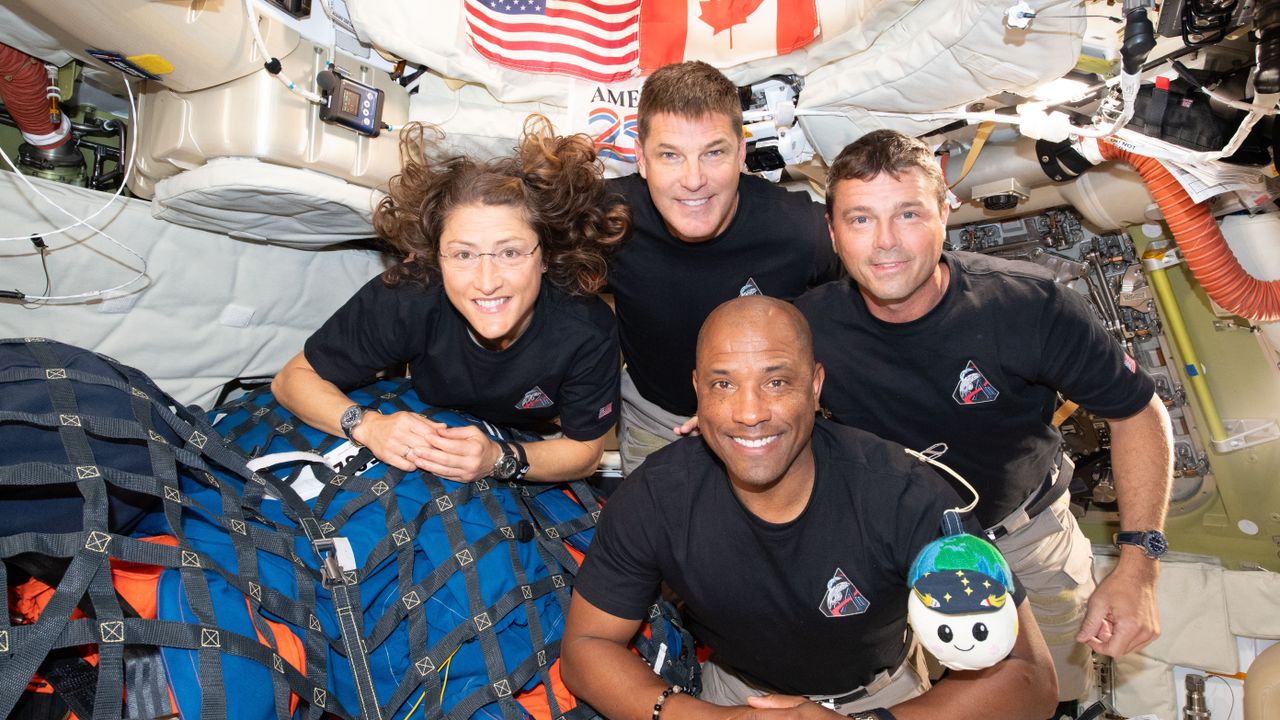
Art002e013365 (April 7, 2026) – The Artemis II crew – (clockwise from left) Mission Specialist Christina Koch, Mission Specialist Jeremy Hansen, Commander Reid Wiseman, and Pilot Victor Glover – pause for a group photo with their zero gravity indicator "Rise," inside the Orion spacecraft on their way home. Following a swing around the far side of the Moon on April 6, 2026, the crew exited the lunar sphere of influence (the point at which the Moon's gravity has a stronger pull on Orion than the Earth's) on April 7, and are headed back to Earth for a splashdown in the Pacific Ocean on April 10.

Humans have orbited the moon for the first time in more than 50 years. But besides the advances in space tech between Apollo 11 in 1969 and Artemis II in 2026, there’s another key technological change between those two launches: Artificial intelligence.

According to fact checks from mutlipe news outlets, including BBC and CBC, viral photos and videos circulating online claiming that Artemis II footage is fake are themselves AI-generated fakes.

Photos from TikTok show the four astronauts wearing a harness system in front of a green screen. But when the BBC ran the photos through Google’s SynthID AI check, which reads embedded watermarks on Gemini’s AI creations, the tool said that those green screen photos were generated with Google AI.

Eagle-eyed viewers watching a CNN interview with the astronauts that aired earlier this week found unusual text overlaid on a floating gravity toy named Rise, leading some to call the video out as an AI fake. However, an analysis showed that those artifacts didn’t appear on the original footage – BBC’s verify team says that the unusual text artifacts were not a green screen error or a sign of AI, but a glitch in the tool used to place text over video footage recorded in camera.

One survey of US adults from 2021 suggests that 12 percent of Americans believe that NASA did not land on the moon in 1969, while another 17 percent responded as “unsure.”

Fake photos being used to claim a historic event was faked is ironic, yes, but also a key example of living in the AI era. Photographs could be faked before the age of AI, but the ease at which anyone with a keyboard can create a fake image is increasing distrust over the credibility of photographs. One survey from 2025 found that 82 percent of respondents said their confidence in media has decreased as a result of AI-generated content.

NASA has been sharing photographs taken on the Artemis II mission since the Orion launched on April 1. Metadata from photographs shared from official NASA channels show photographs that were taken with the Nikon D5 DSLR, the Z9 mirrorless camera, an iPhone 17 Pro Max, and even a nearly 12-year-old GoPro.

You may also like

Browse the best mirrorless cameras or the best DSLRs.

Sign up to read this article
Read news from 100's of titles, curated specifically for you.

Already a member? Sign in here
Related Stories
Top stories on inkl right now
One subscription that gives you access to news from hundreds of sites
Already a member? Sign in here
Our Picks
Fourteen days free
Download the app
One app. One membership.
100+ trusted global sources.