Get all your news in one place.
100’s of premium titles.
One app.
Start reading
Reason
Reason
Politics
Jacob Sullum

Video of the Minneapolis ICE Shooting Does Not Resolve the Issue of Whether It Was Legally Justified

After an immigration agent shot and killed a woman in Minneapolis on Wednesday morning, Secretary of Homeland Security Kristi Noem and President Donald Trump portrayed that use of lethal force as clearly justified. Noem averred that the dead woman, Renee Nicole Good, was engaged in an "act of domestic terrorism" because she was trying to "run a law enforcement officer over." Trump went even further, saying Good "violently, willfully, and viciously ran over the ICE Officer."

Bystander video of the incident immediately cast doubt on those accounts. Footage from various angles "appears to show the agent," later identified as Jonathan Ross, "was not in the path of [Good's] SUV when he fired three shots at close range," The New York Times reported on Thursday. "The SUV did move toward the ICE agent as he stood in front of it," The Washington Post noted. "But the agent was able to move out of the way and fire at least two of three shots from the side of the vehicle as it veered past him."

The Post said the videos it analyzed "do not clearly show whether the agent is struck or how close the front of the vehicle comes to striking him." On Friday, Vice President J.D. Vance posted cellphone video, apparently recorded by Ross himself, that suggests he was in fact hit by the front bumper before moving out of the way. But the evidence so far does not definitively resolve the issue of whether the shots Ross fired as the car moved away from him were legally justified, which hinges on whether he reasonably believed he was in danger at that point, even if that belief may have been mistaken.

On Thursday, the Minnesota Bureau of Criminal Apprehension (BCA) said it had planned to "conduct a joint investigation" of the shooting "with the FBI." But according to BCA Superintendent Drew Evans, the U.S. Attorney's Office in Minneapolis "reversed course" on Wednesday afternoon, saying "the investigation would now be led solely by the FBI," meaning "the BCA would no longer have access to the case materials, scene evidence or investigative interviews necessary to complete a thorough and independent investigation."

Noem characterized the situation a bit differently. "They have not been cut out," she said. "They don't have any jurisdiction in this investigation."

This case resembles previous incidents in which police officers fatally shot motorists they claimed were using cars as weapons, and it raises the same basic issues. Under the Supreme Court's Fourth Amendment precedents, the crucial question is not whether Good was actually trying to run Ross down but whether his avowed belief that she posed a threat to him was "objectively reasonable" given "the totality of the circumstances."

The 1985 case Tennessee v. Garner involved a suspected burglar who was shot while fleeing police. The Supreme Court held that the use of deadly force is unconstitutional in such circumstances "unless it is necessary to prevent the escape and the officer has probable cause to believe that the suspect poses a significant threat of death or serious physical injury to the officer or others."

To assess whether a use of force is "objectively reasonable" under the Fourth Amendment, the Court explained four years later in Graham v. Connor, judges should consider "the totality of the circumstances," paying "careful attention to the facts and circumstances of each particular case." The Court said relevant factors include "the severity of the crime at issue, whether the suspect poses an immediate threat to the safety of the officers or others, and whether he is actively resisting arrest or attempting to evade arrest by flight."

In applying that test, the Supreme Court emphasized last year in Barnes v. Felix, "a court must consider all the relevant circumstances, including facts and events leading up to the climactic moment." That case involved a Texas police officer who stopped a car for suspected toll violations. After endangering himself by jumping on the car as it began to move again, he addressed the resulting hazard by shooting the driver dead. The justices unanimously rejected the test applied by the U.S. Court of Appeals for the 5th Circuit, which focused on "the moment of the threat" to the officer without considering how he ended up in that situation.

The Justice Department's policy on the use of force jibes with what the Supreme Court has said. "Deadly force may not be used solely to prevent the escape of a fleeing suspect," it notes, and "firearms may not be discharged solely to disable moving vehicles."

The Justice Department explains that "firearms may not be discharged at a moving vehicle unless: (1) a person in the vehicle is threatening the officer or another person with deadly force by means other than the vehicle; or (2) the vehicle is operated in a manner that threatens to cause death or serious physical injury to the officer or others, and no other objectively reasonable means of defense appear to exist, which includes moving out of the path of the vehicle" (emphasis added). The circumstances of the Minneapolis shooting suggest that Ross may have violated that policy.

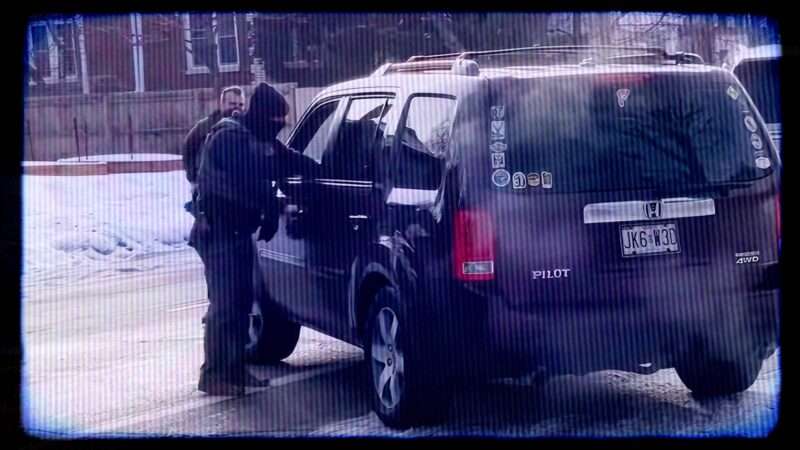
Local and state officials said Good, a 37-year-old mother of three, was acting as "a legal observer," monitoring Immigration and Customs Enforcement (ICE) operations in Minneapolis. At the beginning of her fatal encounter with ICE, her Honda Pilot had been positioned sideways on Portland Avenue between East 33rd and East 34th streets, blocking one lane of traffic, for about three minutes. Good repeatedly waved at ICE vehicles on the street, indicating that they should go around her.

ICE agents approached Good's car, and witnesses said they gave her conflicting instructions: One said she should drive away, while another told her to get out of the car. Video shows one agent grabbing the handle of the driver's side door, apparently in an attempt to enforce the latter command. The SUV backs up a bit and begins moving forward, the front wheels turned to the right, away from the agents. Ross initially is standing near the left front bumper, but he quickly moves out of the way and fires three shots at the car as it moves past him.

These details are reminiscent of a 2015 fatal shooting in Seneca, South Carolina, stemming from a two-bit marijuana sting. Police lured 23-year-old Tori Morton, who ultimately was arrested for possessing 10 grams of marijuana, to a Hardee's parking lot so they could arrest her for selling pot. She was on a date with 19-year-old Zachary Hammond, who drove her to the restaurant, and she was eating an ice cream cone in the front seat of his car when Lt. Mark Tiller, who was assisting the undercover officer who had arranged to buy marijuana from Morton, approached the vehicle. Tiller said Hammond, who was unarmed, saw him, panicked, and tried to run him down, forcing him to fire two shots through the driver's side window in self-defense.

Tiller's account was inconsistent with dashcam video of the incident, which showed that Hammond was already backing up as Tiller approached the car. Hammond continued on his way, making a sharp left so he could pull out of the parking lot. Tiller ran into the path of the car, then backed up to avoid being hit. When Tiller fired the first shot, which entered Hammond's chest through the left side, he was no longer in the car's path. Tiller fired a second shot, which hit Hammond in the back, as Hammond was moving past him. There was no indication that Hammond aimed the car at Tiller, and Tiller was not in danger of being struck when he fired those two rounds.

Local prosecutors nevertheless declined to charge Tiller. Applying South Carolina's test for self-defense, 10th Circuit Solicitor Chrissy Adams concluded that Tiller "actually believed he was in imminent danger of losing his life or sustaining serious bodily injury" and that "a reasonable prudent man of ordinary firmness and courage would have entertained the same belief." The evidence "corroborates and supports Lieutenant Tiller's belief that he was going to be run over," she said. "Therefore, the only conclusion that can be rendered is that deadly force was justified."

A Justice Department investigation of the shooting apparently went nowhere. But a lawsuit that Hammond's family filed against the city of Seneca resulted in $2.2 million settlement, and Tiller was fired about six months later.

The Hammond case illustrates a point that is obviously relevant to the Minneapolis shooting: Even when video evidence undercuts the claim that a driver actually posed an ongoing threat, an officer can still successfully argue that he reasonably, though perhaps mistakenly, believed he was in danger. That is consistent with the Supreme Court's rulings on the use of force, which require a belief that is "objectively reasonable" given "the totality of the circumstances," even if it turns out to be inaccurate in hindsight. It is also consistent with Minnesota's law of self-defense, which allows lethal force "when necessary in resisting or preventing an offense which the actor reasonably believes exposes the actor or another to great bodily harm or death."

Was Ross' purported perception of Good as a potentially deadly threat reasonable at the point when he fired his weapon? I am inclined to think not, although I recognize that people may reasonably disagree. But one thing is clear: Despite the predictable partisan split on the question, the answer should not hinge on how you feel about ICE, Donald Trump, or his immigration crackdown.

The post Video of the Minneapolis ICE Shooting Does Not Resolve the Issue of Whether It Was Legally Justified appeared first on Reason.com.

Sign up to read this article
Read news from 100’s of titles, curated specifically for you.
Already a member? Sign in here
Related Stories
Top stories on inkl right now
One subscription that gives you access to news from hundreds of sites
Already a member? Sign in here
Our Picks
Fourteen days free
Download the app
One app. One membership.
100+ trusted global sources.