Get all your news in one place.
100’s of premium titles.
One app.
Start reading
The Guardian - US
The Guardian - US
World
Stephen Starr in Indianapolis

Venezuelan immigrants enliven midwest food and culture – now DHS wants to send them home

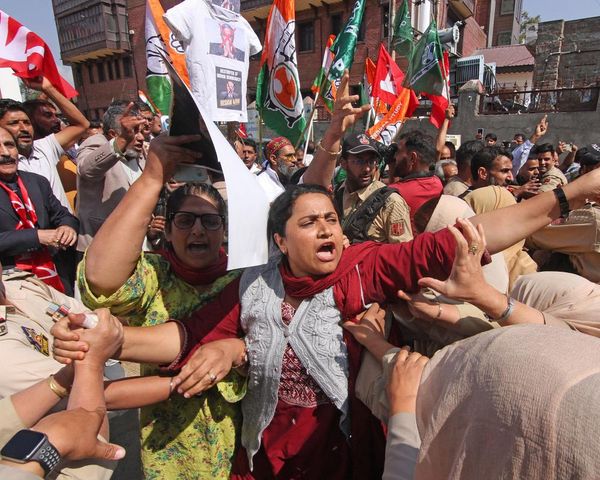
people holding a banner
Demonstrators carry a banner reading ‘Hands Off Venezuela!’ during a protest opposing US military intervention. Photograph: Aopa Images/LightRocket/Getty Images

At a former Coca-Cola bottling plant in downtown Indianapolis, Venezuelans Juan Paredes Angulo and his mother, Andreina, five years ago delivered on a decades-long dream to open a food stall, sharing regional Venezuelan food with a part of America better used to Tex-Mex and Chinese takeout for international cuisine.

Hearing of Venezuelan president Nicolás Maduro’s capture by US forces in an overnight military raid earlier this month came as a complete shock.
“At first we didn’t believe it. We thought it might be AI. But then everybody we know started reaching out about the news. It’s only in our dreams that this would be true,” Juan says. “I feel joy, and ignorance, because I don’t know exactly what could be happening there nor do I know is it absolutely positive.”

He, his mother and sister came to Indiana in 2015 as political asylees.

“I was 16 [when he left Venezuela] and for me to go to college [there] was a waste of time – many of the future opportunities were gone. We don’t have an economy any more.”

Venezuelan immigrants are by far the fastest-growing Hispanic group in the US as hundreds of thousands flee poverty and repression that has afflicted the country for more than two decades. Outside of east and west coast states and Texas, Indiana is home to one of the largest Venezuelan communities in the country that numbers nearly 8,000 people.

But Madero’s kidnapping and the Trump administration’s brutal deportation project, which the administration claims has seen 2.5 million people leave the US in under a year, has put their time, and that for thousands of other Venezuelans in the midwest, at risk.

Within hours of the 3 January attack in Caracas, the Department of Homeland Security released a statement that, in part, read: “Kristi Noem ended Temporary Protected Status [TPS] for more than 500,000 Venezuelans, and now [following the overthrow of Maduro] they can go home to a country they love.”

A day later, a DHS representative told Fox News that the ouster of Maduro means that Venezuelans in the US can “now go home”.

That means that for many of the estimated 1.2 million Venezuelan immigrants who have come to the US over the past decade, thousands of whom have come to the midwest due to its low cost of living and abundant work opportunities, their time in the US could now be on the clock.

TPS is set to expire for more than half a million Venezuelan immigrants, by far the largest immigrant group reliant on the status to live and work in the US, on 2 October.

As Indiana, Ohio and other midwestern states struggle with US-born population decline, immigrants in recent years have played a huge role in slowing that trend.

While nearly half of all Venezuelan immigrants live in Florida, people such as Paredes Angulo and his family have played an important role in filling tax coffers in the midwest, while bringing South American culture to a region that lags behind in diversity.

Of Indiana’s 92 counties, 62 experienced natural population decline, according to 2024 data from the US Census Bureau. The same survey found that almost 70% of the state’s population growth was due to immigrants moving to the state.

The midwest region as a whole saw a net international migration increase of 406,737 people – nearly 10 times the natural population growth increase. Immigrants, who are thought to have paid more than $4bn in Indiana tax contributions, play a crucial role in funding critical Medicare and Social Security programs for all Americans.

All the while, many Rust Belt cities have turned to small businesses such as immigrant-owned food trucks and restauranteurs to convert former manufacturing spaces into food halls that attract people back to their downtown cores.

For cities such as Indianapolis, it’s paying dividends.

An analysis of census data by WalletHub, that compared cities by their ethnoracial, linguistic and birthplace diversity, found that by those measures, Indianapolis was more diverse than Atlanta, Miami or Baltimore.

“With Indiana being as rural as we are, having immigration really opens up our eyes to cultures that aren’t American,” says Danielle Shipley, an organizer at Indy Action Coalition, a non-profit that has pushed back against ICE activity in Indiana.

“We have to change some of our politics, the way that we view the world. Just because Maduro isn’t technically in Venezuela, in charge, his party is still there. Someone seeking asylum here because it’s not safe to go back to Venezuela is not yet safe to be [there].”

But the Trump administration’s crackdown on immigrants – Venezuelans account for the largest number of undocumented immigrants in the US – has caused significant worry in Indiana.

By mid-September, more than 800 individuals, many held on immigration rather than criminal charges, were detained by ICE at Indianapolis’ Marion county jail, according to local media. Last February, ICE agents arrested a Venezuelan national in Indianapolis with alleged ties to criminal gangs, but declined to identify the person.

“Beyond being scared, everyone is really confused; what we’re seeing right now is going to have devastating effects on not just the economy but the culture,” says Karla López Owens, a naturalized citizen and attorney who is running for local office in Indianapolis this year.

“I’ve been living here for 25 years and seen how immigrants come into dilapidated parts of town and make these areas flourish again. I’m really scared about what [the immigration crackdown] is going to mean.”

The bulk of Indiana’s Venezuelan community is centered in Noblesville and Carmel, northern suburbs of Indianapolis in Hamilton county, which ranks as the fastest-growing county in the state.

From Maracay, a city 80 miles west of the capital, Caracas, Paredes Angulo, says he has heard reports that Venezuelans deported back to their home country from the US were harassed by the authorities in Venezuela. “They say that you betrayed the patriarchy,” he says.

Reports of paramilitaries on the streets searching for American nationals have emerged in recent days, with the state department calling on US citizens to leave the country due to security concerns.

“After 10 years of watching the country going deeper and deeper into the ground, the idea of going back to Venezuela has never been on my table. But you never know,” says Paredes Angulo, adding that he is hoping to be able to apply for a green card soon.

“Venezuela’s resources could become more accessible and that would be a boost to the economy, right? But I don’t know how that can happen easily.”

Sign up to read this article
Read news from 100’s of titles, curated specifically for you.
Already a member? Sign in here
Related Stories
Top stories on inkl right now
One subscription that gives you access to news from hundreds of sites
Already a member? Sign in here
Our Picks
Fourteen days free
Download the app
One app. One membership.
100+ trusted global sources.