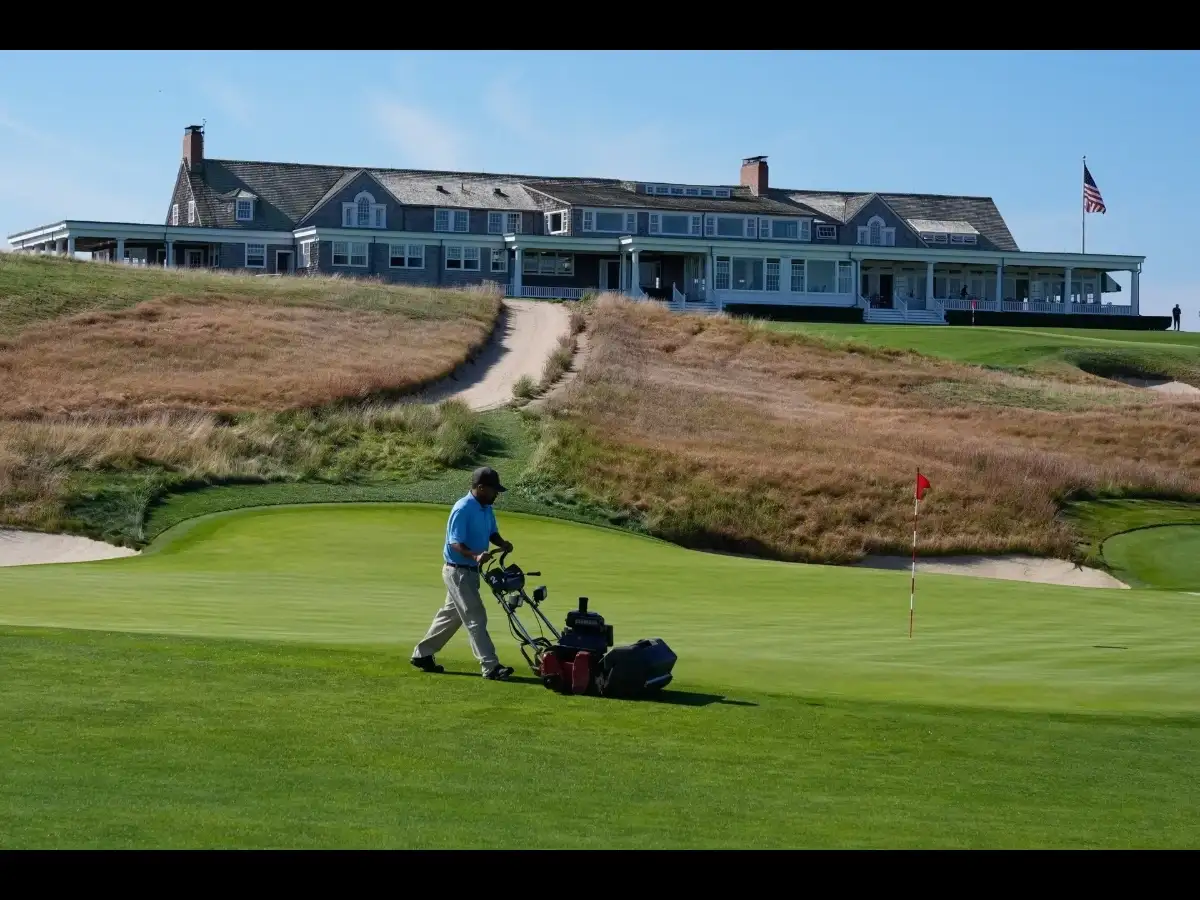
On the outer reaches of Long Island’s South Fork, the wind always arrives before the golfers. It will be there on Thursday, when the 126th US Open returns to Shinnecock Hills, its white-shingled Stanford White clubhouse from 1892 perched above fescue that flashes and leans with every gust. For the sixth time, and the first since 2018, the national championship will be staged at Shinnecock Hills.
William Flynn’s 1931 design will again be presented as a par-70, stretching 7,440 yards, but the scorecard barely hints at how hard it plays. The fairways are conspicuously wide by major-championship standards, and in 2026 the USGA is restoring them to some of their original breadth, giving players ample targets from the tee.
The real test starts with the next shot: Shinnecock demands precision with irons and a deft touch around its firm, slithering greens, where short-game mistakes are ruthlessly exposed. Miss a fairway and find the dense rough, and any hope of attacking is usually gone, which is why accurate drivers have traditionally prospered here.
On the putting surfaces, long putts become exercises in nerve and feel rather than straightforward two putts. At US Opens held at this course in the modern era, only Raymond Floyd and Retief Goosen have finished the week under par.
Each US Open features a bruising drama with it, and nowhere is that more evident than at Shinnecock Hills, where the championship’s history is as scarred as it is storied. In 1896, only in its second playing, the field included John Shippen, widely regarded as the first African American to compete in the US Open, and Oscar Bunn, a Shinnecock golfer whose Nation helped build the course and has long contested the land beneath it. Raymond Floyd prevailed at Shinnecock in 1986 at the age of 43, joining Julius Boros, who won in 1963 and again in 1968 at 48, and Hale Irwin, who won at 45 in 1990, among the oldest champions in the event’s history.
Corey Pavin chased down Greg Norman and settled the championship with a towering fairway wood of roughly 228 yards into the 72nd green in 1995, a swing Johnny Miller, gasping in the commentary booth, hailed as the shot of Pavin’s life.
Brooks Koepka (2018) claimed the trophy at one over par, surviving Tommy Fleetwood’s 63 by a single stroke, adding another dense chapter into Shinnecock lore.
Koepka’s victory matters this week beyond nostalgia. It was the US Open leg of a rare double. He remains the only man since Tiger Woods in 2000 to win both the US Open and the PGA Championship in the same calendar year. Just five players have ever managed it: Gene Sarazen, Ben Hogan, Jack Nicklaus, Woods, and Koepka. Aaron Rai can become the sixth. In M ay, the 31 - year - old from Wolverhampton holed a 68-foot putt on Aronimink’s penultimate hole, walked off with the Wanamaker, became the first English-born PGA champion since Jim Barnes in 1919, and only the second major winner of Indian heritage. He arrives at Shinnecock with the chance to complete a double whose last entry was made on this very turf.
He is not the only man chasing a place in the record book. Rory McIlroy could join an even more exclusive club. Six men — Craig Wood, Hogan, Arnold Palmer, Nicklaus, Woods, and Jordan Spieth — have won the Masters and the US Open in a single season, and none since Spieth in 2015. McIlroy, the finest driver of his generation, would need only four days of the iron play he has threatened all spring.
And then there is the matter of the world’s best player, who has not won since the calendar turned. Scottie Scheffler remains No. 1 by every model that measures it, yet eleven starts have passed without a victory. He needs no reminding of the stakes: a win here would complete the career Grand Slam, and Sunday, the final round, is his thirtieth birthday. Bryson DeChambeau, twice a US Open champion and the bookmakers’ favourite, will relish the firm, demanding setup.
For Indian golf enthusiasts, the most compelling storyline may be the quiet subcontinental current running through the draw. Rai is its standard-bearer, but he is not alone. Akshay Bhatia, the 24-year-old lefthander, won the Arnold Palmer Invitational at Bay Hill in March, a result that marks him as more than a prospect. Sahith Theegala, who lost most of 2025 to an oblique injury, has rebuilt patiently and delivered solid results this season.
And Sudarshan Yellamaraju, born in Visakhapatnam and raised in Canada, will play in his first US Open after teaching himself the game, watching video clips with his father. In March, he tied for fifth at the Players Championship, establishing himself as the top rookie this season.