America is no longer the “anchor” of the global system following its “severe” foreign aid cuts - but improving the lives of the world’s most vulnerable people is still “a solvable problem,” David Miliband, CEO of the International Rescue Committee, told The Independent Tuesday.
Miliband, the former U.K. foreign secretary who has led one of the world’s largest humanitarian groups for more than a decade, is among one hundred leaders, business titans, scientists and activists, and others, honored on The Independent’s third annual Climate 100 List.
The list, celebrating a diverse group tackling the climate crisis, was launched Tuesday during New York Climate Week, which coincides with the gathering of the United Nations General Assembly in the city. Others who made the list include environmental lawyer and activist Erin Brockovich, Octopus Energy CEO Greg Jackson, Swedish campaigner Greta Thunberg and Microsoft co-founder and philanthropist Bill Gates.
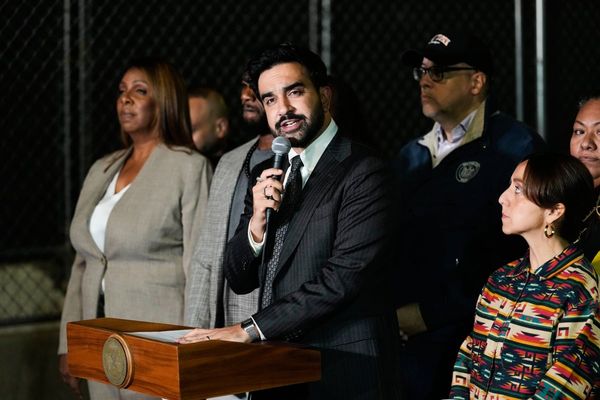
“I was brought up to believe if you can make a difference, you should, and if you don't, it's a waste. Who wants to waste our time here? It's a short time, so let's make the most of it,” Miliband, who gave the keynote address, later told The Independent’s Editor-in-Chief Geordie Greig during a Q&A session.
Miliband oversees the IRC’s $1.1 billion-operations in more than 40 countries which have been shattered by conflict, hunger crises and climate impacts such as drought and flooding. The organization was co-founded by Albert Einstein during the Second World War to help refugees fleeing Nazi Germany.
Greig praised Miliband’s “personal, practical and political antennae, and dedication to public service” and noted his background as the son and grandson of Holocaust survivors.
Miliband addressed the crowd for around 30 minutes on the IRC’s work, saying the twin and overlapping perils of war and climate change are breaking records. And while the world has more resources and is more connected than ever, political will, financial investment and media attention have “vanished.”
He highlighted the Trump administration’s removal of $60 billion funding for the U.S. Agency for International Development last year - 1 percent of the U.S. budget - and how it had cost 700,000 lives as a direct result. A separate analysis, from The Rockefeller Foundation, has projected millions more could die by 2030, he noted.
“The U.S. was the anchor of the global aid system. It paid about a third of total contribution,” Miliband said, noting that the U.K., Germany, and France also cut their foreign aid but the European Union had not.
He continued: “There's an argument for more burden sharing, for more responsibility sharing ... but the consequences of the reductions are very severe.”
Miliband also spoke of “design failure” in the global aid system where funding often arrives too late.
“The system waits for livestock to rot, children to starve, societies to collapse before launching a single emergency appeal. It's horrifying to me,” he said. In 2010 in Somalia, around a quarter of a million people died before famine was even declared, he noted.
“Even 24 hours of warning before a storm or a heatwave can reduce lost lives and resources by around 30 percent,” Miliband said.
Also writing today in The Independent, Miliband said there had previously been a fear that discussing adapting to the effects of climate change meant going soft on preventing it.
“But today, the failures and limits of mitigation mean we have no choice but to seek urgent mitigation and adaptation at the same time,” he wrote.
Even with current efforts, climate change is altering the environment in which politics, economics and conflict operate, Miliband told attendees. That’s been the case in drought-ravaged Somalia, too, where armed militias restrict access to water to control communities, he explained.
Still, media coverage on the climate crisis in recent months has focused on the need for air conditioning during soaring European heatwaves rather than food insecurity in Somalia, or drought in Afghanistan, he said.
“The countries with the greatest need for adaptation, receive the least support for adaptation,” said Miliband. “In that way, the international system is rigged against them.”
Miliband pointed out that 65 wars are happening around the world right now, with the “top humanitarian crisis” in Sudan.
“The danger that we fear is that we're going into a syndrome of forever wars, because the number of wars that finish is much smaller than the number of wars that start,” he said.
Later in the event, Bel Trew, The Independent’s award-winning Chief International Correspondent, spoke to the U.S.’s ongoing war with Iran and what would be its lasting impacts.
“We will have a food crisis off the back of that fact that there was interruption to fertilizers right now,” Trew, who recently reported from Sudan, said during a conversation with David Callaway, founder of analysis group Callaway Climate Insights. “We are not seeing the impact on our lives in the full amount. That won’t happen for another year.”
When asked by an audience member how he remained hopeful in the face of such steep challenges, Miliband shared words of wisdom he had heard recently from former New Zealand Prime Minister Jacinda Ardern.
“She said, ‘In New Zealand, we say nothing's too small,’” he said. “I thought that was really quite inspiring in the way that it says, ‘Look, stop moaning, do something.’”