
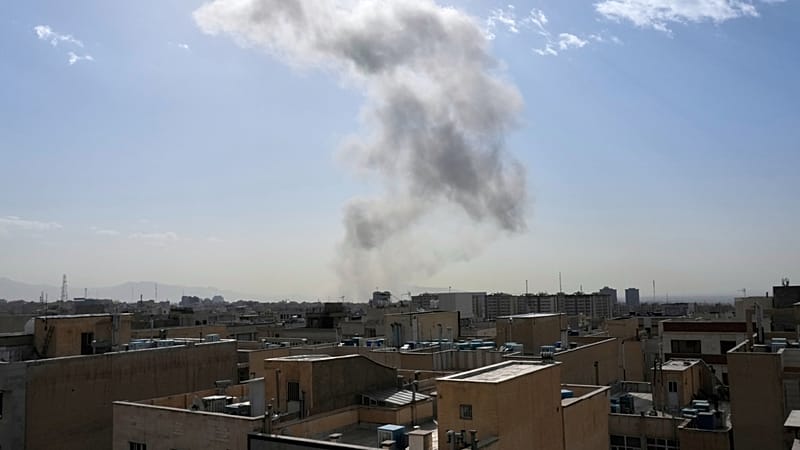
The United States and Israel launched what President Donald Trump described as “major combat operations” against Iran on Saturday, marking a dramatic escalation in regional tensions. The strikes appeared to target military, intelligence and government-linked sites across the country.
Trump said, “we tried to make a deal,” and accused Iran of developing missiles capable of threatening Europe.

Trump called on the Iranian public to “seize control of your destiny,” while Israeli Prime Minister Benjamin Netanyahu said the operation aimed to create conditions for Iranians to “take their fate into their own hands.”
What was targeted?
Iranian media reported strikes nationwide. Roads to Khamenei's compound in downtown Tehran had been shut down by authorities as other blasts rang out across the capital.
Khamenei has not made a public appearance in recent days and wasn't immediately seen after. During the 12-day war in June, he was believed to have been taken to a secure location away from his Tehran compound.
In Tehran, witnesses heard the first blast by Khamenei’s office. Iranian state television later reported on the explosion, without offering a cause.
More explosions struck Iran’s capital after Israel said it was attacking the country. Authorities have offered no casualty information from the strikes.
Targets in the Israeli campaign included Iran’s military, symbols of government and intelligence targets, according to an official briefed on the operation, who spoke on condition of anonymity to discuss nonpublic information on the attack.
Both Iran and Israel closed their air space for civil flights
Israel declared a state of emergency. Sirens sounded throughout the country. The authorities announced that the so-called "proactive alert" was intended to prepare people for possible rocket attacks.
Iran’s Revolutionary Guard Corps releases statement after strikes on Israel. “In response to the aggression of the hostile and criminal enemy against the Islamic Republic of Iran, the first wave of large-scale missile and drone attacks by the Islamic Republic of Iran toward the occupied territories has begun,” the statement said.
Iran-backed Houthi rebels in Yemen say they'll resume attacks on shipping. The Iranian-backed Houthi rebel group in Yemen have said they will resume missile and drone attacks on shipping routes and on Israel in support of Iran. That’s according to two senior Houthi officials, who spoke in condition of anonymity because there is no official announcement from the Houthi leadership.
How did Iran respond?
Iran responded within hours. The Revolutionary Guard said it launched a “first wave” of missiles and drones targeting Israel.
Sirens sounded across Israeli cities as air defenses worked to intercept incoming projectiles.
Iran also launched strikes targeting US military installations in Bahrain, Kuwait and Qatar, according to regional officials and Euronews journalists based in Dubai. Iraq and the United Arab Emirates temporarily closed their airspace.
Iran’s Foreign Ministry issued a defiant statement, saying the country “will not hesitate” to defend itself.
How did the Europeans respond?
European leaders moved quickly to assess the fallout from the strikes on Iran, amid concerns about regional spillover.
The European Union began evacuating some staff from the Middle East and convened emergency consultations. Germany scheduled a crisis meeting, while France and Italy urged their citizens in the region to exercise extreme caution.
EU foreign policy chief Kaja Kallas described the situation as “perilous” and said Brussels was coordinating with both Israeli and Arab officials to explore diplomatic options. While reaffirming concerns over Iran’s missile and nuclear programs, the EU also called for restraint and de-escalation.
Several European governments said they had little or no advance notice of the strikes. Switzerland urged all parties to respect international law and protect civilians, reflecting broader European efforts to prevent the conflict from widening.







