
Urth started life in 2014 under the name Gobe but rebranded in 2020 to reflect the company’s eco-friendly love for Planet Earth. It’s the vision of founders Christian, Chris, and Minnie, with the company slogan “Conscious design. Positive impact”.
Urth has earned goodwill as a Certified B Corporation, under which it is required to consider the impact of its decisions on its workers, customers, community, and environment, and not just its stakeholders. It is also positioned as an environmentally friendly company using sustainable designs, recyclable packaging, and carbon offsetting by planting trees for every product sold, with the aim of having a net-positive impact.

This sounds like a company I would love to get behind, as I would rather my money went to a company doing some good for the world, rather than its profits only serving its shareholders. So I picked up Urth’s I-Red 72, a filter designed for black-and-white infrared photography, to see if it’s just as good for the lens as it claims to be for the planet.
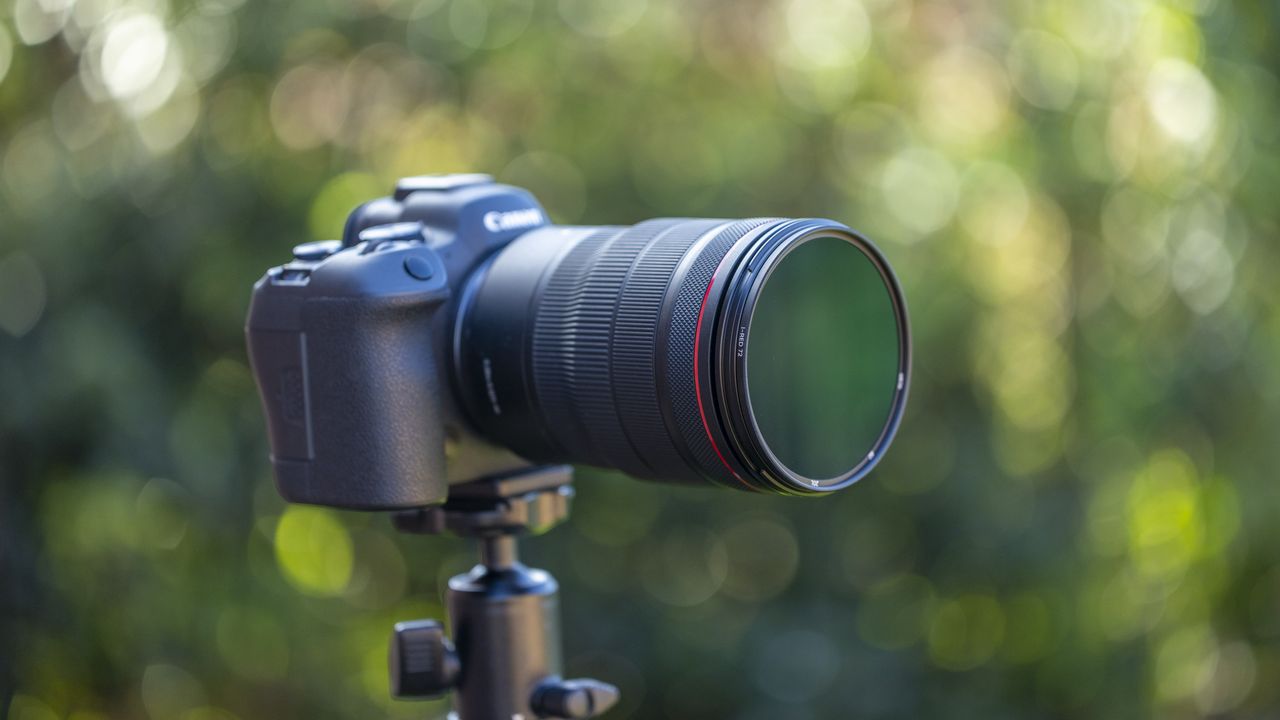
To thoroughly test the Urth I-Red 72, I tried it out with a Canon EOS R camera that had been converted to full-spectrum infrared photography by the experts at Advanced Camera Services, so a big shout-out to ACS for supplying the infrared camera for my tests, so I could take infrared photos in color. Let’s see how the Urth I-Red 72 got on…
Urth Infrared Filter Plus+: Specifications
Filter type |
Screw-in / magnetic round |
Filter threads |
37-95mm |
Material |
Aluminum |
Depth |
5mm (3mm mounted) |
Weight |
22g (82mm) |
Urth Infrared Filter Plus+: Price
In the USA, the Urth I-Red costs as little as $59 for the smallest 37mm filter thread version, up to $159 for the largest 95mm filter. You’ll pay a bit of a premium to go magnetic, with the smallest 39mm filter costing $69 and the largest 82mm variant setting you back $159.
Where I'm based in the UK, the IR Filter Plus+ costs between £45 and £115 for the 37mm to 95mm threaded filters, respectively, or to go magnetic, it’s £49 for the smallest 39mm option to £119 for the largest 82mm filter size.
As a product designed in Australia, it would be rude to leave out the Australian pricing, too. Here, the standard threaded design can be picked up between AU$79 for the 37mm filter and AU$209 for the 95mm size. To go magnetic, it will cost you between AU$89 and AU$199 for the 39mm and 82mm versions, respectively.
Urth Infrared Filter Plus+: Design & Handling
Urth filters are engineered by Urth’s design team in Australia and ‘expertly’ assembled in China. One of Urth’s key philosophies is to make high-quality products that stand the test of time to reduce landfill, and the upshot of this, for us consumers, is that the product is made from some very high-quality components.
This includes aerospace-grade aluminum, which is both slim and warp resistant, in addition to German Schott B270 glass and a CoraNano 20-layer dual-side nano-coating for clarity and contrast – more on image quality in the 'performance' section.

The filter is available in no less than 16 sizes for filter threads between 37mm and 95mm. A new addition to the range is the ability to purchase the filters as a magnetic option in nine sizes, between 39mm and 82mm.
The filter is pretty much opaque when held up to light, as it is designed to only pass light above the 720nm spectrum for infrared photography. While this can be used with a standard camera for long-exposure effects with boosted IR contrast, the best results will come from using the I-Red 72 on an IR-converted camera for ‘full-spectrum’ infrared photography.
The Urth I-Red 72 comes in sustainable cardboard packaging and a metal tin, which feels a little more premium than the standard plastic hard cases I’ve received with other filter brands. It also comes with a small microfibre cleaning cloth.

You’d be hard-pushed to find plastic in an Urth product, as they aim to be eco-friendly; however, the foam Urth has opted to use inside the tin is very fibrous and leaves lots of little fibres on the filter every time you put it away, and as a result, it needs cleaning before use. While Urth has tried to make an environmentally sustainable case, the irony is that it's not really fit for purpose, and mine would end up in the bin!

However, while I can't recommend the hard case, the filter itself should perform very well as it’s made from very high-quality components. Let’s take a look at how it performed…
Urth Infrared Filter Plus+: Performance
The coatings on the Urth IR Filter Plus+ were some of the best I've tested, and here you can see just how hydrophobic they are. Water and oil really don't want to 'stick' to the filter surface, so it's easily shaken off and easy to clean and maintain, too. In addition, it also boasts coatings for anti-reflectance, dust, and scratch resistance.

To test the filter, I used my Canon RF 15-35mm f/2.8L IS USM lens on an IR-converted full-spectrum Canon EOS R. However, while the camera is capable of full-spectrum photography, the wavelengths that the Urth I-Red 72 enables to pass through are 720nm and above, which is too high for color IR shots (usually around 590nm), but perfect for monoschrome infrared shots.

Image quality was very good, and converting the images to black and white revealed the punchy mono look you'd expect from a monochrome infrared photo, with bright white foliage and deep dark skies.
Zooming in to 200% did reveal a very slight softness in sharpness, though this is a common trait of other infrared filters I have tested, and from a distance, the images looked sharp and punchy. It's also hard to compare the image quality of shots with and without the filter attached because the contrast of the scene changes so dramatically.

The results on my full-spectrum converted camera were impressive. However, shooting on a non-converted camera, as I'm sure many of you will, provides less-than-impressive results. Here, the filter lets in way too much visible light – holding it up to a light source, you can see through the filter with its red tint, whereas other IR filters I assessed were pretty much opaque and difficult to see through.

This was also evident in the exposure times, with my standard exposure of 1/3200 sec on my non-converted EOS R5 extending to just 1 sec. By comparison, other IR filters I've tested blocked out more visible light and gave an exposure in the region of 20-30 secs.
In short, the filter passes too much light to create the classic punchy IR images on standard cameras, with greens turning bright white and blue skies turning black. But on a full-spectrum converted camera, it produces decent results.
Urth Infrared Filter Plus+: Verdict
The Urth Infrared Filter Plus+, also called the I-Red 72, put in a solid performance with great image quality, coatings, and is made from premium materials. My biggest disappointment was with the metal hard case, which had a material inside that tended to shed little fibres onto the filter, which wasn't ideal. While I can wholeheartedly recommend the filter, which is a fantastic product for black-and-white infrared photography, I can't recommend the hard case, and I would suggest buying a cheap replacement, to cut down on cleaning.
While it's available as a round screw-in filter with filter threads ranging between 37-95mm, or a slightly more limited range of magnetic round filters, there's no square filter option for those who use a slot-in system with a filter holder.
Also bear in mind that the 720nm band of light this filter passes isn't suitable for full spectrum color infrared photography and is only intended for black-and-white infrared, but in this area it excels.
|
Features ★★★★☆ |
The Urth Infrared Filter Plus+ is packed to the brim with great features, including a slim filter profile and multi-coating for oil, water, dust, and scratch resistance. |
|
Design ★★★★☆ |
The metal hard case gets 0/5 for leaving fibers on the filter; however, the filter itself is designed really well from premium materials and is available in a wide range of filter threads. |
|
Performance ★★★☆☆ |
With the issue of the metal case to one side, the filter scores well with its brilliant coatings. The filter is well suited for use on an IR-converted camera, though it fails to produce punchy IR-style images on standard non-converted camera bodies |
|
Value ★★★★☆ |
It is a little on the pricey side but I think its well worth the money for the extra features you get with this filter, and want to shoot monochrome IR images. |