
Universities have failed to take a trauma-informed approach when caring for students affected by ongoing conflicts in Gaza, a royal commission has heard.
The commission into anti-Semitism in Australia has heard evidence an Australian National University student was asked to provide death certificates for relatives who were killed by Israeli forces.

Mary Russell, chief executive of the Tertiary Education Quality and Standards Authority, said she had heard of several instances where academics had not responded to students affected by Israel-Palestine tensions in a reasonable way.
Dr Russell said while it was customary for universities to require proof before assessment changes were granted, there were "profound differences" in circumstances if family members died at the hands of the Israeli Defense Force or Hamas.
"The lack of trauma-informed and student-centred approaches... were so significant and important and so pervasive," she said.
Dr Russell appeared on the final day of hearings into anti-Semitism and hate speech on university campuses with dozens of witnesses believing more could be done to protect staff and students.
Monash University professor David Slucki told the commission that universities had "pretty adequate" policies for protecting Jewish people on campuses, instead calling for broader conversations about university cultures.
"You don't legislate your way out of social discord. We actually need to find a way to change the cultures in our institutions," he said.
Professor Slucki, who helped develop the Australian universities' definition of anti-Jewish hatred, said it was important to remember that understandings of Zionism - and therefore definitions of anti-Semitism - varied based on interpretation of history.
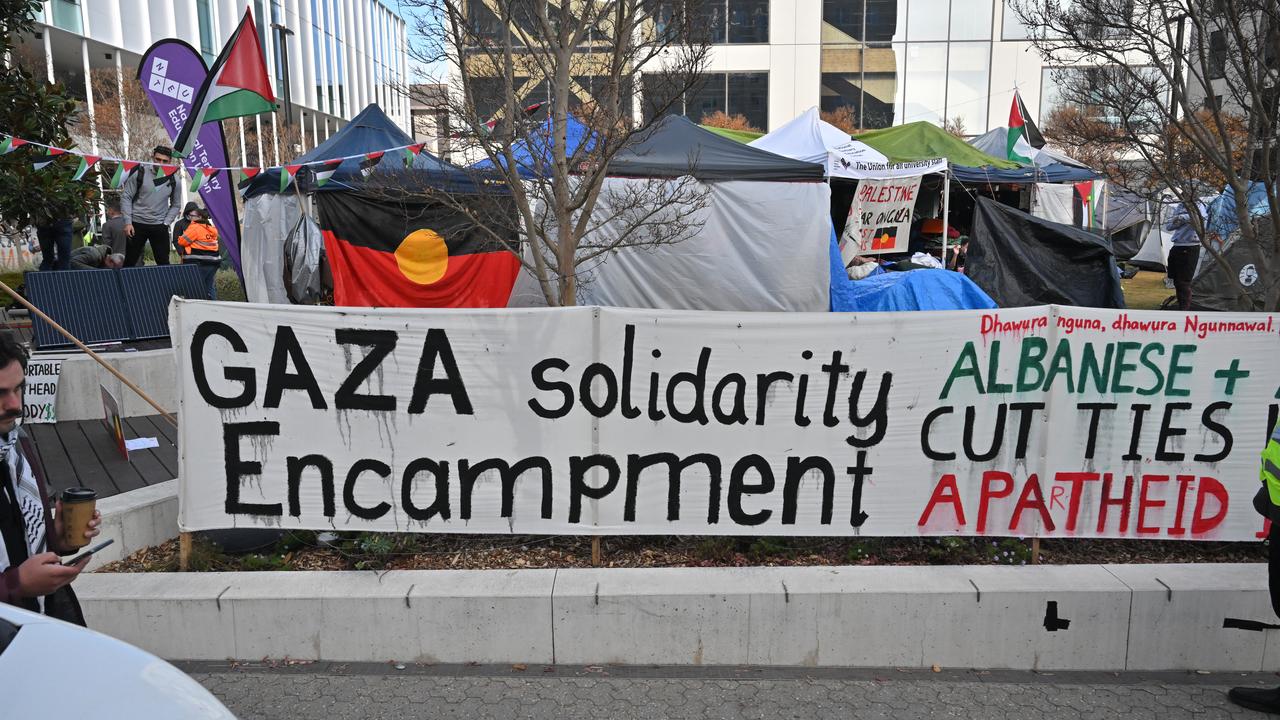
Monash took a stricter route than most universities in cracking down on pro-Palestine encampments.
Several external protesters were expelled from campus and chants were banned.
"Criticising states is a vital part of our democracy," said Prof Slucki, the director of the Australian Centre of Jewish Civilisation.
"We have to be clear cut in our mind when we are talking about what is criticism, what is debate, what is effective pedagogy in a classroom, rather than putting a blanket idea of what's acceptable and not acceptable."
His team had developed a course on anti-Semitism that had trained 1700 university leaders, including about "trauma" experienced by Palestinians.
But others felt programs were not enough.
In a statement, the Australia Israel and Jewish Affairs Council said university leadership allowed anti-Semitism to flourish almost unchecked.
"The harrowing testimony of Jewish students and staff, together with the evidence of several university vice-chancellors, has laid bare systematic failures of university leadership," the council said in a statement.
"These hearings should be a watershed moment. Australian universities should finally accept responsibility and accountability for their failures."
The commission will sit in Melbourne for a second week from Monday before moving to Sydney.
On Friday, the commission announced protests and the responses of police will go under the microscope in a block of hearings in August.
It will examine a pro-Palestine protest at the Sydney Opera House in October 2023, where attendees allegedly shouted "f*** the Jews".
A neo-Nazi rally outside NSW Parliament House in November 2025 will also be examined.
More than 60 protesters attended the demonstration, which NSW Police chose not to oppose at the time.
"The right to engage in peaceful protest is a fundamental attribute of democratic life," Commissioner Virginia Bell said in a statement.
"The commission's focus in this hearing block will be on whether there are opportunities to improve the way police respond to anti-Semitic conduct in protest settings."







