A year on from an election no one saw coming, there are hints and fears another poll might not be far off.
Tasmania's government appears in constant crisis as it contends with another minority parliament, wayward ministers and the state's many challenges.
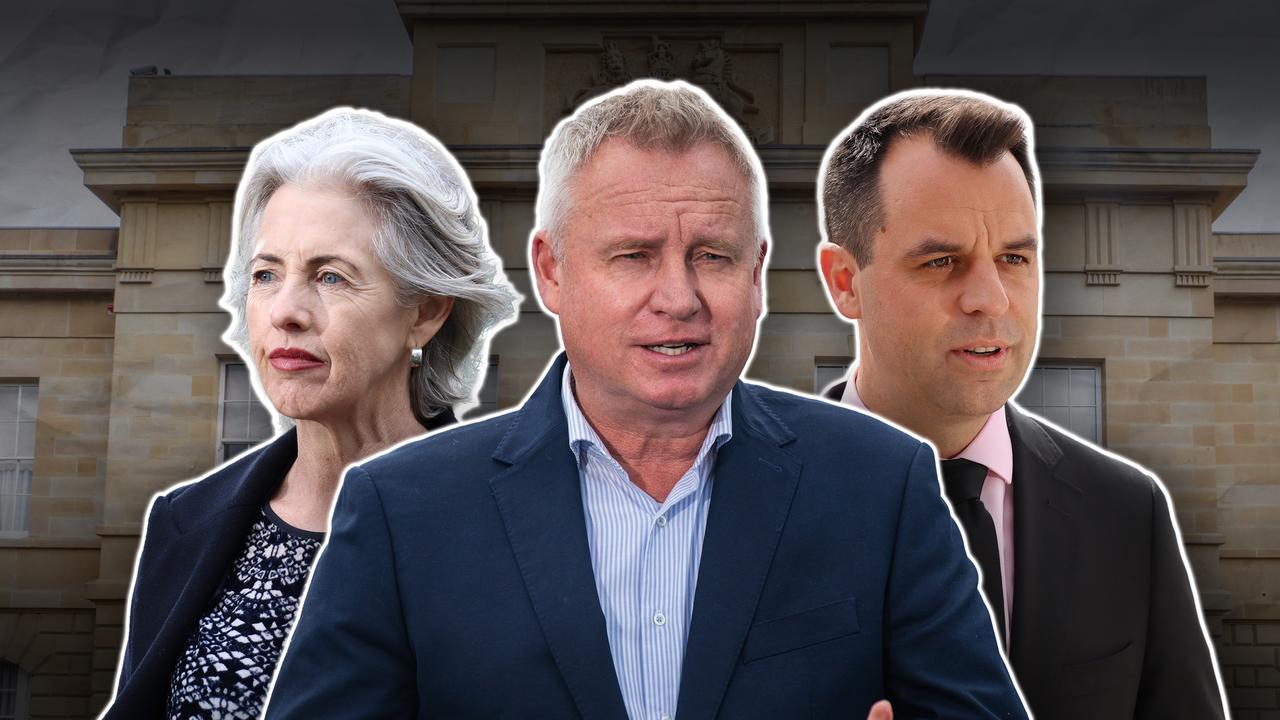
In June, parliament voted to censure Premier Jeremy Rockliff, the first such motion in the legislature's history.
Mr Rockliff was ticked off for his handling of two ministerial departures during a fractious parliamentary sitting, a tough budget and crossbench discontent.
It appears, according to political veteran and Liberal senate candidate Brad Stansfield, that Tasmania is on the brink.
"My frank assessment is I think the state has become close to ungovernable," he said on his Poll Position podcast.
Mr Stansfield is in a position to judge, given he helped return the Liberals to government in 2014 and then served as premier Will Hodgman's chief of staff.
The Liberals have won four elections in 12 years since but the last two, in 2024 and 2025, in minority.
The last year has been particularly precarious given Mr Rockliff did not agree a coalition or confidence agreements with the Greens or enough crossbenchers to enjoy the security of a majority.
Instead, every parliamentary motion and piece of legislation is in jeopardy, with the government needing either the Labor opposition, the Greens, or four of the seven crossbenchers to pass each part of its agenda.
In 2025, Mr Rockliff enjoyed a personal political high note when he secured support for a new Hobart waterfront stadium.
That success now feels a long way away.
"The government is a long, long way short of a majority on the floor ... and people are realising, as John Howard used to say, politics is governed by the iron law of arithmetic," Mr Stansfield says.
"Fourteen out of 35 ain't enough. It ain't even close."
The censure - backed by Labor's 10 MPs, the four Greens and five independents - followed Mr Rockliff's stonewalling over two ministerial departures.
Environment minister Madeleine Ogilvie resigned her portfolios in late May after misleading parliament over taxpayer-funded legal fees.
Tourism minister Jane Howlett followed her to the backbench a fortnight later for another parliamentary indiscretion.
Mr Rockliff has since admitted the state has spent more than half a million dollars in legal fees defending the pair over Integrity Commission investigations.
Greens leader Rosalie Woodruff says it was essential the premier was sanctioned for protecting and defending those ministers.
"He never apologised. He never accepted any wrongdoing and the evidence was overwhelming ... so there were consequences for bad behaviour," she tells AAP.
Dr Woodruff admits the parliamentary sanction was "a big deal" but it doesn't mean the Greens are ready for a fresh no-confidence vote to force a poll.
"Everyone is trying to provide some kind of a stable parliament," she says.
"We want to work. We want to do the job. No one has an intention to have an early election."
On this point, opposition leader Josh Willie is in lockstep.
"No one wants an early election," he tells AAP.
"It's no secret that I'd love to lead a Labor government but there are no shortcuts and we hear Tasmanians when they tell us they want stability."
All parties and crossbenchers canvassed by AAP are steadfast about voters opposing an election and wanting their MPs to get on with it.
Recent issues such as the closure of Liberty Bell Bay's manganese smelter, the budget's ballooning debt and dire economic forecasts would suggest the state needs focused government.
Crossbenchers say both major parties need to work more closely with them - with briefings, collaborations and more respect - given the minority environment.
"We have to make the best of what the people of Tasmania elected ... to be as co-operative and and constructive as possible," independent David O'Byrne says.
Peter George, who shares the Franklin electorate with him, says "nobody actually wants to see this parliament fail".
"But it's not operating the way a minority parliament should be operating," he adds.
The parliamentary numbers give rise to another possibility: that the crossbench and Greens might opt to flip the government without an election.
In the 35-seat house, Labor have 10 MPs, the Greens four, with at least four of seven crossbenchers seen as progressive-leaning, giving them a notional majority.
That grouping did not emerge in negotiations following the 2025 election as Labor opted against offering policy concessions to win support, effectively handing the Liberals a fifth term.
Mr Rockliff, in contrast, promised a review in the state's contentious salmon industry, a reversal on native logging plans and to end greyhound racing.
In any case, a Labor-Green-independents government might have been a perverse outcome in the eyes of the electorate, given the Liberals polled 40 per cent, and Labor crashed to 26 per cent, its worst result in a century.
Following their failure at the election and in the post-poll talks, Labor flipped leaders from the right faction's Dean Winter to Mr Willie, from the left.
Relations between Labor and the Greens have noticeably warmed since then, with some policy agreement, and notably, a collaboration over the censure.
Is there the prospect they might use their numbers, along the crossbench, and argue the governor to commission them without an election?
Mr Willie doesn't address that question, while Dr Woodruff says it's "not in my mind at all".
Independents aren't ruling it out.
Mr George says he is "tasmania parliamopen to it" should relations improve, while Mr O'Byrne, who is colder on the idea, says it might be possible in the event of "serious transgressions".
Mr Stansfield - who has nominated to fill a Liberal Senate vacancy - calls this scenario the "palace coup".
"Of course Labor ... if given the opportunity, will, in my view, take it up. They would be mad not to," he adds.
"A change of government by Christmas? You'd be a fool to bet against it. The chances of this parliament lasting four years are, and always were, absolutely zero. Zilch."
Complicating the picture further is the rise of One Nation.
Lee Hanson, the daughter of party founder Pauline Hanson, spearheads the party in Tasmania and on polling evidence, is poised to be a big force.
Pollsters DemosAU had One Nation at 21 per cent in a poll earlier this month, with the Liberals crashing to 28 per cent and Labor slumping to 21 per cent.
Those numbers are yet another reason why incumbent MPs are keen to avoid another election but, in time, could further entrench Tasmania's "ungovernable" minority parliaments.