
Get all your news in one place.
100’s of premium titles.
One app.
Start reading
The Independent UK
The Independent UK
National
David Fischer

New underwater park unveiled as 22 cars are plunged into the ocean in Florida — for a good reason

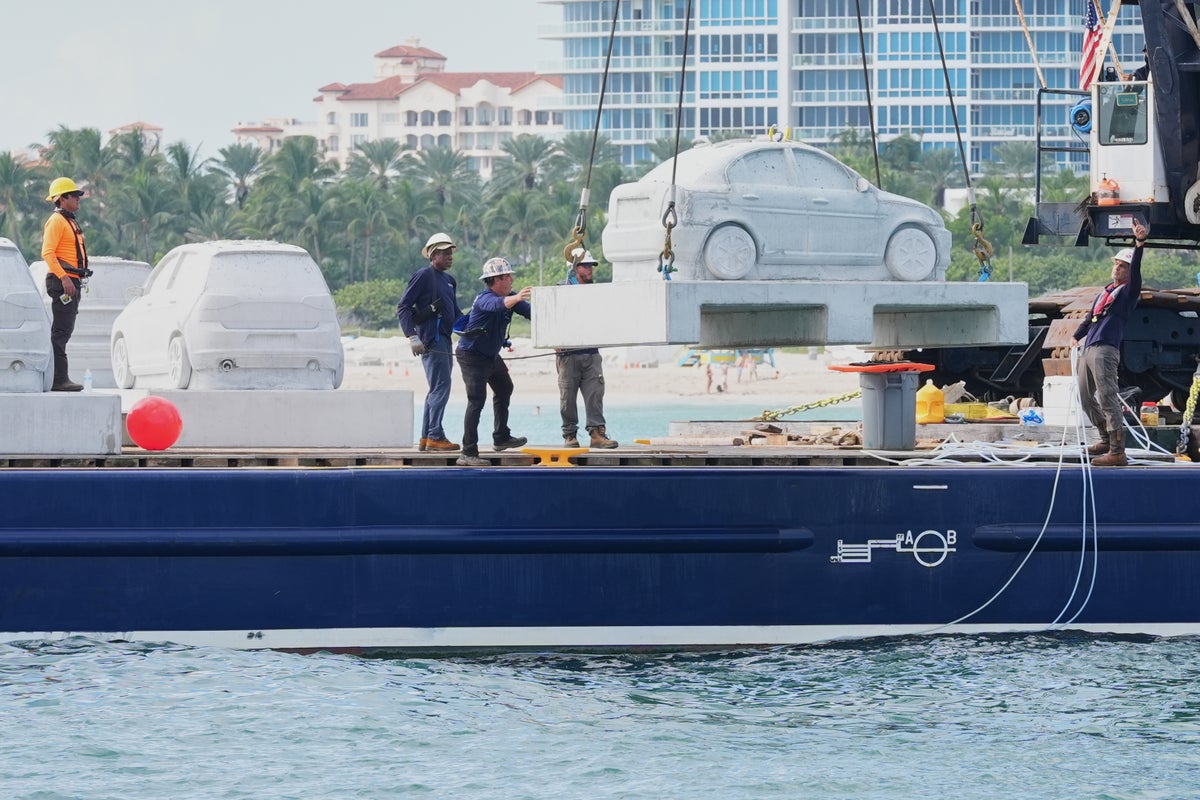
Workers prepare to submerge a marine grade concrete car that will be attached with native corals as part of a pioneering underwater marine sculpture park Tuesday, Oct. 28, 2025, in Miami Beach, Fla - (AP Photo/Marta Lavandier)

South Florida has a new tourist attraction but you won’t be able to spot it from land.

Over several days late last month, crews lowered 22 life-sized cars into the ocean, several hundred feet off South Beach.


The project was organized by a group that pioneers underwater sculpture parks as a way to create human-made coral reefs.

"Concrete Coral," commissioned by the nonprofit REEFLINE, will soon be seeded with 2,200 native corals that have been grown in a nearby Miami lab. The project is partially funded by a $5 million bond from the city of Miami Beach.

The group is also trying to raise $40 million to extend the potentially 11-phase project along an underwater corridor just off the city's 7-mile-long (11-kilometer) coastline.

“I think we are making history here," Ximena Caminos, the group's founder, said. “It’s one of a kind, it’s a pioneering, underwater reef that’s teaming up with science, teaming up with art.”

Workers prepare to submerge concrete cars that will be part of an underwater marine sculpture park off South Beach,Tuesday, Oct. 28, 2025, in Miami Beach, Fla. Native corals grown in a lab will be attached to the cars to create a reef (AP Photo/Marta Lavandier)

She conceived the overall plan with architect Shohei Shigematsu, and the artist Leandro Erlich designed the car sculptures for the first phase.

Colin Foord, who runs REEFLINE's Miami coral lab, said they'll soon start the planting process and create a forest of soft corals over the car sculptures, which will serve as a habitat swarming with marine life.

“I think it really lends to the depth of the artistic message itself of having a traffic jam of cars underwater,” Foord said. “So nature’s gonna take back over, and we’re helping by growing the soft corals.”

Foord said he's confident the native gorgonian corals will thrive because they were grown from survivors of the 2023 bleaching event, where a marine heatwave killed massive amounts of Florida corals.

Plans for future deployments include Petroc Sesti's “Heart of Okeanos,” modeled after a giant blue whale heart, and Carlos Betancourt and Alberto Latorre's “The Miami Reef Star, a group of starfish shapes arranged in a larger star pattern.

“What that’s going to do is accelerate the formation of a coral reef ecosystem,” Foord said. "It’s going to attract a lot more life and add biodiversity and really kind of push the envelope of artificial reef-building here in Florida.”

Besides being a testing ground for new coral transplantation and hybrid reef design and development, Miami Beach Mayor Steven Meiner expects the project to generate local jobs with ecotourism experiences like snorkeling, diving, kayaking and paddleboard tours.

The reefs, featuring marine-grade concrete, will be located about 20 feet (6 meters) below the surface of the water and about 800 feet (240 meters) from the shore.

“Miami Beach is a global model for so many different issues, and now we’re doing it for REEFLINE,” Meiner said during a beachside ceremony last month. “I'm so proud to be working together with the private market to make sure that this continues right here in Miami Beach to be the blueprint for other cities to utilize."

The nonprofit also offers community education programs, where volunteers can plant corals alongside scientists, and a floating marine learning center, where participants can gain firsthand experience in coral conservation every month.

Caminos, the group's founder, acknowledges that the installation won't fix all of the problems — which are as big as climate change and sea level rise — but she said it can serve as a catalyst for dialogue about the value of coastal ecosystems.

“We can show how creatively, collaboratively and interdisciplinarily we can all tackle a man-made problem with man-made solutions,” Caminos said.

Sign up to read this article
Read news from 100’s of titles, curated specifically for you.
Already a member? Sign in here
Related Stories
Top stories on inkl right now
One subscription that gives you access to news from hundreds of sites
Already a member? Sign in here
Our Picks
Fourteen days free
Download the app
One app. One membership.
100+ trusted global sources.
