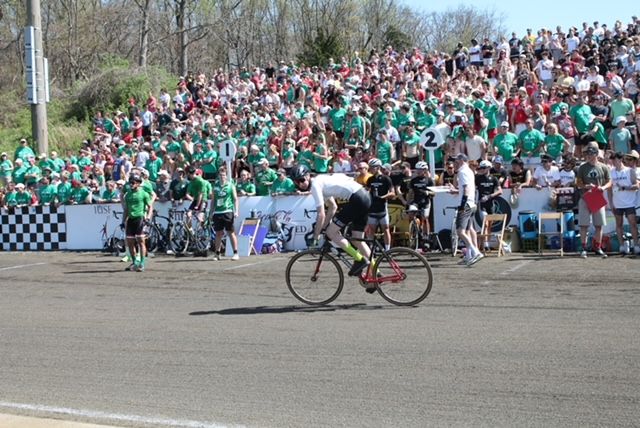
There are some late arrivals to serious gravel now and Jacob 'Jake' Richards is one who has not just ambition, but a plan. The 27-year-old earned a second entry into the wild card field at this year's Life Time Grand Prix series, and wants to be a pro rider. However, he doesn't want to just get paid to ride, but wants "to make a big difference in others' lives".
He'll take the start on Thursday in the pro field at the Sea Otter Classic gravel race, though most eyes will be on 2025 Grand Prix champion Cameron Jones (Scott Sports USA-RCC) and three-time Grand Prix winner and defending Sea Otter Classic winner Keegan Swenson.
The love for cycling captivated Richards as a teenager, and he did several epic rides across the US, including Key West, Florida to Bloomington, Indiana. That led him to a spot on the Grey Goat Cycling team for racing with his older brother in the Little 500 in Bloomington, Indiana (think Cutters in the movie 'Breaking Away'). He won a collegiate title in the Team Pursuit while attending Indiana University. After moving to Utah for a teaching position in 2022, he found some dirt roads to ride in the Ogden area and then competed at the 2023 Unbound Gravel 200 as his first competitive gravel event.
When you see bib number 77 in the Sea Otter Classic this year, that's Richards. He has renewed confidence that he can make a go of a privateer career in off-road races. He spoke to Cyclingnews about his untraditional path to the Life Time Grand Prix wild card selection, balancing training and racing with a full-time job, his love of teaching at the Utah Charter School to inspire his students, and even how he met one of the Cutters growing up in Bloomington.

Cyclingnews: Tell us about growing up in Indiana and how you got involved with cycling.
Jake Richards: Indiana, in general, can be a bit boring, but Bloomington is a bit of a diamond in the rough, especially for cycling. To be honest, there is not a lot to do unless you are into the lake life/hanging at quarries or sports. I played just about every sport I could growing up (baseball, basketball, tackle and flag football, soccer, tennis, hockey, wrestling, golf, cross country, track). My main sport was baseball, playing in competitive travel leagues in the summer, until I learned that you can do more with bikes than ride them around the neighborhood and to the mall with your buddies.
As a kid, I always heard about the Little 500 and had wanted to go so badly. Even my 5th grade engineering teacher was a 'Cutter'. I have talked to him throughout the years, seeing him at different events, and even chatting with him my freshman year about how to be successful with dyslexia, which we both have. Once my older brother joined a team [for the Little 500], I was able to start hanging out with the guys on the team and actually help the team out by being a lap counter and attending my first little 500.
CN: The Little 500 is such a famous amateur cycling event, held at Indiana University, and popularised by the movie "Breaking Away", filmed long before you were born. Tell us about when you first competed as a teen with your brother, even before you were in college.
JR: Over my last several years in high school, I started getting closer with the guys on Gray Goat, even to the point that they invited me to join their winter training trip my senior year. I was able to drive down to Gulfport, Mississippi with the team. It was so cool to be able to feel like a part of the team with my brother. So this really led to my decision to go to IU and race in the Little 5 and be a part of a team with my brother.
We spent so much of our beginning year on the bike training for races together, especially since we both lived at home for a bit in college. He was my main training partner. We were actually on three teams together - Little 5, domestic team, and collegiate team.
I chose to go to IU for the Little 500, even though I was offered a partial scholarship to ride for Marian University. So it may not be as notable to those who don't know the Little 5, but most of my highlights come from this race. Participating in this race is something truly special; competing in front of 20,000+ people on a track is like nothing else, it's like racing your bike in an arena.
CN: So did the movie capture the true essence of the amateur 'Cutter' team versus pros and college teams?
JR: The movie is actually pretty accurate overall. I think the most fictional part is that a non-undergrad student is allowed to participate in the event. Also the fighting between the cutters and the Greek teams is a little exaggerated. There is always a bit of a feud between independent teams and Greek life, but overall, the community now (at least as of when I was in college) was extremely positive.
CN: Even before college, you mentioned your brother inspired you to ride a bike instead of pursuing baseball or other sports. Tell us about your first road bike and what rides you accomplished as a teenager.
JR: When I was in seventh grade, my older brother, Josh, who is two years older than me, decided to go on a bike trip from San Francisco, California to Bloomington, Indiana, with a group called DeCycles. I thought this was the coolest thing in the world, so I started saving up to go the next year. My mom helped me buy my first road bike. This was my first road bike, and I took it on the trip in 2013 from El Paso, Texas to Bismarck, North Dakota. I loved this bike and would still have it as a towny bike if it weren't a 53cm and I’m 6’4”, haha.
I don’t know what my mom was thinking by allowing her 14-year-old kid to ride across the country, but I am so glad that she had that trust in the group and me to do so. This is how I fell in love with the bike and where it can take me. I then continued doing the next four trips, riding from Key West, Florida, to Bloomington; Bloomington to Nova Scotia, Canada; Seattle, Washington to Los Angeles, California; and Los Angeles, California to Bloomington.

CN: When you were at Indiana University, what were your top three cycling highlights?
JR: I completed two out of three goals in college - to qualify and compete in Collegiate Road Nationals, to win the spring series (showing we were the fastest team on the Little 500 track), and to win the Little 500.
I qualified and raced in the 2022 collegiate national championships, for which I had to skip graduation, and my parents drove to Georgia to watch me race. Then it was winning the Little 500 Spring Series. The one I missed was winning the Little 500, which our opportunity was taken from us on the last lap of the ‘21 and ‘22 race by someone crashing us out on the final corner of lap 199 of 200. That isn’t saying that we would have won if we didn’t crash, but we had a really strong team.
My third highlight was being a part of a Team Pursuit Championship team in 2019.
CN: You went from Indiana to Utah, so how did you find the teaching job and a love for off-road riding?
JR: Gray Goat Cycling. The two brothers who started this team, Matt and Ryan Kiel, are also the founders of Two Hoosiers Cyclery that originated in Ogden. They had moved there to work for several cycling companies, including Enve Composites. So I moved to Ogden for the summer of 2019, the shop gave me a mountain bike to ride, and I fell in love with the mountains. I then continued this summer internship until the end of the summer in 2022. I had graduated with a degree in Elementary and Special Education, so when the school year was about to start, I got a job working in a Moderate Special Education Unit in the Ogden School District.
CN: What do you enjoy most about teaching and why you want to continue with this career?
JR: I am currently a teacher at a charter school in a Salt Lake City suburb. I teach 7th, 8th, and 9th grade special education. The classes I cover are Directed Studies, eighth-grade Math, and Reading Interventions. Directed Studies covers Social Skills and Study Skills lessons and allows students to have time receiving help on content in other classes. I can target skills that the students need help with, and I can share my own life stories, which really draws some engagement from the students. This is where I love to share that I race bikes professionally and receive support to do so with my students, so they can see that they, too, can make their dreams come true.
I want to make a big difference in others' lives, and I don’t really see how only racing bikes can have that large an impact. I’ve always said that I want to be professional in a scene that I am paid to ride my bike, and I am extremely stoked to be able to say that I have made that come true.
It can be really hard to be a teacher and race at this level. The schedule for racing seems pretty ideal for racing, but with the majority of Grand Prix events being during the school year, I end up using all my personal time off.
In the summer, when I am not going to school every day, I put on mechanic education nights through my sponsor, Dangerous Pretzel Co., put on Monday night rides called the Pretzel Pedal, and run a GroupMe and Instagram called @Saltlakeridesbikes in attempts to help build some community.

CN: Once you got into off-road in Utah, what was your first real race?
JR: My first gravel race was Unbound 200. Unbound 200 being my first gravel race, it seems a bit unhinged or ignorant. Even though I started out mostly racing road, I was always drawn to ultra-endurance and the dirt. I had done a couple Everests and several 200+ mile rides.
My first Unbound was an eyeopener though. It was the 2023 mud addition with 4-6 miles of running in the first 20 miles of the race. The day went from being top three through the first mud section, to then getting passed in the second, running for several miles while trying to clean the 20+ pounds of mud on your bike, to then getting in the rhythm, to breaking a wheel and limping it to the 100-mile aid station, to almost getting heat stroke and sitting on the side of the road, to getting caught in a thunderstorm, to calling my brother to pick me up because I was so cold, to having my legs come back and passing an insane amount of people, to finishing 74th overall. It was a rollercoaster of emotions.
CN: This year is your second time in the wild card for the Life Time Grand Prix, and that field was stacked with pros like Petr Vakoc, Adam Roberge, Brennan Wertz, Alex Howes. What did you learn in 2025 that will help you this season in the wild card?
JR: The biggest thing I learned is that I am more capable than I think I am. I remember lining up at Sea Otter [last year] being on the wheel of Lachlan Morton, who I have looked up to for many years and feeling over the moon. Alex Howes, in 2019 I watched him at the Tour of Utah.
I learned from racing in these fields that there was a panic moment of everyone trying to figure out their tire selection. I had only brought 2.0 or 45mm tires, but it seemed like everyone was going somewhere in the middle. At Unbound, walking around the expo, I ended up seeing Dylan Stucki, from the 2022 Single Speed Cyclocross World Championships in Durango, and he told me that I am the only one who knows my setup, so what other people run doesn’t matter at all, so run what I am confident in, and that will be the best setup for me. This really gave me the confidence to believe that I am one of the pros, even though I don’t have as much experience, that I am one of the guys that people look to for advice too.
CN: What are your goals this year?
JR: Obviously, I would love to make the selection to be in the Grand Prix, but realistically, my goals lie in my placement in the wild card standings and knowledge learned from the races. Coming from a road background, I am still learning to be less frustrated with the tactics of gravel chasing and group chasing.
Subscribe to Cyclingnews for unlimited access to our gravel cycling coverage in 2026. We'll be on the ground at the biggest races of the season, bringing you breaking news, expert analysis, in-depth features, and much more. Find out more.