Nearly 130 world leaders are descending on New York this week for a UN General Assembly overshadowed by wars in the Middle East and Ukraine, growing concerns over artificial intelligence and fresh questions over whether the United Nations can still command influence in an increasingly fractured world.
US President Donald Trump’s appearance at the General Assembly is set to be among the most closely watched, coming more than a year into his second term and at a time when Washington has sharply reduced its financial support for the UN and pulled out of dozens of its bodies.
The gathering comes with the post-World War Two international order under mounting pressure and the 80-year-old organisation confronting both a financial squeeze and questions about its ability to respond to some of the world’s biggest crises.
Chinese President Xi Jinping will not attend the New York gathering. Xi, whose last address to the General Assembly was delivered virtually in 2021, is instead expected to hold one-on-one talks with Trump in Washington on Thursday.
His absence is likely to add to the wider debate over the UN’s role as major powers increasingly turn to bilateral diplomacy while conflicts that have tested the organisation’s ability to intervene continue.
The leadership question is also moving closer. UN Secretary-General Antonio Guterres is due to complete his term at the end of 2026, with no clear frontrunner yet emerging to succeed him.
The 15-member UN Security Council could hold high-level meetings on Ukraine, artificial intelligence and the Middle East during the gathering, including discussions involving Arab leaders, according to diplomats.
More than a year into Trump's second term, "we would no longer say that the UN is in freefall, but we would say that it's stuck in an open-ended crisis," said Richard Gowan of the International Crisis Group.
"The UN may not be in emergency care like it was last year, but it seems to be trapped in a trauma center for the foreseeable future," Gowan said.
The financial strain remains acute. The United States avoided losing its General Assembly vote after paying $725 million towards the UN’s regular budget this week. Washington, however, still owes the organisation more than $1 billion while continuing to press for spending cuts and reforms.
AI risks move up the agenda
Artificial intelligence is also expected to occupy a prominent place in this year’s discussions, following warnings from several industry leaders calling for a coordinated slowdown in the development of increasingly powerful AI systems.
Those warnings centre on concerns that advanced systems could eventually become capable of improving themselves and move beyond effective human control.
Guterres has called for countries at the forefront of AI development to establish "common guardrails in order to avoid this race to the bottom that could lead one day to a gigantic disaster at the global level."
The UN chief has repeatedly pushed for international governance of AI. The organisation created an advisory body on the technology in 2023, bringing together technology executives, government officials and academics.
The issue has also exposed a sharp difference between Guterres and Trump. The US president has dismissed concerns about AI risks as a "hoax," arguing that there is a "sick conspiracy" against the technology and that China would benefit from doubts surrounding its development.
Middle East war takes centre stage
The escalating conflict in the Middle East is expected to dominate much of the diplomacy in New York, with the US-Israeli war against Iran contributing to global inflation and adding to instability across the region.
Recent gains by Houthi militants have also raised concerns about shipping through the Bab el-Mandeb Strait, a critical maritime route, and the possibility of further pressure on global energy prices.
"It's very difficult to have a military solution for that problem, and the experience of fighting in Yemen demonstrated how complicated it is to have successful interventions," Guterres said, adding that the UN's envoy on Yemen was making a "huge effort" to advance talks.
Diplomatic efforts have yet to produce a breakthrough as Iran and the United States continue exchanging strikes and Trump threatens a major escalation.
Iranian President Masoud Pezeshkian is scheduled to address the General Assembly on Wednesday.
Israeli Prime Minister Benjamin Netanyahu is expected to speak on Thursday. Netanyahu is wanted by the International Criminal Court over allegations of war crimes and crimes against humanity in Gaza, allegations that Israel denies.
Palestinian President Mahmoud Abbas, meanwhile, will again be absent from the gathering in person after the United States denied him a visa. The General Assembly voted on Thursday to allow Abbas to deliver his address by video.
Diplomats also expect a high-level meeting on Sudan on the sidelines of the gathering, although expectations of a diplomatic breakthrough remain low.
Ukraine war enters another UN gathering
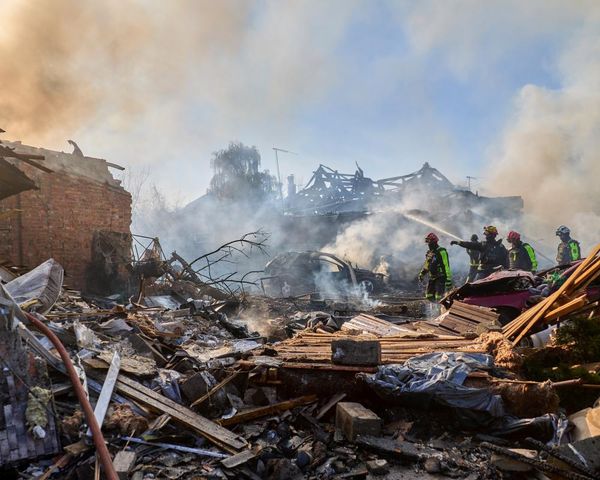
Russia’s war in Ukraine, now more than four years old, will form another major strand of discussions.
Ukrainian President Volodymyr Zelenskiy and Russian Foreign Minister Sergei Lavrov are due to address the General Assembly. Zelenskiy is expected to use the gathering to reinforce international support for Kyiv ahead of another difficult winter.
The Security Council has remained unable to take decisive action to end the war because Russia, one of its five permanent members, holds veto power.
Trump has repeatedly expressed frustration over his inability to broker an end to the conflict after making that a priority when he returned to the White House in January 2025. He spoke with Russian President Vladimir Putin earlier this month, though it remains unclear whether Trump will meet Zelenskiy during the New York gathering.
Beyond the battlefield, Guterres warned that the wars in Ukraine and the Middle East are increasingly converging into broader risks for global food supplies and energy markets.
"The effective blockade existing in the Black Sea is creating enormous problems that add to the problems generated by the Middle East crisis, and I think it would be very important to find a way to allow Ukrainian exports and Russian exports of food, fertilizers and energy to take place in a safe way through the Black Sea," he said.
With wars stretching from Europe to the Middle East, anxiety over AI rising and its own finances under pressure, the UN gathering will therefore be as much a test of the institution itself as an attempt to address the crises confronting its members.