Closing summary
President Volodymyr Zelenskyy’s powerful chief of staff, Andriy Yermak, has resigned after Ukraine’s anti-corruption agencies conducted searches at his apartment. Zelenskyy announced the departure of Yermak, who had been leading the country’s peace negotiations with the US, in a late-afternoon social media video on Friday.
The president praised Yermak but made clear that “there should be no reason to be distracted by anything other than the defence of Ukraine”. Yermak had submitted his resignation, the president said. The search for a successor would begin on Saturday and the office of the president of Ukraine, which Yermak led, would be “reorganised” as part of the process.
A daughter of the former South African president Jacob Zuma has resigned as an MP, after being accused of tricking 17 South African men into fighting for Russia in Ukraine by telling them they were travelling to Russia to train as bodyguards for the Zumas’ uMkhonto weSizwe (MK) party. Duduzile Zuma-Sambudla, 43, the most visible and active in politics of her siblings, volunteered to resign and step back from public roles while cooperating with a police investigation and working to bring the men home, the MK chair, Nkosinathi Nhleko, said at a press conference in Durban.
Belgium has hit back against an EU plan to use Russia’s frozen assets to aid Ukraine, describing the scheme as “fundamentally wrong” and throwing into doubt how Europe will fund Kyiv. In a sharply worded letter, Belgium’s prime minister, Bart De Wever, said the proposal violated international law and would instigate uncertainty and fear in financial markets, damaging the euro.
A spokesman for the European Commission, Guillaume Mercier, told Ukrainian local news station Radio Svoboda on Friday that they were following the corruption investigation closely and the searches showed that Ukraine’s anti-corruption agencies were working. He added that fighting corruption was central to the country’s European Union accession.
Polish authorities have charged five people alleging they acted for foreign intelligence services of an unspecified country and threatened Poland’s security by taking photographs of critical infrastructure and putting up posters and graffiti, the public prosecutor’s office said. The group consists of two Ukrainians (including an teenage girl) and three Belarusians. Four of them have been detained pending trial, with the fifth one only placed under travel restrictions due to his ill health.
German authorities have placed a Ukrainian man in custody who is suspected of damaging the Nord Stream pipelines over three years ago, AP reported. A judge at the Federal Court of Justice in Karlsruhe issued an arrest warrant on Friday for 49-year-old Ukrainian Serhii K. and ordered he be held in custody, federal prosecutors said.
Hungary’s Orbán has met with Russia’s Putin in Moscow in another show of close relations between the two leaders and countries and much to the frustration of the EU. Welcoming him to the Kremlin, Putin praised Orbán’s “balanced” position on Ukraine, after Hungary repeatedly tried to block further sanctions on Russia.
Keir Starmer’s attempt to reset relations with the EU have suffered a major blow, after negotiations for the UK to join the EU’s flagship €150bn (£131bn) defence fund collapsed. The UK had been pushing to join the EU’s Security Action for Europe (Safe) fund, a low-interest loan scheme that is part of the EU’s drive to boost defence spending by €800bn and rearm the continent, in response to the growing threat from Russia and cooling relations between Donald Trump’s US and the EU.
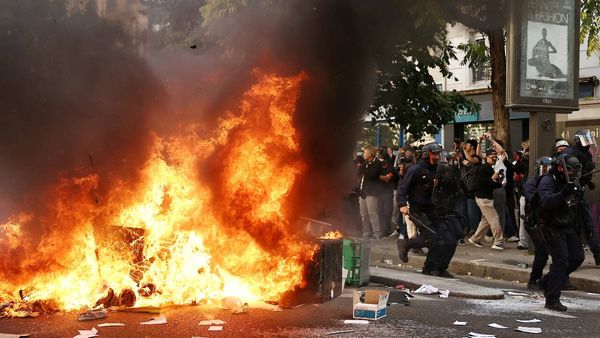
Strikes and protests in Italy on Friday against Giorgia Meloni’s government caused the cancellation of dozens of flights and disrupted train services around the country. The hardline USB union and smaller worker organisations called the one-day action against the government’s plans to raise military spending and its support for Israel.
A spokesman for the European Commission, Guillaume Mercier, told Ukrainian local news station Radio Svoboda on Friday that they were following the corruption investigation closely and the searches showed that Ukraine’s anti-corruption agencies were working.
He added that fighting corruption was central to the country’s European Union accession.
Keir Starmer’s attempt to reset relations with the EU have suffered a major blow, after negotiations for the UK to join the EU’s flagship €150bn (£131bn) defence fund collapsed.
The UK had been pushing to join the EU’s Security Action for Europe (Safe) fund, a low-interest loan scheme that is part of the EU’s drive to boost defence spending by €800bn and rearm the continent, in response to the growing threat from Russia and cooling relations between Donald Trump’s US and the EU.
Entrance to the scheme would have enabled the British government to secure a bigger role for its defence firms. In September, France proposed a ceiling on the value of UK-produced military components in the fund.
The UK and EU had been expected to sign a technical agreement on Safe after establishing an administrative fee from London. But after months of wrangling, and only days before the 30 November deadline for an agreement, sources said the two sides remained “far apart” on the financial contribution Britain would make, Bloomberg reported.
Strikes and protests in Italy on Friday against Giorgia Meloni’s government caused the cancellation of dozens of flights and disrupted train services around the country.
The hardline USB union and smaller worker organisations called the one-day action against the government’s plans to raise military spending and its support for Israel.
Recent years have seen the emergence of the USB as an aggressive grass-roots union which is challenging the traditional dominance of the three main confederations, the left-wing CGIL and the centrist CISL and UIL.
Milan’s Malpensa cancelled at least 27 flights, while Bologna scrapped at least 17. Other affected airports include Milan’s Linate, Naples and Venice.
Italy’s flagship carrier ITA Airways said it had cancelled 26 domestic flights due to the strikes.
Yermak formally dismissed from post
And here’s the official confirmation: the presidential decree formally dismissing Yermak from the post.
Ahead of peace talks earlier this year, my colleague Pjotr Sauer offered this helpful snap profile of Yermak, describing his unprecedented position at the heart of the Ukrainian government:
Andriy Yermak is Ukraine’s presidential chief of staff and widely regarded as the country’s second most powerful figure after the country’s president.
A former entertainment lawyer and film producer, Yermak became a close confidant of Zelenskyy during his media career and joined his political team in 2019.
Since Russia’s full-scale invasion in 2022, Yermak has emerged as a central figure in Ukraine’s wartime leadership.
He oversees foreign policy, intelligence coordination, and high-level diplomacy, including prisoner exchanges and peace negotiations.
His influence is so extensive that he has been dubbed Ukraine’s “Green Cardinal” and “de facto vice-president”. Yermak’s prominence has drawn praise and controversy, with critics accusing him of centralising power.
He’s now gone from the administration.
Yermak’s resignation just hours after his property was raided by anti-corruption agencies is clearly at attempt to quickly move past the controversy which comes at what is probably the worst possible moment for Ukraine as it faces growing pressure from allies and enemies alike, and in particular from the increasingly impatient US administration under Donald Trump.
But let’s make no mistake: this is a massive, massive moment for Zelenskyy and Ukraine.
Updated
'Russia really wants Ukraine to make mistakes,' Zelenskyy says ahead of talks with US 'in near future'
In the speech, Zelenskyy also spoke about the upcoming further peace talks, including meetings with the US “in the near future.”
In a longer passage on the position Ukraine finds itself in, he says that “Russia really wants Ukraine to make mistakes,” but insists: “There will be no mistakes on our part.”
“Our work continues. Our struggle continues. We have no right not to press on. We have no right to retreat or collapse,” he says.
'I want there to be no rumours and speculation,' Zelenskyy says as Yermak resigns
In a speech published on his Telegram channel, Ukraine’s president Volodymyr Zelenskyy has announced a plan to “reboot” his office with his chief aide, Andriy Yermak, resigning from the post.
He says Yermak has submitted his resignation earlier today.
“I am grateful to Andriy for always presenting the Ukrainian position in the negotiation track exactly as it should be. It has always been a patriotic position. But I want there to be no rumors and speculation,” he says.
He will hold “consultations” on who could take over the role tomorrow, he says.
Zelenskyy explained that the move came as Ukraine needed “internal strength” at a time of key talks about a potential peace deal.
Updated
Zelenskyy's closest aide Yermak resigns after property raid
Big, big news from Ukraine.
More in a moment.
Updated
Talks on post-Brexit UK joining EU's SAFE fund collapse
Meanwhile, talks on the UK joining the European Union’s flagship £130bn defence fund have failed, PA Media reported.
Negotiations foundered over how much the UK should pay to participate in the EU’s Security Action for Europe (Safe) rearmament fund, the news agency said.
Reports suggested the post-Brexit UK rejected French demands to pay up to £5bn to participate in the scheme.
Minister for European Union relations Nick Thomas-Symonds said it was “disappointing” but the UK was focused on obtaining “value for money”.
“Negotiations were carried out in good faith, but our position was always clear: we will only sign agreements that are in the national interest and provide value for money,” he said.
PA noted that the Safe scheme will provide up to 150 billion euros in “competitively priced, long-maturity loans” to EU member states requesting financial assistance for investments in defence capabilities, with the UK hoping to be one of the partner countries that could participate in joint procurement exercises, potentially benefiting British firms.
You can find more on this over on our UK blog led by Andrew Sparrow (13:42).
Now, let me bring you some first political reactions from Ukraine after this morning’s news of that Ukrainian anti-corruption agencies searched the property of Volodymyr Zelenskyy’s closest aide, Andriy Yermak.
Oleksandr Merezhko, a lawmaker from Zelenskyy’s party who serves as head of the parliamentary foreign affairs committee, told Ukrainian outlet Glavkom the scandal could have a negative impact on talks, Reuters reported.
Another pro-Zelenskyy lawmaker, Bohdan Yeremenko, went further, writing on Facebook that it would be “impossible to save” Yermak.
“There is no such friendship that would be worth a good name,” he said.
Polish prosecutors charge five people for allegedly acting for foreign intelligence services
Meanwhile, Polish authorities have charged five people alleging they acted for foreign intelligence services of an unspecified country and threatened Poland’s security by taking photographs of critical infrastructure and putting up posters and graffiti, the public prosecutor’s office said.
The group consists of two Ukrainians (including an teenage girl) and three Belarusians. Four of them have been detained pending trial, with the fifth one only placed under travel restrictions due to his ill health.
The prosecutors alleged the group was recruited via online messaging services to act for foreign intelligence services of an unspecified country, with alleged activities taking place between March 2024 and February 2025. They are believed to have been paid in cryptocurrencies. If convicted, they could face jail for between 5 to 30 years.
The arrests come amid a broader crackdown on foreign – primarily Russian – intelligence activities in Poland, after a recent Russian rail sabotage attack on a busy line to Ukraine.
Poland has repeatedly blamed Russia for the attack, accusing it of “state terrorism.”
Updated
Germany places Ukrainian man suspected of Nord Stream explosions in custody
Meanwhile, German authorities have placed a Ukrainian man in custody who is suspected of damaging the Nord Stream pipelines over three years ago, AP reported.
A judge at the Federal Court of Justice in Karlsruhe issued an arrest warrant on Friday for 49-year-old Ukrainian Serhii K. and ordered he be held in custody, federal prosecutors said.
K. arrived in Germany on Thursday after Italy’s highest court approved his extradition earlier this month. He was detained on a European arrest warrant in August at a campground near the Adriatic coastal city of Rimini, Italy, where he was vacationing with his family.
In contrast, in October, a Polish court blocked the extradition to Germany of another Ukrainian man suspected of involvement in the 2022 attack on the Nord Stream gas pipeline and ordered his release.
Belgium's de Wever worried about using frozen Russian assets in case of Russian war victory
in Brussels
In language that will dismay many of Ukraine’s EU backers, the Flemish nationalist also suggested in his letter that Ukraine could lose the war.
“In the very probable event Russia is ultimately not officially the losing party, it will, as history has shown in other cases, be legitimately asking for its sovereign assets to be returned,” De Wever said.
EU leaders failed to agree on the idea in October, but are under added pressure to finalise the plan after the White House revealed its thinking on Russia’s frozen assets, which are mostly held in Europe, above all Belgium.
The controversial US-led 28-point plan that emerged last week proposed that $100bn (£76bn) in frozen Russian assets would be invested in “US-led efforts to rebuild and invest in Ukraine”, with the US reaping 50% of profits from the venture. The rest of Russia’s frozen assets would be invested in a US-Russian investment vehicle focused on joint projects.
These ideas are understood to have been removed from the latest version of the plan to end the war, but have underscored for European leaders the urgency of acting quickly.
“The US proposal has maybe sharpened some European minds,” Latvia’s former prime minister Krišjānis Kariņš told the Guardian, saying he had been taken aback by the original proposals on the funds.
There had been “the realisation that things could go very, very differently [so] better to keep those funds under European control and therefore take some decisions in Europe which would preclude anyone else getting their hands on the assets”, he said.
The assets are seen as a key element of upping pressure on Russia, as well as a means of funding Ukraine’s defence at a time when many EU governments are grappling with tight budgets or deficits.
EU leaders are due to discuss the idea at a summit on 18 and 19 December, having already pledged to meet Ukraine’s funding needs. Kyiv is estimated to need €136bn to maintain its defence and keep the country running in 2026 and 2027.
The Belgian government said it wanted to see a legal text and has faulted the lack of detail about risk-sharing with the other 26 member states if the plan goes wrong.
Brussels has also called for legal proposals on common EU borrowing to fund Ukraine, using unspent funds in the EU budget as the guarantee. De Wever argues this option would be cheaper than using the assets, once the risks are factored in.
The commission has suggested money for Ukraine could be funded by common borrowing on capital markets, but member states are unenthusiastic.
Germany, Sweden, as well as central and eastern European states and von der Leyen, argue the frozen assets plan is the best option.
Let’s bring you a bit more on de Wever’s letter on frozen Russian assets, from Jennifer Rankin.
Both leaders also took a swipe at Viktor Orbán for his visit to Moscow.
Merz said that the EU leaders “have been aware of Viktor Orbán’s position for years,” recalling his visit to Moscow last years, just days after assuming the EU presidency, which he said was unsuccessful and followed by brutal attacks on Ukraine.
“He’s travelling without a European mandate and without consulting us,” he stressed.
Picking up this theme, Golob said that the Hungarian leader “has not played with the European team for some time and that visit comes within that context.”
Germany's Merz says agreeing on frozen Russian assets is 'increasingly urgent'
But other countries are growing impatient, with German chancellor Friedrich Merz saying today that he saw the need to use frozen Russian assets as “increasingly urgent.”
Speaking alongside Slovenian prime minister Robert Golob, Merz said that “Ukraine needs our support [as] Russian attacks are intensifying” ahead of winter.
“I hope that we can come to a joint solution within the European Union,” he said.
Merz added that he discussed this also bilaterally with de Wever, saying he thinks his arguments are “valid,” but adding: “I believe we also have valid arguments to achieve our shared goal, to exert maximum pressure on Russia to end this war.”
He said that Russian threats, of legal action and others, are “not unfamiliar to us,” but insisted the use of frozen asserts was the right idea.
Responding for Slovenia, Golob said the latest proposal discussed by him with Merz on frozen assets is “a very good compromise,” and he insisted that getting to an agreement with Belgium remained in his view possible.
Commission 'trying to make sure concerns ... are addressed' on use of frozen Russian assets
For what it’s worth, the European Commission’s spokesperson Paula Pinho confirmed the commission received de Wever’s letter at her press briefing earlier today.
She said the commission was finalising its proposal, and has consulted extensively with its in-house legal teams.
“We have a very solid, excellent team of lawyers in the Commission, as you know, who has given many … examples of its excellence. So we are fully confident [about] our teams of lawyers who are part of the commission staff,” she said.
She added:
“What we are trying to do is to really make sure that the concerns that have been expressed and notably by Belgium and the prime minister are addressed in a satisfactory manner, so that everybody is comfortable with the positions that are being put forward by the commission.”
Belgium hits back at calls to use Russia's frozen assets to fund Ukraine
in Brussels
Meanwhile, Belgium has hit back against an EU plan to use Russia’s frozen assets to aid Ukraine, describing the scheme as “fundamentally wrong” and throwing into doubt how Europe will fund Kyiv.
In a sharply worded letter Belgium’s prime minister, Bart De Wever, said the proposal violated international law and would instigate uncertainty and fear in financial markets, damaging the euro currency. “These risks are unfortunately not academic but real,” he wrote to European Commission president Ursula von der Leyen.
As well as “systemic risks for the EU as a financial marketplace” De Wever warns about Euroclear being sued by Russians with a claim on the assets, landing the Belgian government with the multi-billion euro bill.
He insists he will not sign off on the scheme unless all Belgium’s concerns are addressed including “a full guarantee to be provided by willing member states” if the loan goes wrong, according to the letter seen by the Guardian, which was first reported by Politico.
The Flemish nationalist leader also argues that moving forward with the reparations loan plan would prevent the EU from reaching a peace deal, because the Russian assets would not be available for the reconstruction of Ukraine.
Belgium hosts €183bn of Russian assets, around two thirds of Russian assets immobilised in the west, at the Brussels-based central securities depository Euroclear.
The intervention comes amid growing pressure on the EU to agree the use of Russia’s frozen assets to aid Ukraine, after a US-led plan to end the war called into question Europe’s control of the funds.
The commission is expected to imminently present a draft legal text on using Russian assets immobilised in Europe as the basis for a €140bn (£122bn) loan for Ukraine.
Updated
Putin praises Orbán's 'balanced' position on Ukraine as they discuss energy deliveries
Meanwhile, Hungary’s Orbán has met with Russia’s Putin in Moscow in another show of close relations between the two leaders and countries and much to the frustration of the EU.
Welcoming him to the Kremlin, Putin praised Orbán’s “balanced” position on Ukraine, after Hungary repeatedly tried to block further sanctions on Russia.
He also said he would still be happy for his next summit with the US president, Donald Trump, to take place in the Hungarian capital, Budapest, as briefly discussed in October.
For his part, Orbán insisted that Russia remained part of “Hungary’s energy supply now and will remain so in the future,” once again despite EU’s plans to phase out this source.
Updated
The Commission also totally rejected dismissed Russia’s criticism of Volodymyr Zelenskyy as “illegitimate” leader of Ukraine, after Vladimir Putin suggested yesterday that was a technical reason he couldn’t agree a peace deal with Zelenskyy.
“President Zelensky is the democratically elected president, by the Ukrainian people, of Ukraine,” a commission spokesperson said in response, somewhat mockingly adding that Putin seems to have “some difficulties in recognising the democratically elected president of his neighbour country, Ukraine.”
EU will 'follow situation very closely,' but searches show anti-graft agencies are working
The European Commission has very cautiously responded to the reports coming from Kyiv at its daily midday briefing.
EU chief spokesperson Paula Pinho noted the searches, stressing they were “ongoing” and said that these actions “show that the anti-corruption bodies in Ukraine are doing their work.”
Enlargement spokesperson Guillaume Mercier followed the same line, saying that the probe “showed precisely that the anti-corruption bodies are actually in place and they’re allowed to function.”
He added:
“Let me stress the fight against corruption is a key element for a country to join the EU, it requires continuous efforts and a strong capacity to fight corruption. This is a key element that we also address in our enlargement report that was published a couple of weeks ago, so we will continue to follow the situation very closely.”
Updated
Ukraine’s anti-corruption agencies search home of Zelenskyy’s chief aide — first story
in Kyiv
Ukraine’s anti-corruption agencies have said they are conducting searches at the home of Volodymyr Zelenskyy’s powerful chief aide and lead negotiator in the latest round of peace talks, Andriy Yermak.
Journalists filmed about 10 investigators entering Kyiv’s government quarter in a widening of the investigation into a nuclear energy kickback scandal allegedly run by an associate of the Ukrainian president who has fled the country.
The scandal first emerged earlier in November, but after days of damaging revelations, it dropped down the news agenda when Donald Trump unexpectedly released a pro-Russian 28-point peace plan.
But Friday’s developments will thrust the scandal back into the spotlight just as Ukraine had been carefully wooing the White House on a 19-point counterproposal, with Yermak fronting talks in Geneva with the US secretary of state, Marco Rubio.
Zelenskyy himself has denounced the scheme. However, questions have been raised about how much senior figures in government knew about what was happening, given how many have been accused of involvement.
And let’s go back to Dan Sabbagh in Kyiv for his first story on this morning’s news.
Political analyst Viktor Shlinchak, of the Kyiv-based Institute for World Politics, described the searches as a “Black Friday” for Yermak and suggested Zelenskyy may be forced to dismiss him.
“It looks like we may soon have a different head of the negotiating team,” he wrote in a Facebook post, quoted by Reuters.
'Everyone will be watching this very closely' — snap reaction
in Kyiv
Hello Jakub, it’s Dan Sabbagh just walking down the streets in Kyiv.
What to say about this extraordinary news? It’s clearly very significant that Andryi Yermak’s apartment in the government district in the heart of Kyiv has been searched by officers from Ukraine’s powerful NABU anti-corruption agency.
But the question is, what will happen next? It certainly, on the face of it, looks like a widening of the corruption investigation relating to allegations of kickbacks demanded of contractors of the state nuclear energy company, Energoatom.
But of course we don’t know what the outcome of these searches will be and it may well be that the corruption investigators will conclude there’s nothing to see here. So the situation is balanced.
Everyone in Ukraine will be following developments closely. There’s a lot of anger, of course, because of this moment in the war as most Ukrainians in Kyiv, for example, are enduring power outages many hours a day because of the Russian bombing. And so the whole allegation of kickbacks in the most important electricity company, nuclear energy being the most important, it’s a very serious one.
But for now, the outcome is unclear. Andriy Yermak is President Zelenskyy’s most important aide, the head of his office, inseparable from him since the early days of the invasion and indeed throughout.
Zelensky has always stood by Yermak, and there’s no immediate sign of that changing, but everyone will be watching very closely.
Yermak's property search will have huge repercussions for Ukraine and potentially peace talks — snap reaction
The revelations that anti-corruption police are searching the property of Volodymyr Zelenskyy’s chief of staff Andriy Yermak will have huge repercussions for the Ukrainian political scene and possibly for peace negotiations as well.
It is hard to overstate the significance of Yermak in the Ukrainian political system.
He combines multiple roles for Zelenskyy: most trusted sounding board, domestic political enforcer, controller of access to the president, main point of contact for foreign politicians and chief peace negotiator.
Yermak is such a powerful chief of staff that people who know how the president’s office operates describe his relationship with Zelenskyy as symbiotic.
Those who have dealt with Yermak, both inside and outside Ukraine, describe him as a workaholic and a ruthless operator, who has moved against alternative centres of political influence in the country and has systematically worked to acquire political power.
With such influence inevitably comes enemies, and there are few in the Ukrainian elite who have a positive view of Yermak, though many admire his work ethic and political skills.
Foreign politicians have often appreciated knowing they can use Yermak as a direct line to the president, but some have found him a frustrating interlocutor, and figures in the Trump White House are known to have expressed a preference for dealing with Rustem Umerov, the current head of Ukraine’s security council, over Yermak.
Up to now, Zelenskyy has always resisted calls to fire Yermak or even clip his wings, but if he is now caught up in a corruption scandal, these are likely to get louder. Politically, getting rid of his chief of staff might be Zelenskyy’s smartest move, but those who know both men say the relationship is so close it’s hard to imagine Zelenskyy taking that step.
“I suppose it’s theoretically possible that Zelenskyy could function without him but in practice I can’t imagine that ever happening,” one former senior official told me a couple of months ago.
Updated
Hungary's Orbán expected to visit Putin for talks on energy, Ukraine
Another big story happening today is Hungarian prime minister Viktor Orbán’s unexpected visit to Moscow, where he is due for talks with Russia’s Vladimir Putin on energy supplies and ending the Ukraine war.
“I am going there to ensure that Hungary’s energy supply is secured for the winter and the following year at an affordable price,” Orbán said in a video uploaded to Facebook.
Hungary has been Russia’s closest ally in the EU, repeatedly criticising the bloc’s response to the Russian aggression on Ukraine, calling for more engagement with Moscow and for sanctions to be lifted.
AFP noted that since returning to power in 2010, Orbán has met Putin 15 times, including four times since the full-scale invasion in 2022.
The Hungarian prime minister is facing a tricky parliamentary election early next year, with his Fidesz party trailing behind the pro-EU opposition forces in the polls, which may explain why he is looking for successes wherever he can find it.
If you’re wondering how serious for Ukraine and Zelenskyy this could get, let’s just say that Yermak has overnight literally fronted Ukraine’s response to the latest peace talks, with an interview in The Atlantic magazine in the US.
Characterised as “Zelenskyy’s chief of staff, lead negotiator and closest aid throughout the full-scale war with Russia,” Yermak insisted that “not a single sane person today would sign a document to give up territory.”
“As long as Zelensky is president, no one should count on us giving up territory. He will not sign away territory,” he told the magazine by telephone from Kyiv.
He was also directly involved in the talks in Geneva over the weekend.
Updated
Morning opening: Zelenskyy's number two sees apartment searched as part of anti-graft probe
Ukrainian anti-corruption authorities are searching properties linked to president Volodymyr Zelenskyy’s powerful chief of staff Andriy Yermak.
In a post on Telegram, Yermak confirmed the authorities were given “full access” to his apartment, and that he is cooperating with the officers, with his lawyers present.
In a joint statement, the National Anti-Corruption Bureau of Ukraine and the Specialised Anti-Corruption Prosecutor’s Office said the searches were “authorised” and linked to an unspecified investigation.
“NABU and SAPO are conducting investigative actions (searches) at the head of the Office of the President of Ukraine,” they said. “Investigative actions are authorised and are being carried out within the framework of an investigation.”
It was not immediately clear what was the investigation about.
Reuters noted that erlier this month, the two agencies unveiled a sweeping investigation into an alleged $100m kickback scheme at the stage atomic energy company, involving Zelenskyy’s ex-business partner.
While Yermak has not been named a suspect in the investigation, but opposition lawmakers and some members of Zelenskyy’s own party had called for his dismissal as part of Ukraine’s worst wartime political crisis, the agency said.
Earlier this year, Ukraine had been engulfed in a political crisis over Zelenskyy’s controversial plans to reform the anti-corruption authorites, which ultimately had to be reversed after intense international criticism, including from the European Union, which continues to say that the fight against corruption remains one of Ukraine’s key task on its path to join the bloc.
The searches come at a tricky time for Ukraine amid growing pressure from the US to agree to a peace deal with Russia, and any perceived or real sense of wrongdoings at the top of the government could undermine Ukraine’s position further.
This could be explosive.
I will bring you all the key updates throughout the day.
It’s Friday, 28 November 2025, it’s Jakub Krupa here, and this is Europe Live.
Good morning.