Get all your news in one place.
100's of premium titles.
One app.
Start reading
The Independent UK
The Independent UK
Technology
Anthony Cuthbertson

UK rocket startup demonstrates world first plasma in nuclear fusion breakthrough

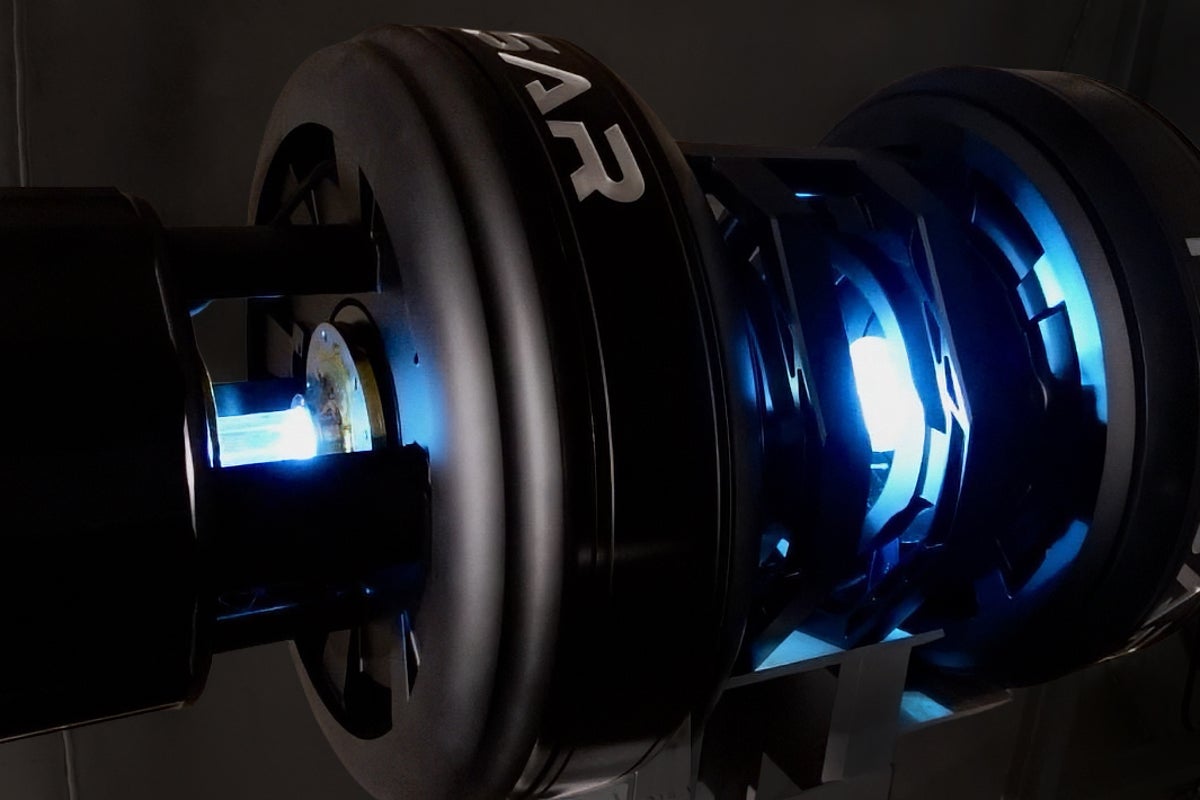
Pulsar Fusion achieved its 'first plasma' in its Sunbird nuclear fusion exhaust test system - (Pulsar Fusion)

A team of British scientists has achieved the first ever plasma ignition inside a nuclear fusion rocket, marking a major milestone towards a new era of interstellar space travel.

Bletchley-based Pulsar Fusion demonstrated the breakthrough during a remote live stream at Amazon’s MARS conference in California this week, with CEO Richard Dinan describing it as an “exceptional moment” for his company.

The first plasma was achieved using a combination of electric and magnetic fields to guide the charged particles through the startup’s Sunbird nuclear fusion exhaust test system.

Further experiments and upgrades are now planned to improve the efficiency of the next-generation propulsion system.

Nuclear fusion involves mimicking the same natural reactions that occur within the Sun in order to produce near-limitless energy, with some describing it as the “holy grail” of clean energy.

Harnessing the super-hot plasma within an electromagnetic field has proved immensely difficult, however the extremely cold temperatures and near-perfect vacuum conditions of space mean it could be easier to achieve there than on Earth.

If it is achieved, fusion propulsion could offer 1,000 times the power of conventional thrusters currently used in orbit, with a theoretical top speed for a rocket of around half a million miles per hour (800,000kph).

A working nuclear fusion rocket would cut journey times to Mars from months to weeks, making missions to the Red Planet far more feasible.

The shortened journey time would also reduce the harmful health risks that astronauts are exposed to, such as space radiation and extended periods of microgravity.

“With the space economy projected to exceed $1.8 trillion by 2035, faster in-space transport isn't just a scientific goal; it's an economic one,” read a statement from Pulsar Fusion following the latest breakthrough.

Pulsar Fusion's next steps for its Sunbird exhaust system include performance testing, superconducting magnet upgrades, and eventually experiments with new types of fuel cycles.

Pulsar Fusion began constructing its nuclear fusion rocket in 2023 (Pulsar Fusion)

tk

Sign up to read this article
Read news from 100's of titles, curated specifically for you.
Already a member? Sign in here
Related Stories
Top stories on inkl right now
Our Picks
Fourteen days free
Download the app
One app. One membership.
100+ trusted global sources.