Get all your news in one place.
100's of premium titles.
One app.
Start reading
International Business Times UK
Stephanie Cruz

UK Lands First G7 Gulf Trade Deal Worth £3.7B — Without a Human Rights Clause

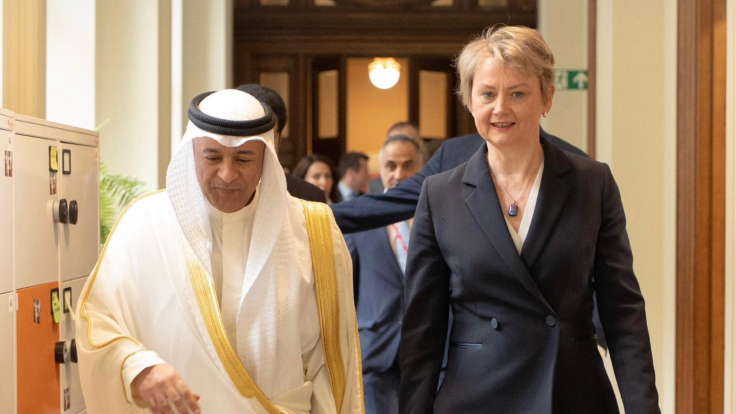
GCC Secretary General Jasem Mohamed Albudaiwi and UK Foreign Secretary Yvette Cooper in London on 20 May 2026, following talks on the newly concluded Gulf-British free trade agreement. (Credit: GCC General Secretariat Website)

Britain has signed a free trade agreement with the Gulf Cooperation Council that the government says will add £3.7 billion ($4.9 billion) a year to the UK economy, making it the first G7 nation to secure such a deal with the six-member bloc. The agreement covers Bahrain, Kuwait, Oman, Qatar, Saudi Arabia, and the United Arab Emirates.

It does not include a human rights clause.

The deal, announced on 20 May, is projected to lift domestic wages by £1.9 billion ($2.5 billion) annually over the long term and strip away an estimated £580 million ($770 million) in tariffs on British exports once fully implemented, CNBC noted. Of that, £360 million ($478 million) in duties will be removed from day one.

Negotiations started four years ago. At the time, the projected GDP boost was £1.6 billion ($2.1 billion). The final terms more than doubled that figure, with negotiators understood to have exceeded original expectations on tariff liberalisation.

Prime Minister Sir Keir Starmer called the agreement 'a huge win for British business, and for working people who will feel the benefits in the years ahead through higher wages and more opportunities.'

£580M in Tariffs Scrapped on British Exports to Gulf

The GCC imports roughly 85% of its food. Under the deal, British exports, including cereals, cheddar cheese, chocolate, and butter, are expected to become tariff-free. Medical equipment and advanced manufacturing also fall under the new terms.

For the first time in a GCC trade agreement, the bloc has committed to allowing the free flow of data. That means UK firms operating in the Gulf will no longer need to build costly local data centres to store information in the region. The agreement also contains first-of-their-kind GCC commitments on anti-corruption, in a chapter covering animal welfare, the environment, innovation, labour, and women's economic empowerment.

Prime Minister Sir Keir Starmer labels the agreement 'a huge win' for the British business. (Credit: Simon Dawson / No 10 Downing Street, OGL 3 , via Wikimedia Commons)

Current bilateral trade between the UK and the GCC stands at roughly £53 billion ($70.4 billion). The deal is projected to increase that figure by 20%, with British exports making up two-thirds of the growth, the BBC reported. Demand for imports into the GCC is forecast to double by 2050.

The services sector accounts for about 80% of the British economy and more than half of UK exports to the Gulf. Trade Secretary Peter Kyle described the GCC as 'an important and growing set of markets' and called the agreement a signal of confidence at a time of global instability.

This is the fifth major trade deal struck under Starmer's government, following agreements with India, the United States, the European Union, and South Korea.

Rights Groups Warned Against a Deal Without Protections

The government chose not to seek a dedicated human rights clause, a decision that drew sharp criticism well before the ink was dry. Human Rights Watch and 13 other organisations published a joint statement in September 2025 calling on the government to embed strong human rights conditions before signing. They warned that the deal risked contributing to abuses against migrant workers, including wage theft, employer exploitation, and conditions amounting to forced labour.

The criticism cut close to home for Labour. While in opposition in June 2022, the party publicly attacked the Conservative government for dropping human rights and rule-of-law provisions from the same GCC negotiations. Labour's shadow international trade secretary at the time accused the Conservatives of acting 'as though human rights and the rule of law are optional extras, to be discarded at will, rather than principles and values that are fundamental to what we stand for as a country.'

The government has said it considers human rights issues best addressed through diplomatic and political channels rather than trade agreements. The deal preserves the UK's right to regulate, with no requirement to alter domestic standards.

Chancellor Rachel Reeves said the agreement would 'open up a world of economic opportunity' and described it as proof that Britain is backing its firms to compete globally.

Sign up to read this article
Read news from 100's of titles, curated specifically for you.
Already a member? Sign in here
Related Stories
Top stories on inkl right now
One subscription that gives you access to news from hundreds of sites
Already a member? Sign in here
Our Picks
Fourteen days free
Download the app
One app. One membership.
100+ trusted global sources.