Get all your news in one place.
100’s of premium titles.
One app.
Start reading
The Independent UK
The Independent UK
Arpan Rai

Western and Russian envoys clash in rival op-eds ahead of Putin’s visit to India

Vladimir Putin was due to arrive in Delhi on Thursday evening to hold talks with Indian prime minister Narendra Modi at a delicate juncture for the long and largely warm relations between the two countries.

The tension around the Russian president’s trip was exemplified by not one but two rare op-eds run by a major Indian newspaper from serving envoys of foreign powers.
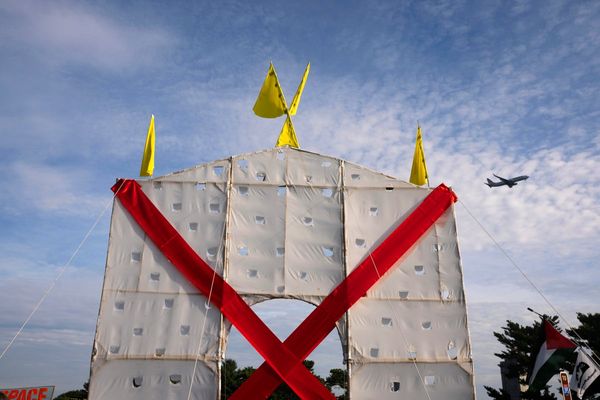
In a joint article for the Times of India, British high commissioner Lindy Cameron, French ambassador Thierry Mathou and German ambassador Philipp Ackermann denounced Mr Putin over the war in Ukraine, putting Delhi in an awkward position ahead of the president’s trip.

In his first visit to one of Moscow’s key traditional allies since the Ukraine war began in early 2022, Mr Putin was expected to pitch increased sales of Russian oil, missile systems and fighter jets.

Accusing the Russian leader of escalating the war in Ukraine even while peace talks were underway, the European envoys claimed Moscow had launched 22 of the “largest air attacks of the entire war” since the talks began.

“These are not the actions of someone that’s serious about peace. Neither are these indiscriminate attacks mere accidents,” they said, “they are a systematic choice by Russia to wage its war of aggression with absolute ruthlessness. And it must end.”

Mr Putin, the European diplomats argued, was “the one leader who could end the war any time he so wishes”.

They also accused Russia of making incursions into European airspace, sparking concern in Nato countries.

In the wake of drone sightings near sensitive facilities, such as airports, in multiple European nations in recent months, a senior Nato military official warned that the alliance was considering “pre-emptive” action against Russia.

Admiral Giuseppe Cavo Dragone, chief of the Nato Military Committee, accused Russia of conducting a campaign of drone incursions and cyber attacks in Europe and said that the alliance, led by the US, could adopt a more “aggressive” approach to deter the “hybrid attacks”.

Financial Times reported recently that Nato had been put on high alert after three vessels in the Baltic Sea were suspected of dragging their anchors in an attempt to damage energy and communication cables.

In another swipe, the envoys claimed that Russia continued “to try to exploit and undermine trust in key democratic institutions, including elections, independent media, civil society and the rule of law, to further their own interests”.

“Russia’s malign global activity, including through cyberattacks and disinformation, shows us that the Russian leadership’s appetite for territorial expansion and global destabilisation goes well beyond Ukraine,” they wrote.

The op-ed and its timing alarmed Indian strategic affairs analysts. “This vicious article against Russia just before Putin’s state visit to India breaches diplomatic norms, is a diplomatic insult to India as it questions India’s close ties with a very friendly third country,” Kanwal Sibal, former Indian foreign secretary, said on X.

The Independent contacted the Indian foreign ministry for comment but did not receive a response.

Suhasini Haidar, diplomatic affairs editor for The Hindu newspaper, said that foreign ministry officials “expressed their displeasure to the media, saying it was ‘not acceptable’ for envoys to comment publicly on a third country, but did not demarche the envoys themselves”.

Not long after, the Times of India published another op-ed, this time by Russian ambassador Denis Alipov, who said it was “necessary to set the record straight” on “grossly distorted account of the conflict in Ukraine”.

Mr Alipov described the piece by his European counterparts as “yet another attempt to mislead the Indian public about the origins and context of the crisis”.

“It was Russia, in fact, that never sought this war,” the envoy wrote. “By contrast, it was Europe and the Obama administration that precipitated the Ukrainian conflict in 2014 by supporting a coup d’état that overthrew the legitimate president, Viktor Yanukovych, in order to turn Ukraine into a bulwark against Russia.”

He said the former Ukrainian president had negotiated a settlement with the violent street protesters seeking to overthrow him and that it was “an agreement guaranteed by high European representatives”.

“They betrayed that commitment before the ink on the document had even dried,” the ambassador said. “Yanukovych was forced to flee for his life to avoid being lynched by neo-Nazi mobs. This was the first act of European treachery in the unfolding Ukrainian tragedy.”

Mr Alipov also levelled serious allegations against former British prime minister Boris Johnson.

“Immediately after the outbreak of hostilities, Russia sought negotiations with Ukraine to reach an early settlement,” he wrote. “Delegations from both countries met in Istanbul to finalise an agreement. When the talks were nearing completion in April 2022, then British PM Boris Johnson arrived in Kiev and dissuaded Zelenskyy from signing the deal. This was the third European treachery.”

The ambassador decried Europe’s “hypocrisy”, which he said was “on full display in its efforts to sabotage the peace plan proposed by US president Donald Trump”.

“Against the backdrop of Trump’s outreach to President Putin and their Alaska meeting in August for peace negotiations, Europe has exposed itself as the true warmonger – and the chief obstacle to peace in Ukraine,” Mr Alipov said. “This was the fourth European treachery.”

A man cycles past a hoarding with images of Vladimir Putin and Narendra Modi in Delhi on 4 December 2025 (Reuters)

Mr Putin is arriving with defence minister Andrei Belousov and a sizeable delegation of business leaders.

Michael Kugelman of the American think tank Atlantic Council said the visit “offers an opportunity for Delhi to reassert the strength of its special relationship with Moscow, despite recent developments, and make headway in new arms deals”.

Delhi is likely to discuss the purchase of more S-400 air defence systems among a raft of energy and defence deals.

Indian officials, though, worry that any energy or defence deal may trigger a reaction from the US.

In August, president Donald Trump doubled import levies on India as punishment for its purchases of Russian crude.

Ahead of Mr Putin's visit, Indian and Russian officials held discussions for deepening cooperation in areas from defence to shipping and agriculture.

The two sides had agreed in August to start talks on a free trade deal between India and the Eurasian Economic Union led by Russia. They are also in talks to expand the partnership in civilian nuclear energy, Indian analysts say.

Recent US-Russia talks to end the Ukraine war could make it easier for New Delhi to engage with Moscow, said Harsh Pant, head of foreign policy studies at the Observer Research Foundation think tank.

“A large part of the trading relationship was based on energy, which is now losing traction under the threat of sanctions from the US," he added.

"And at the end of the day, only defence remains, which continues to bind the two together.”

Sign up to read this article
Read news from 100’s of titles, curated specifically for you.
Already a member? Sign in here
Related Stories
Top stories on inkl right now
One subscription that gives you access to news from hundreds of sites
Already a member? Sign in here
Our Picks
Fourteen days free
Download the app
One app. One membership.
100+ trusted global sources.