
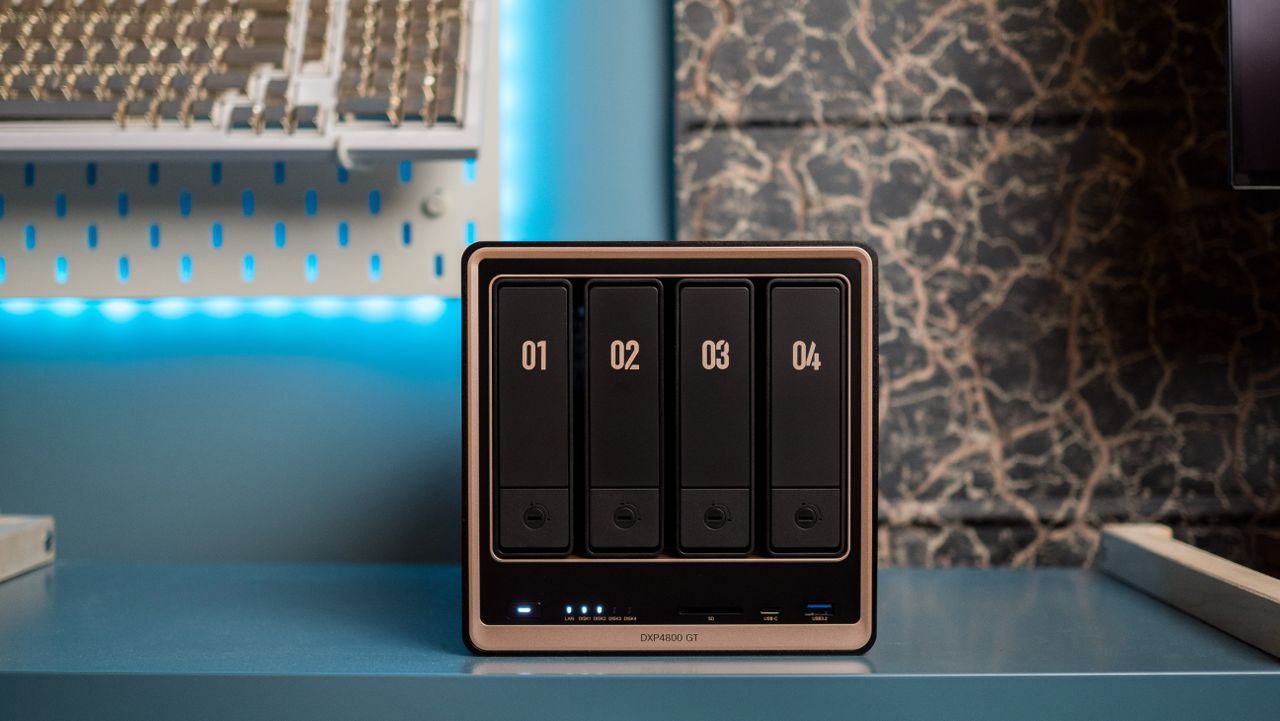
I just tested the DXP4800 Pro, and my key takeaway of that 4-bay NAS is that it has everything you need if you need to buy a home server in 2026. So when UGREEN said that it's coming out with a new 4-bay model, I was intrigued. The DXP4800 GT just made its debut, and I've been using the NAS alongside the DXP4800 Pro and the ZimaCube 2, and after two weeks of testing, it's easy to say that this particular NAS server is unique in several ways.
Think of the DXP4800 GT as the creator-focused model in the DXP4800 series. The DXP4800 Plus is powered by the Intel Pentium Gold 8505 platform and costs $619 on Amazon, the DXP4800 Pro gets the Intel Core i3-1315U and retails at $679, and the DXP4800 GT uses AMD's Ryzen Embedded R2514 and is making its debut at $659. As is always the case with UGREEN products, there's a decent $70 discount at launch, bringing the price down to $589 — you get the same deal when buying the NAS on UGREEN's site. If you don't need four drive bays, there's also a DXP2800 GT that's being introduced alongside the DXP4800 GT, and that model costs $509.

Regardless of what model you're considering, you get 10 Gigabit Ethernet connectivity as standard, along with 8GB of pre-installed memory, and the ability to slot in a total of 144TB of storage — each of the four drive bays holds a maximum of 32TB, and the two M.2 slots can take in 8TB SSDs. You also get an SD card reader, HDMI out, USB-C with 10Gbps bandwidth, and USB-A 3.2 Gen 2 ports.
The DXP4800 GT is being positioned at creators, and it has a few key differences from the DXP4800 Plus and DXP4800 Pro. The biggest change is the inclusion of two 10 Gigabit Ethernet ports, which make the DXP4800 future-proof. While the other two models get Intel, the GT is powered by the AMD R2514, and unlike other AMD models, this has an integrated Vega 8 GPU, enabling hardware-assisted transcoding. The R2514 platform is fabricated on a 12nm node, and includes four cores and a max turbo of 3.7GHz with base clocks of 2.1GHz.
Another change on the DXP4800 GT is ECC memory and U.2 NVMe SSD integration. While it's good to see UGREEN offer these features, the installed 8GB memory in the NAS isn't ECC-compatible, so you'll need to switch it out with an ECC memory module if you want to use the feature. The NAS uses DDR4 memory instead of DDR5 like the Plus and Pro, and you can install a total of 64GB. And as for U.2 NVMe integration, the SATA1 and SATA2 drive bays can slot in these 2.5-inch SSDs if you want to go that route instead of traditional HDDs.
Lastly, the DXP4800 GT gets pre-installed storage that houses the UGOS Pro software, but unlike the DXP4800 Plus and Pro models — which have 128GB SSDs — you get a 64GB eMMC instead. Similarly, the M.2 SSD slots use PCIe Gen 3x2, so you can't slot in faster Gen4 SSDs in the NAS. I get that Gen3 drives are good enough, but as this is being targeted at enthusiasts, Gen4 connectivity would have been much better.
Oddly enough, for a NAS positioned as a creator-focused product, there's no Thunderbolt 4 connectivity. This is where a NAS like the ZimaCube 2 wins out with its two Thunderbolt 4 ports, and I would've liked UGREEN to include at least one port.
What does all of this translate to in everyday use? The DXP4800 GT has proven to be just as capable as its siblings, and I didn't see any problems with the NAS. The software has identical features, and I was able to use Docker containerization to install utilities I wanted — including Plex and Jellyfin. The AMD platform is more than adequate for a NAS server, but I'd suggest adding another 8GB of RAM if you want to use it as a homelab.
Traditionally, AMD-based NAS models missed out on hardware transcoding, but that thankfully isn't the case on the DXP4800 GT. The NAS handles 4K transcoding in Plex without any issues, and even if you have several client devices, there won't be a bottleneck — I got 4K HDR streams playing simultaneously on four devices at once.
The UGOS Pro software is decent enough, but it doesn't quite have the same feature-set as other NAS models in this category. The plus point is that you can install TrueNAS or any of its derivatives without too much of a hassle.
The design of the DXP4800 GT itself is similar to the DXP4800 Pro and Plus, and the only difference is the gold accents at the front. I do like how the accents contrast the gunmetal chassis, but other than that, it has the same dimensions, and the same weight. The metal chassis is built to last, and you get the same magnetic dust filter at the rear.
To sum up, I think the DXP4800 GT is a good choice if you need two 10GbE ports. The AMD platform holds its own against the Intel-based NAS servers in this category, and the ability to add ECC memory or U.2 SSDs is a decent enough differentiator. However, if you don't need those niche features, the DXP4800 Pro is the better choice — it has faster M.2 storage slots, faster RAM, and you still get 10GbE connectivity.
UGREEN DXP4800 GT
The DXP4800 GT has enough new features to stand out on its own, and if you need ECC memory, U.2 SSD integration, or two 10GbE ports, this is the NAS server to buy.