Get all your news in one place.
100’s of premium titles.
One app.
Start reading
Cycling Weekly
Cycling Weekly
Sport
Adam Becket

UCI proposed budget cap, pro cycling teams refused, president says

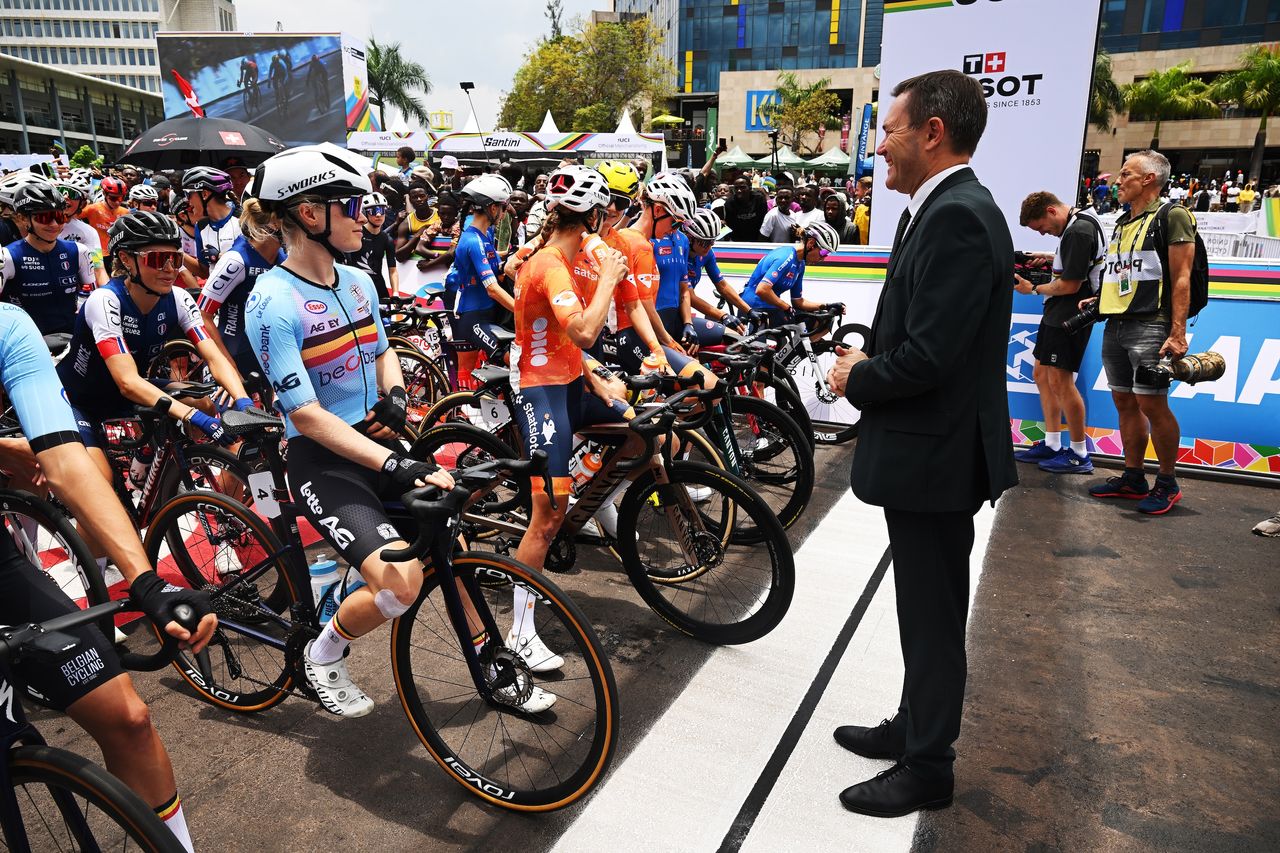
David Lappartient speaks to riders at the Road World Championships.

Professional cycling teams refused to sign up to a budget cap, the UCI's president has revealed, adding that he feels they were "wrong" to do so.

In an interview with French newspaper Ouest-France, published on Wednesday, David Lappartient said he "remained convinced" that a financial restriction would help the sport.

The concept of a budget cap is not new to cycling, and the UCI revealed last year that it planned to implement one in coming years. At the time, a press released stated: "This aims to preserve sporting fairness by avoiding excessive disparities between teams in terms of budget."

However, those attempts appear to have failed, with the new WorldTour and Women's WorldTour licences expected to be awarded for 2026 onwards without any restrictions on spending.

"The big teams have very large budgets, and as a result, where before a relatively small sum could be enough to achieve a decent result, today you're just a bystander," Lappartient told Ouest-France. "We considered implementing a 'budget cap' for all the teams, and paradoxically, the teams didn't accept it. I was surprised that it was mostly the smaller teams that refused. I think they were wrong because it seems necessary to level the playing field."

He was speaking after the closure of Arkéa-B&B Hotels, a longstanding French pro team, which he called "sad".

The Breton squad are not the only ones disappearing this season, while the proposed merger between Intermarché-Wanty and Lotto drags on; meanwhile, the team at the top, UAE Team Emirates-XRG, won 95 races this season, the most ever. At the men's Tour de France, as many as 15 teams were searching for a new sponsor.

"Why vote against it when a budget cap is proposed?" Lappartient asked. "They say yes, but first the cycling model needs to change. With a budget cap, if you exceeded the limit, you had to pay a tax that went to other teams. There was a mitigating mechanism in place. When you look back at cycling history, consider La Vie Claire. They finished 1st, 2nd, 4th, 7th, and 12th in the 1986 Tour de France. And the team's budget at the time, relative to the others, was probably even higher than UAE Team Emirates'.

"I'm not saying it was right. But there have always been teams with more resources than others. The goal is to regulate things a little. And I remain convinced that a budget cap is one of the elements to achieve that."

Asked if he thought cycling's sponsorship model was outdated, the Frenchman responded: "Can't we say that cycling was undervalued compared to its true worth, and that today, it's a sport that has taken on a global dimension? And, as a result, we have sponsors of a more global scale, with more international teams.

"Perhaps this is the price of success, with cycling enjoying very high viewership. The real winners are the riders, who are earning a much better living."

Sign up to read this article
Read news from 100’s of titles, curated specifically for you.
Already a member? Sign in here
Related Stories
Top stories on inkl right now
One subscription that gives you access to news from hundreds of sites
Already a member? Sign in here
Our Picks
Fourteen days free
Download the app
One app. One membership.
100+ trusted global sources.