
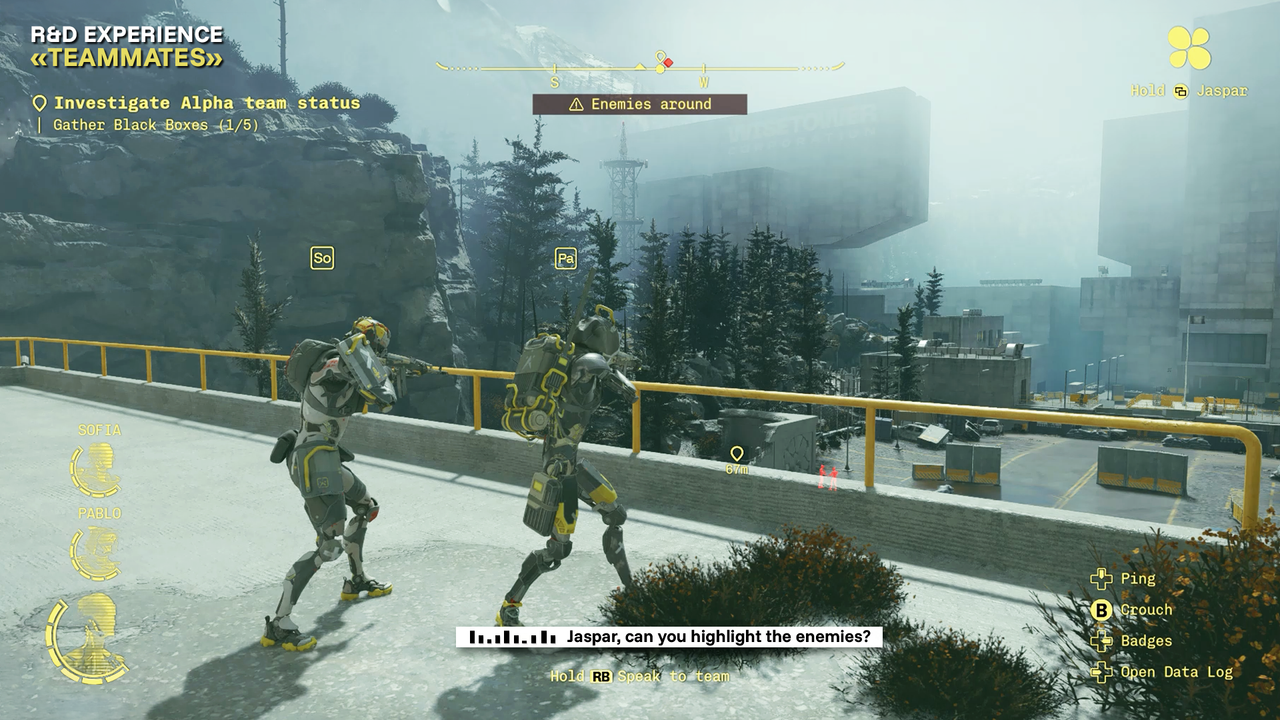
The use of AI in game development is hugely controversial, but Ubisoft is ploughing ahead with its experiments in player-facing generative AI. A new short playable experience in closed testing with gamers aims to explore how adaptive generative AI-driven gameplay and responsive characters can shape a new generation of more interactive games.
Last year's initial prototype Neo NPC already displayed cognitive and natural language abilities, but the non-playable characters remained in a static environment. Now the same team has developed Teammates, which puts AI-driven NPCs in the more traditional gameplay setting of a first-person shooter where they can respond dynamically to real-time voice commands and adapt their behaviour to different situations, revealing distinct personalities as they do so.

Ubisoft says Teammates react naturally in various situations. From mission briefings to battlefield commands, they should adapt to players’ strategies, moods and even personal slang. The idea is that they can interpret player intent and tone, as well as environmental cues, to generate fluid, context-aware reactions.
“It’s really about experimenting with entirely new ways of creating interactive stories,” said Virginie Mosser, Narrative Director on the project at Ubisoft. “Our role is to give AI meaning, to narrativise it, ensuring logic doesn’t replace soul. We designed Teammates to leave space for player creativity, finding that balance between emotion and unpredictability.”

Alongside Teammates, Ubisoft has introduced a new in-game personal assistant called Jaspar. Designed to support players through their missions, he recognises the player by name, helps with onboarding, understands the game’s lore and can highlight threats or key objects in the environment. The AI companion can also remind players of mission objectives, suggest next steps, and generally act as a tactical guide, Ubisoft says.
Jaspar can manage HUD elements, open menus and control settings, adjusting the player interface on the fly, adapting for colour blindness or modifying visual elements. Ubisoft reckons there's potential for this agentic AI to improve accessibility and personalisation in future games.
“Games of tomorrow will listen, understand and react to players far more than today, and our research gives a glimpse of what adaptive, generative play could add on top of proven game systems,” said Xavier Manzanares, Director of Gameplay GenAI.
“It’s the first time we’ve shared an experiment this early with players, but our goal is to pave the way with a strong technology layer so our creators can start imagining the value it could bring to their project and players.”
The prototype is currently playable for a limited number of participants in a closed playtest. This will be used to get feedback on how the systems operate in live gameplay scenarios. And should also provide insights into how players react, and if they welcome the AI-driven NPCs. That may depend on how fluid the interaction really is. You can find more information on the Ubisoft Teammates wesbite.
If you need to upgrade your setup for making games, see our pick of the best laptops for game development.