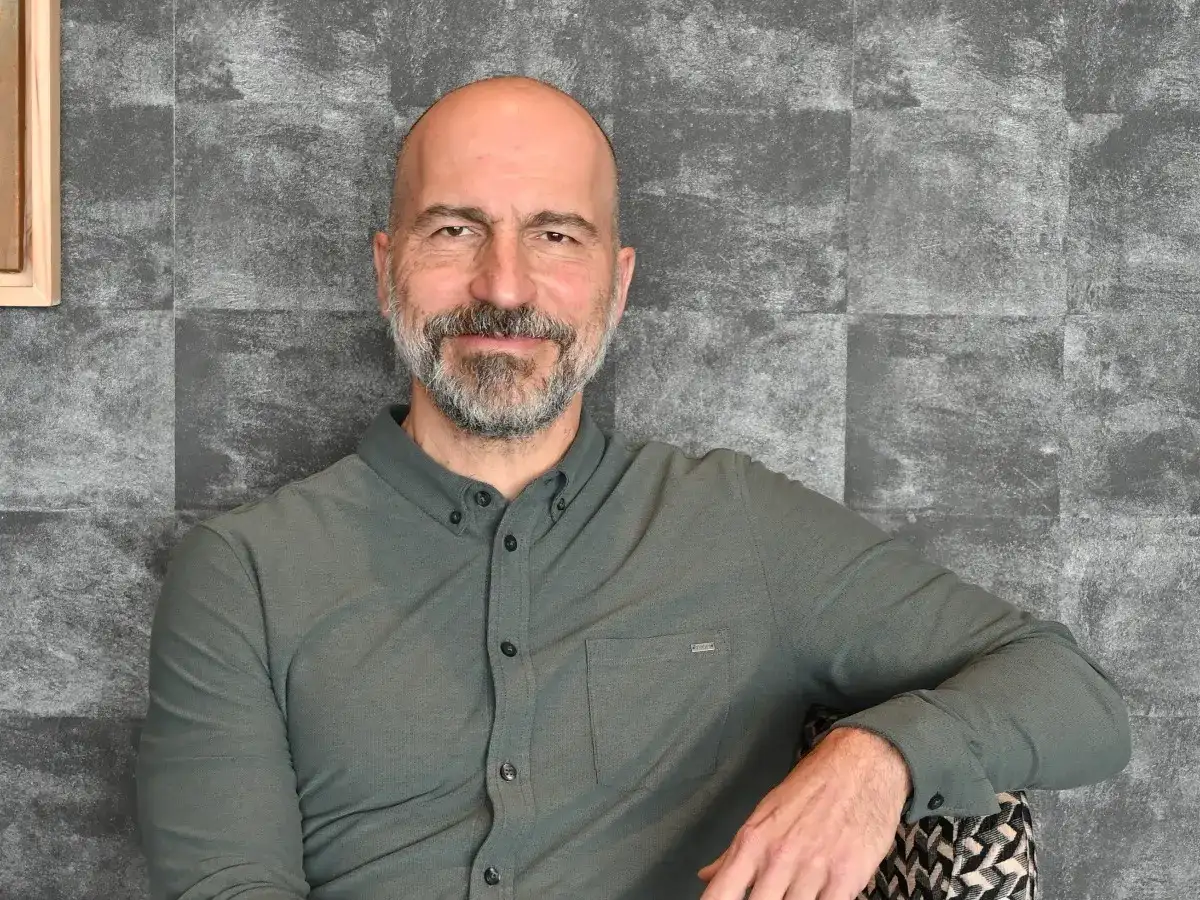
Dara Khosrowshahi told ET in an interaction that Uber is open to collaborating with founder Travis Kalanick. This and more in today’s ETtech Top 5.
Also in the letter:

■ Delhivery bets on discipline
■ India’s fintech gap
■ India’s ChatGPT image rush
Uber open to teaming up with Travis Kalanick on autonomous vehicles: CEO Dara Khosrowshahi
Uber CEO Dara Khosrowshahi told ET that the company would seriously consider partnering with founder Travis Kalanick on new ventures.
Driving the news: “We’re already working with Travis in the restaurant space, and I have enormous respect for him—he’s our founder. If opportunities emerge in other areas, we’d certainly look at them seriously because there are very few entrepreneurs I trust as much,” Khosrowshahi said during his five-day India visit last week.
Tell me more: The Information reported in March that Kalanick is planning a new self-driving car and robotics venture with backing from Uber.
These comments come as autonomous driving accelerates, with players like Waymo, Tesla and Zoox racing towards large-scale deployment.
Large market: The Uber CEO told ET in a wide-ranging interview that India is on track to become the company’s largest market by trips within the next decade, from its current third position.
He also spoke about Uber’s big India bets, its new data centre partnership, a possible return to food delivery, and the threat of AI. Watch the interview here.
Also Read: Of rides & rivals: Travis Kalanick on Uber’s capital strategy, competition with Lyft
Micron urges Indian firms to plan ahead as AI memory crunch set to deepen through 2028
Sumit Sadana, chief business officer at Micron, told us the global AI-driven memory chip shortage could stretch well beyond 2028 despite massive investments in new capacity.
Demand and supply: “We’re already in a place where aggregate demand is far above aggregate supply—at levels I have not seen in my career,” he said. “There is no physical way to supply the demand that all of our customers have.”
Sadana added that the shortage is expected to worsen as major global tech firms continue locking in future supply. Indian firms without firm procurement plans, he cautioned, risk being left empty-handed.
Why this matters: High-bandwidth memory (HBM) chips, the workhorse of AI servers, has become one of the world’s biggest supply bottlenecks. The crunch could hit India especially hard, as many local buyers have long shunned long-term supply deals over cost concerns.
FDE emerges hottest role in AI market, commands big pay premium
The most coveted job in AI today is not building LLMs but deploying them.
The forward deployed engineer (FDE), once a niche role, is now in hot demand, with firms like OpenAI, Google, Anthropic and Cognition dangling compensation between $350,000 and $550,000.
What’s the role: FDEs are hands-on consultants who build and deploy AI agents inside customer environments. They hunt for high-impact use cases and embed models like GPT and Claude deep into existing workflows.
Irrational pricing unlikely in third-party logistics even as ecommerce growth improves: Delhivery’s Sahil Barua
Delhivery CEO Sahil Barua said India’s third-party logistics sector is unlikely to return to the days of irrational pricing and aggressive cash burn, even as ecommerce growth recovers.
Industry reset: Barua pointed to consolidation in the sector, including Delhivery’s acquisition of Ecom Express, as evidence that the market has moved beyond unsustainable competition.
Growth momentum: Delhivery clocked 30% revenue growth in the March quarter, powered by a 72% jump in express parcel shipments to 306 million orders.
Shift underway: Barua argued that, over time, ecommerce firms like Amazon, Flipkart and Meesho will push more volume to third-party logistics providers because running in-house delivery networks is structurally more expensive.
Consolidation theme: While third-party players may gain share, Barua said there is little room for new entrants–signalling a more concentrated logistics market ahead.
Why India cannot build a world-class fintech champ yet: Jupiter CEO Jitendra Gupta
India has built the world’s most envied digital financial infrastructure—the Unified Payments Interface (UPI), Aadhaar, the Account Aggregator (AA) and ONDC. And yet, as of 2026, it has not produced a single consumer fintech like Brazil’s Nubank, the UK’s Revolut, or Chime in the US.
What's the holdup: In every market where fintechs have scaled, regulators carved out a licence category between an unregulated tech vendor and a full-fledged bank — allowing non-bank players to hold customer funds, issue cards or extend credit. India has no such middle ground.
Also Read: Fintechs trade the wild west for regulatory licences
The bank-first instinct: RBI’s hierarchy is clear: banks first, NBFCs below, fintechs last.
- Credit cards on Rupay-on-UPI: banks only.
- CLOU (Credit Line on UPI): banks only;
- NBFCs, who underwrite most of India’s unsecured consumer credit, were excluded.
A constructive agenda: A few changes could be genuinely transformative, such as:
- A graduated fintech licence ladder
- A regulatory sandbox with formal waivers and automatic graduation paths
- Opening CLOU to NBFCs
- Sector-wide alignment of RBI directions with the DPDP,
Read the full opinion piece here.
India crosses one billion ChatGPT-generated photos in under a month
India has emerged as the biggest market globally for OpenAI’s latest AI image-generation tool.
What’s happening? Posting on X, Sam Altman said that Indian users created more than 1 billion images in under a month after the launch of ChatGPT Images 2.0.
Unlike earlier AI image tools, which were popular mainly with designers and developers, the new version is spreading among everyday users in India—fuelling trends like anime-style selfies, tiny animated avatars, and cinematic portrait edits.
Tell me more: Rolled out in late April, the model offers sharper instruction-following and better handling of text, icons and detailed image elements.
Salesforce to spend $300 million on Anthropic tokens in 2026: CEO Marc Benioff
Salesforce CEO Marc Benioff said that the company could spend close to $300 million on Anthropic tokens in 2026, mainly to power AI-led coding and software development.
Tell me more: Speaking on the All-In podcast, Benioff said AI coding tools are making engineers more productive, not replacing them—cutting development costs while speeding up software creation.