Get all your news in one place.
100's of premium titles.
One app.
Start reading
Cycling News
Cycling News
Sport
Patrick Fletcher

UAE Team Emirates-XRG use new lactate gel mix for a second stage at 2026 Tour de France

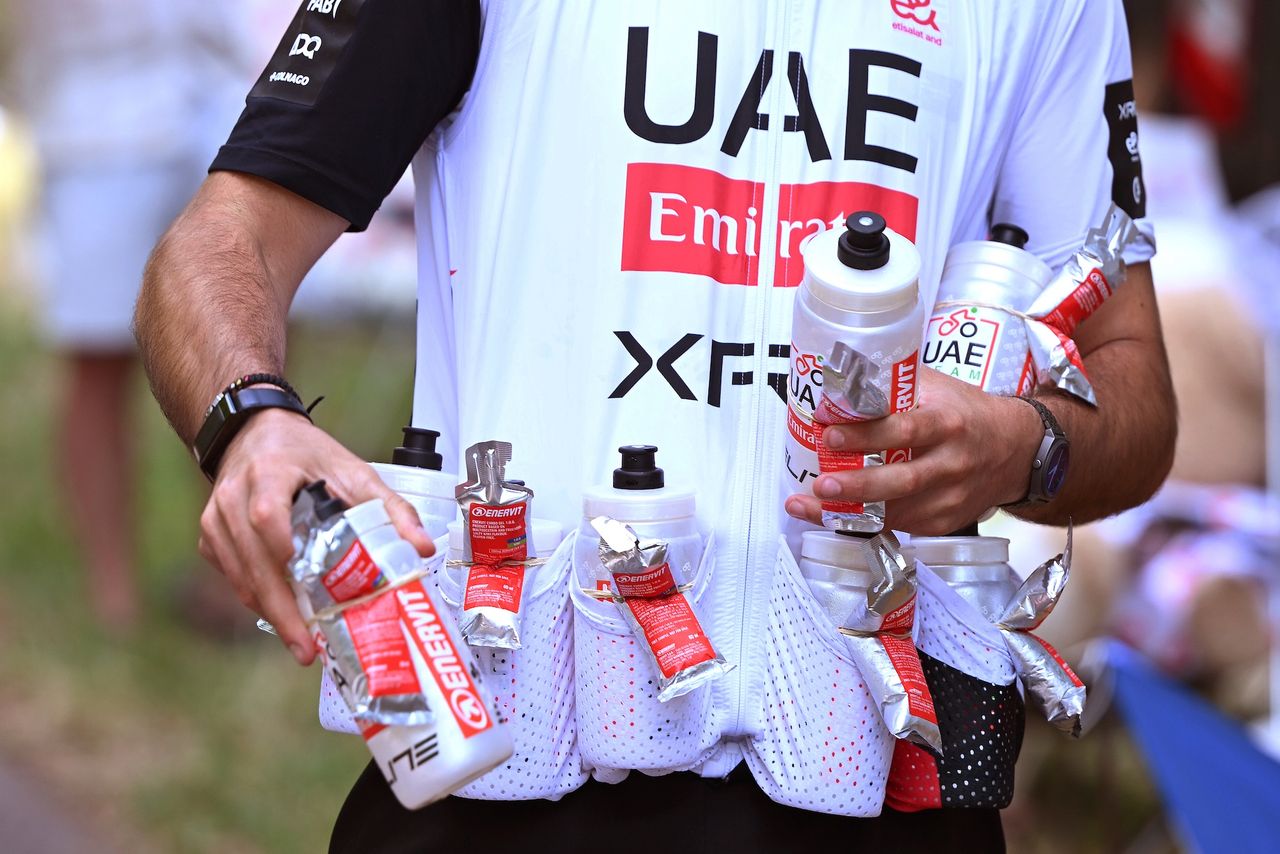
The soigneur waits for the UAE Team Emirates-XRG in the feeding area during the 113th Tour de France 2026 - Stage 14 (Photo by Dario Belingheri/Getty Images).

With lactate proving an attention-grabbing new theme in the sports nutrition sphere, UAE Team Emirates have confirmed they are using a new exogenous lactate product at the Tour de France, and explained how they are doing so.

Lactate has become a nutritional talking point in recent weeks with a number of products supposedly able to channel what was once seen as a waste product of the body into a new fuel source.

Some come in the form of gel sachets, like the ones common among cyclists seeking a sugary carbohydrate hit, but UAE Team Emirates-XRG are using a slightly different product that has just been unveiled by their nutrition supplier, Enervit.

Named the C2:1PRO Lactate Gel Mix, Enervit’s product is a drink mix, meaning it’s mixed with water and consumed from a bottle. It contains 10g of sodium lactate, mixed with 90g of carbohydrate in a 2:1 glucose-to-fructose ratio, and some vitamin B1.

Amid confusion over who is actually using lactate products, Enervit made their revelation on Friday morning, and on Saturday morning the UAE Team Emirates-XRG nutritionist Gorka Prieto-Bellver spoke to Cyclingnews about their use of the new gel mix.

“We have been working with Enervit for two or three years now, just to try to develop the best product possible,” he said.

“The lactate you can use like an extra fuel, because it’s absorbed in a different way in the gut, it’s absorbed faster than glucose, so that’s why it’s an interesting fuel to give the riders extra energy.”

Prieto-Bellver explained that the team are not using it as a routine part of their nutritional regime, but instead saving it for selected days. After using it on the opening day’s team time trial, they used it again for the first time since then on Saturday’s mountainous stage 14.

“We’re using it when it’s needed, not always,” Prieto-Bellver said.

“It’s not for all the stages but for stages where the energy expenditure is quite high.”

It is somewhat unusual that the team are only using the product selectively. There have been other mountainous energy-intensive stages where they haven’t used it, for example.

“It’s not something new, but we still need to do more research, to know how is the impact on performance,” Prieto-Bellver said.

That would indicate the team are still testing the waters, and the biggest bike race in the world might seem like a risky place to do that. The team underline the fact they’ve been helping to develop the product for years now and are familiar with it, but it’s clearly still in something of a trial phase.

“It’s something we have to try otherwise we do not know, so that’s why we are using it,” said Prieto-Bellver.

The world’s biggest bike race deserves world-class coverage. Subscribe to Cyclingnews for unlimited access to our unrivalled reporting of the 2026 Tour de France. From Barcelona through to Paris, our experienced team will bring you breaking news, expert insight, and in-depth coverage from every stage as the battle for the yellow jersey plays out. Plus, access the Cyclingnews app to follow the action on the go! Find out more.

Sign up to read this article
Read news from 100's of titles, curated specifically for you.
Already a member? Sign in here
Related Stories
Top stories on inkl right now
One subscription that gives you access to news from hundreds of sites
Already a member? Sign in here
Our Picks
Fourteen days free
Download the app
One app. One membership.
100+ trusted global sources.