Get all your news in one place.
100's of premium titles.
One app.
Start reading
International Business Times
Business
Merin Rebecca Thomas

U.S. Factory Output Picks Up In April As Auto Production Surges Amid Supply Risks

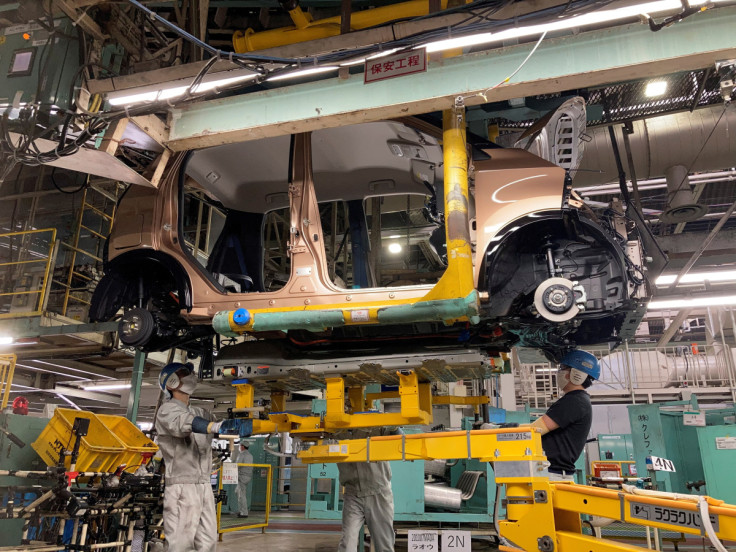
Motor vehicle and parts production climbed 3.7% in April, making it the single largest contributor to the monthly increase. (Credit: Reuters)

U.S. factory production rose in April at a faster pace than economists expected, driven by a sharp increase in motor vehicle output and suggesting steady underlying momentum in the manufacturing sector despite emerging supply-chain pressures tied to global geopolitical tensions.

Manufacturing output increased 0.6% in April following an upwardly revised 0.1% gain in March, according to data released Friday by the Federal Reserve. Economists surveyed by Reuters had expected a 0.2% rebound after an initially reported 0.1% decline in the previous month, underscoring that factory activity came in stronger than anticipated.

Motor vehicle and parts production climbed 3.7% in April, making it the single largest contributor to the monthly increase. The Federal Reserve's industrial production data showed that autos continued to play an outsized role in stabilizing factory output during a period of uneven demand across other manufacturing categories.

On a year-over-year basis, factory production rose 1.3% in April, indicating that industrial activity has maintained modest growth despite fluctuations in inventories, interest rates and global trade conditions.

The broader industrial production report, which includes manufacturing, mining and utilities, has been closely watched by economists for signals on the health of the U.S. economy, particularly as higher borrowing costs have weighed on certain sectors over the past year. The latest reading points to continued resilience in production activity, led by transportation equipment.

The April data comes against a backdrop of renewed concern over global supply chains. Disruptions linked to the war involving Iran and regional instability in the Middle East have added uncertainty to energy markets and shipping routes, with ripple effects reaching industrial inputs and logistics networks. While the Federal Reserve data did not quantify the impact of these disruptions, market participants have increasingly pointed to geopolitical risk as a factor that could influence manufacturing costs and input availability.

Broader economic indicators have also shown mixed signals in recent months, with consumer demand holding up in some areas while industrial orders in others remain uneven. The strength in auto production suggests that certain segments of manufacturing continue to benefit from stabilizing supply conditions and production normalization following earlier disruptions.

Data from the Federal Reserve's industrial production report confirmed that factory output has now posted consecutive monthly gains, reinforcing the view that the sector is not experiencing a broad contraction. However, economists continue to monitor whether external shocks or financial tightening could affect momentum later in the year.

Additional reporting from Reuters noted that the April increase exceeded market expectations, with autos providing the primary boost to overall manufacturing performance, while other categories showed more modest movement.

Separate data from the Federal Reserve's broader industrial production release indicated that capacity utilization across manufacturing remained steady, reflecting balanced use of factory resources despite uneven sectoral performance. Federal Reserve data also showed that durable goods manufacturing continued to outperform nondurable categories in recent months.

Sign up to read this article
Read news from 100's of titles, curated specifically for you.
Already a member? Sign in here
Related Stories
Top stories on inkl right now
One subscription that gives you access to news from hundreds of sites
Already a member? Sign in here
Our Picks
Fourteen days free
Download the app
One app. One membership.
100+ trusted global sources.