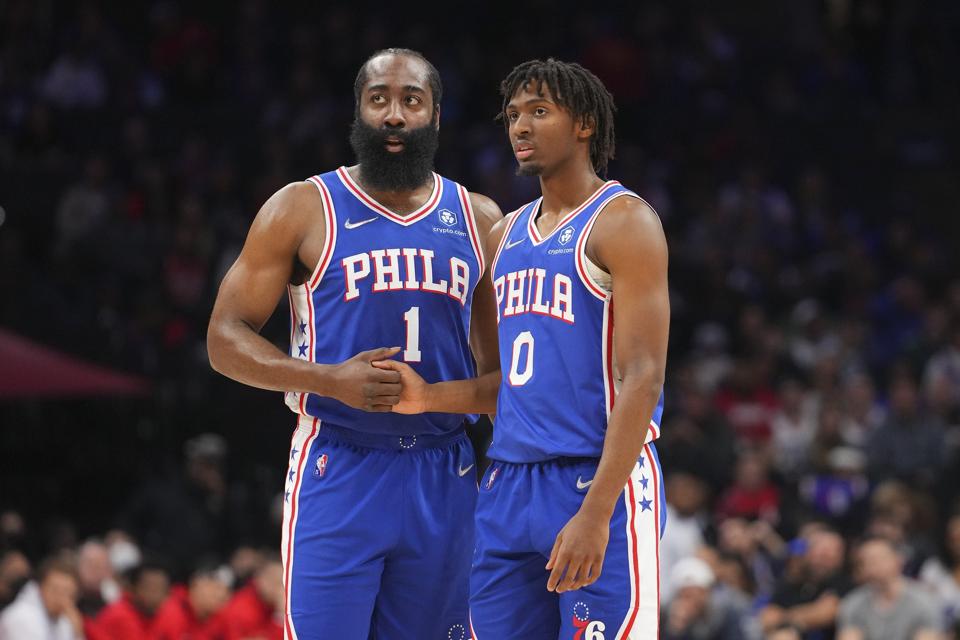
The Philadelphia 76ers are set to become exorbitantly expensive this summer.
Regardless of whether James Harden chooses to opt in and extend his current contract or decline his $47.4 million player option to become a free agent, he's likely going to sign a five-year deal worth around $270 million in July. With Tobias Harris on a near-max deal and Joel Embiid on a max deal—along with a supermax extension beginning in 2023-24—those three alone project to consume nearly $110 million in salary-cap space next season.
Without factoring in any draft picks or free-agent signings, the Sixers are already $6.4 million over the projected $147 million luxury-tax threshold for next season, per Spotrac. They could carve out some wiggle room by declining Danny Green's $10 million team option, but he has value as their lone mid-sized tradable contract.
That financial landscape makes second-year guard Tyrese Maxey the biggest key to the Sixers' long-term future with Embiid and Harden.
Maxey was already in the midst of a breakout season prior to Harden's arrival. He stepped into the starting lineup to replace the soon-to-be-departed Ben Simmons and averaged 16.9 points on 46.9 percent shooting, 4.6 assists, 3.5 rebounds and 1.4 three-pointers across his first 51 games.
In the 14 games since Harden's debut in late February, Maxey is up to 19.6 points, 3.4 assists, 2.9 rebounds and 2.5 three-pointers while shooting 55.2 percent overall and 48.6 percent from deep.
Sixers head coach Doc Rivers believes Maxey's recent success stems from to him moving back "home" to his natural position of off-guard rather than being the Sixers' full-time point guard. With Harden now often orchestrating the Sixers' offense in half-court sets, Maxey can utilize his lightning-quick speed to explode to the basket upon catching a pass.
Maxey's shooting percentages figure to regress over a larger sample size, and he isn't likely to supplant Embiid or Harden as the Sixers' offensive focal point any time soon. They don't need him to, though. As long as he holds up as a reliable third option, he'll vastly outperform his minuscule rookie-scale salary.
Maxey, the No. 21 pick in the 2020 NBA draft, is earning only $2.6 million this season. He'll earn $2.7 million next year and $4.3 million in 2023-24 on the final year of his rookie contract, at which point he'll be due for a huge raise.
If the Sixers don’t win a title this season—they’re currently a +1200 to do so, trailing the Brooklyn Nets, Milwaukee Bucks, Boston Celtics and Miami Heat in the East—they won’t have many ways to upgrade their roster this summer. They'll have the $6.3 million taxpayer mid-level exception, but they'll be limited to handing out veteran-minimum contracts beyond that. They also owe their second-round pick to either the Minnesota Timberwolves or Miami Heat, and the Brooklyn Nets could choose to take their first-round pick this year rather than next year.
The Sixers struck gold last offseason by signing Georges Niang to a two-year, $6.7 million deal with a portion of their mid-level exception. But given their holes on the wing and at backup center, they'll need to be similarly fortunate with their signings this summer. Otherwise, their best hope for improvement may be development from young players such as Isaiah Joe, Paul Reed and Charles Bassey.
Maxey is living proof of how a young player making a leap can impact the long-term trajectory of a franchise.
He averaged only 15.3 minutes per game as a rookie, and most of his opportunities came early in the season when a bunch of players wound up in health-and-safety protocols and at the very end of the season. His 39-point eruption during a short-handed loss to the Denver Nuggets last January and his 30-point, seven-rebound, six-assist outing against the Orlando Magic in the regular-season finale were a precursor of things to come, but Simmons' absence helped expedite his development this season.
At worst, Maxey projects to be a high-level starter moving forward. At best, he has All-Star upside. Players of his caliber would cost at least $20 million annually on the free-agent market. The Sixers have him under contract for one-tenth of that price next season.
That's going to be especially critical given their financial restraints.
If the Sixers do sign Harden to a five-year deal this summer, they'll have both him and Embiid under contract through the 2026-27 season. Harris has only two more years on his deal, so he'll come off the Sixers' books right when Maxey's rookie-scale contract ends.
The Sixers could shuffle some money around by trading Harris for two smaller contracts, much like the Dallas Mavericks did with Kristaps Porzingis at this past year's trade deadline. However, they aren't likely to ever have significant salary-cap space as long as Harden and Embiid are on their books, barring a drastic cap spike in the mid-2020s.
Having a player of Maxey's caliber under contract for roughly $7 million over the next two seasons combined is a team-building cheat code. It gives the Sixers more flexibility to round out their roster without racking up a nine-figure tax bill, regardless of what they decide to do with Harris this offseason. That should help them retain other rotation players such as Niang and Matisse Thybulle rather than allowing them to walk away in free agency.
At some point, the Sixers' bill will become due. Maxey will be eligible to sign an extension in July 2023, and if he continues on his current trajectory, he'll be in line for a max or near-max deal.
But for the next two seasons and change, the Sixers will have Maxey on one of the NBA's most valuable contracts from a production-per-dollar standpoint. With Embiid and Harden gobbling up $80-plus million in cap space every year, he's the bargain-basement steal who can help balance out their books.
Unless otherwise noted, all stats via NBA.com, PBPStats, Cleaning the Glass or Basketball Reference. All salary information via Spotrac.