Get all your news in one place.
100's of premium titles.
One app.
Start reading
TechRadar
TechRadar
Craig Hale

Two years in the making: Canva AI 2.0 required an entire re-architecturing effort, and its yours to try if you can find the easter egg

Canva AI 2.0.
  • Canva wants to be thought of as an AI-first platform that continues to democratize design
  • Asset generation and editing is about to get vastly better with layering
  • The AI is personalized with memory, but still stays within brand

At its Create conference in Los Angeles, Canva lifted the wraps off a project two-or-more years in the making, Canva AI 2.0, marking a fundamental shift in how its software will get used.

Four years after the business launched the Visual Worksuite (now just Visual Suite) with the then-new Docs and an updated version of Presentations, Canva now wants to become an AI platform with design tools, instead of a design platform with AI tools.

In doing so, the company's going all-in on agentic AI and autonomy, which it sees as paramount to continuing its work to democratize design for all.

Canva AI 2.0 is Canva's biggest shift yet

Core to Canva AI 2.0 is a three-tiered approach to getting things done – sitting on top is the Visual Suite, which we've all become familiar with by this point.

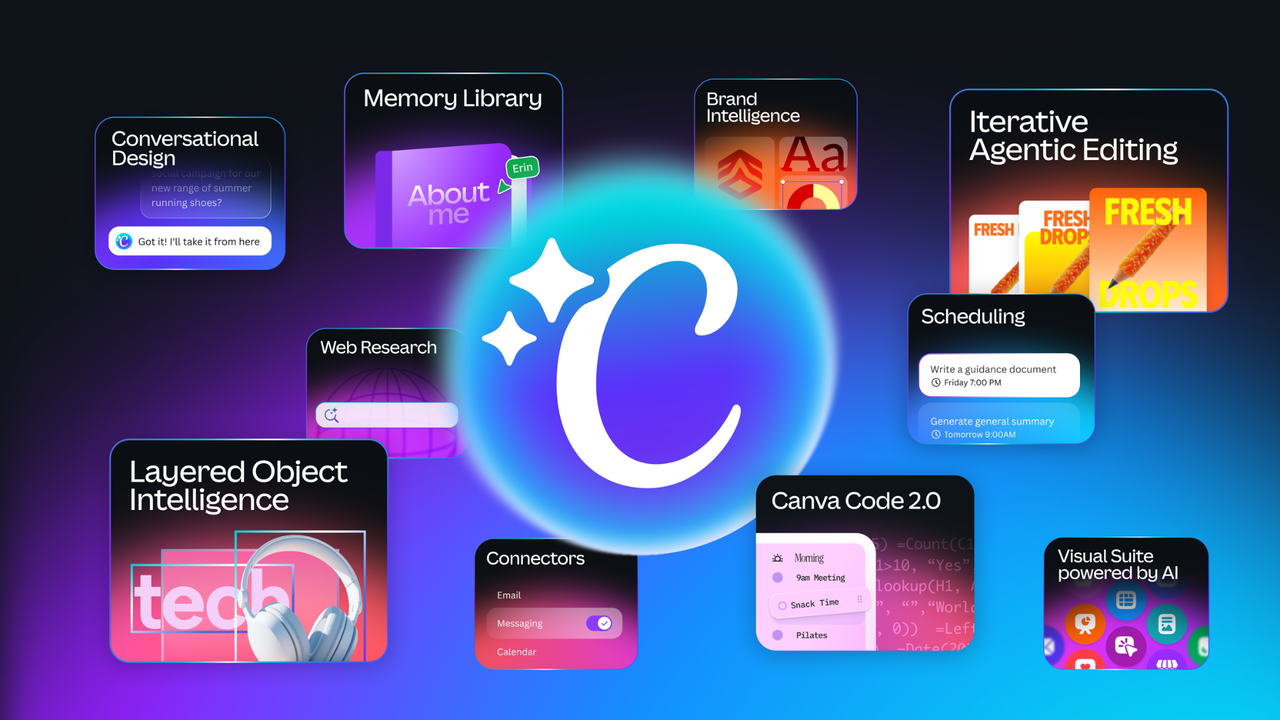
Beneath that, though, are AI and context. Some of the new tools being launched and refined in what is essentially Canva's "re-architecture" are the same conversational interface across the entire design journey and two crucial but overlooked asset generation benefits – layered object intelligence and iterative agentic editing.

Speaking at the event, co-founders Cliff Obrecht and Cameron Adams criticized existing AI chatbots for having to re-generate entire pixels to make edits, trying their best to keep everything else the same. Conversely, Canva AI 2.0 builds out an asset in multiple layers and elements, so that each part can be edited by either the AI or a human worker.

As for existing images, including those already generated by AI, importing them into Canva will automatically decipher them and generate layers for easier revisions.

Crucially, Canva will also be able to generate a memory file for users, teams and orgs (which can be edited and refined) to personalize content better by preferences, while access to brand guidelines keeps fonts, colors and other rules get applied for maximum consistency.

Canva AI 2.0 is launching today under research preview, and in true Canva style, it will become available to the first million users who discover it through an easter egg.

Sign up to read this article
Read news from 100's of titles, curated specifically for you.
Already a member? Sign in here
Related Stories
Top stories on inkl right now
One subscription that gives you access to news from hundreds of sites
Already a member? Sign in here
Our Picks
Fourteen days free
Download the app
One app. One membership.
100+ trusted global sources.