Good morning. Antisemitism often appears to arrive in sudden shocks. A violent terror attack. A spray-painted wall. A racist assault that plunges Jewish communities into fear and forces the rest of society to pay attention.
The end of 2025 brought two such horrors: the attack on a Manchester synagogue, which killed two British Jewish worshippers, and the Bondi beach attack, which killed 15 people. Together, those events hardened a sense among much of the Jewish diaspora that a hatred long woven into history is once again intensifying.

The response from governments often follows a familiar playbook. Swift condemnations are issued, security is reviewed and ramped up, and promises to root out the issue are made. But at a deeper level few changes are made and the cycle repeats. The crisis in the UK is now perceived as so severe that the US is openly discussing providing amnesty to British Jews.
For this First Edition, I wanted to step back and revisit the fundamentals: how do we define antisemitism, how has it operated in Britain and why have efforts to confront it fallen short? To do that, I spoke to David Feldman, a history professor and director of the Birkbeck Institute for the Study of Antisemitism (BISA). That’s after the headlines.
Five big stories
Greenland | Donald Trump has linked his repeated threats to seize control of Greenland to his failure to win the Nobel peace prize, as transatlantic tensions over the Arctic island escalated further and threatened to rekindle a trade war with the EU.
Jeffrey Epstein | Almost all of the Epstein files are still unreleased a month after the Congress deadline, to the anger of survivors.
Gaza | The Kremlin said Vladimir Putin has been invited to join Donald Trump’s “board of peace” to oversee a ceasefire in Gaza.
Scotland | The country’s largest health board has admitted that contaminated water caused serious infections in child cancer patients linked to four deaths in Glasgow.
Spain | Spain will begin three days of mourning on Tuesday as rescuers continue to comb through the wreckage of twisted train cars and scattered debris to locate victims after a train collision that killed at least 40 people and injured dozens.
In depth: ‘My own parents were not allowed to join a golf club as late as 1973’
For many people in the UK, their understanding of British Jewish history begins and ends with the Holocaust. But to make sense of today’s crisis, David Feldman tells me it is essential to place antisemitism in a much longer national story.
Britain’s relationship with its Jewish population goes back centuries – and is a far cry from the national myth of being a safe haven for Europe’s Jews during the second world war. Jews had already been in the UK for hundreds of years when they were expelled from England in the 13th century and barred for centuries after, only resettling in significant numbers in the late 1600s, Feldman explains. Even then, Britain’s identity was fundamentally Christian, embedding prejudice in law and public life. A 1753 attempt to allow foreign Jews to naturalise was abandoned after public outcry, and it was not until 1858 that a professing Jew could sit in parliament. Benjamin Disraeli, already an MP, had converted to Christianity at 12.
While conditions improved over time, Feldman says it is often forgotten how widespread everyday discrimination remained in the UK, well into the late 20th century. “Until then, in the UK, private schools had quotas for the numbers of Jewish children they would take,” he says. “There were barriers to Jews advancing in the legal and medical professions. Clubs would not admit Jewish members; my own parents were not allowed to join a golf club as late as 1973.”
***
How should we define antisemitism?
The British Jewish community is a small minority, estimated at about 300,000 people, 0.5% of the population. Feldman stresses that it is also far from monolithic, shaped by differences of class, race, politics and religious practice, as well as by varied understandings of what it means to be Jewish in Britain today.
So how do we define the hatred that impacts this community? Feldman argues there is no simple answer. “We are living through a breakdown in consensus over what antisemitism is,” he explains. “That makes the problem harder to deal with, because it makes it controversial, and it feeds into the fear and anxiety being felt by some Jewish people.”
Feldman describes antisemitism as an umbrella term. “People disagree over what should be brought under that umbrella,” he says. “The sharp end of this debate arises when people disagree over whether or when anti-Zionism and denunciations of Israel are antisemitic.”
This kind of disagreement is not unique to antisemitism, he adds. Similar disputes surround other abstract concepts, including racism and Islamophobia. But since the early 2000s, arguments over antisemitism have increasingly centred on Israel and Zionism. (Zionism can be defined as a Jewish national movement that sought to create a Jewish state, then to secure and sustain it.) Feldman points to the Second Intifada and the 2001 UN World Conference against Racism in South Africa, which helped revive the slogan “Zionism is racism” and triggered a sense of crisis among many Jewish Zionists worldwide.
From that point on, he says, there were concerted efforts to expand the definition of antisemitism to include anti-Zionism and certain denunciations of Israel, culminating in the working definition issued in 2016 by the International Holocaust Remembrance Alliance (IHRA).
“There are some forms of denunciation of Israel which most experts and most people on the street would agree are antisemitic,” Feldman says. “Those, for example, that use classical antisemitic stereotypes about Jewish power and Jewish bloodlust.”
But he says that the IHRA definition has been understood by many as going further. “In a direct response to the charge that ‘Zionism is racism’, the definition is drafted in such a way that if you say that the state of Israel is illegitimate because it is a ‘racist endeavour’, then you might be accused of antisemitism.”
At the same time, Feldman argues, campaigns against antisemitism have increasingly drifted away from broader, universal anti-racist principles – instead situating it as a unique form of hatred. That shift prompted the emergence of alternative definitions, most notably the Jerusalem Declaration on Antisemitism (JDA), which he helped draft.
“What marks out the JDA are two things: it starts from a set of universal principles, [which] apply to identifying antisemitism but not only to antisemitism; and it tries to set out what is, on the face of it, antisemitic and what is not,” he tells me.
The IHRA definition, however, is far more widely adopted in the UK, and has come into tension with the JDA. Feldman attributes this partly to the tone of the debate itself. “There is a lot of name-calling on both sides. Critics of the IHRA definition accuse supporters of ‘weaponising’ antisemitism, while supporters of the Jerusalem Declaration, although it was drafted by academics – people in Jewish studies, Holocaust studies, antisemitism studies – are accused of being political agitators.
“What we have is a clash of values and principles: between the universal and broad anti-racist principles promoted by the JDA and by the conception of antisemitism, held by many supporters of the IHRA definition, that antisemitism is a unique hatred.”
***
What does the data tell us?
Recorded antisemitic incidents have risen sharply in recent years, and Jewish people report feeling significantly less safe. The largest survey of British Jews since 7 October 2023, conducted in summer 2025, found that 35% felt unsafe in Britain, up from 9% in 2023. Almost half now see antisemitism as a “very big” problem, compared with just 11% in 2012.
The Community Security Trust recorded 1,521 antisemitic incidents in the UK between January and June 2025. This is the second-highest total logged for the first half of a year – the highest being the 2,019 incidents recorded between January and June 2024, in the aftermath of the 7 October Hamas attacks. CST’s chief executive, Mark Gardner, said the incidents ranged in severity from physical attacks to “racial hatred, yelled at Jewish schoolchildren – scrawled on synagogue walls and thrown at anyone who is Jewish or suspected of being Jewish”.
Yet Feldman says that the evidence from surveys of people’s attitudes, in Australia and in the UK, shows that within the population as a whole, antisemitism is diminishing. That raises the question, he says, of where these dreadful events come from, and what causes them.
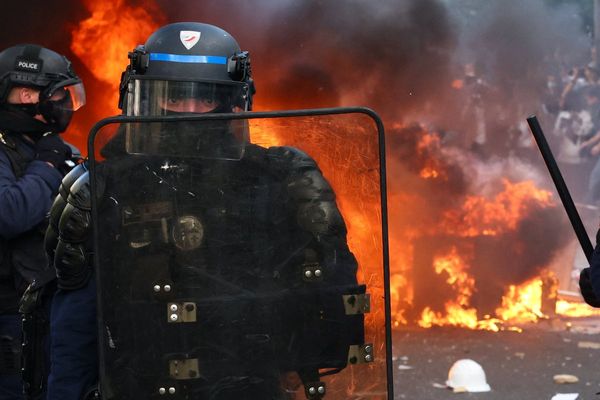
In Manchester and Bondi (pictured above), Feldman explains, the killers were inspired by and supported Isis, a transnational Islamist organisation seeking a global caliphate. Some campaigners have linked the chants and placards at protests in support of Palestinian rights as having normalised and popularised the justifications for antisemitic terror. Feldman points out that support for Isis is distinct from support for Palestinian rights: “While some antisemitic expressions have appeared at protests in support of Palestinians during Israel’s war in Gaza, the majority of demonstrations have been peaceful and not anti-Jewish.”
That hasn’t comforted those feeling under threat. In New South Wales, Australia, an inquiry is investigating banning a specific phrase: “globalise the intifada”. And in the UK, the police response, or lack of, to anti-Jewish chants at such protests has reinforced the view that antisemitism is treated differently to other forms of racism. The controversy around the banning of Maccabi Haifa fans from attending a football match in Birmingham increased the perception the police are institutionally failing the Jewish community.
Figures within the Trump administration have leapt on the controversy, with reports they are discussing the possibility of granting asylum to Jewish people from the UK. Have once safe countries like the UK and Australia become places of peril for their respective Jewish communities? “As we acknowledge how terrible the toll of these events have been, especially, of course, on the victims, but also on other Jews, both nearby and far away, we shouldn’t fall into the trap of saying Australia as a whole or the UK as a whole has become a dangerous place for Jewish people,” says Feldman.
***
Tackling antisemitism
In much of his work, including a recent report on antisemitism he co–authored for Runnymede Trust, Feldman distinguishes between antisemites and what he and his colleagues at BISA call a “a reservoir of antisemitism”. “Antisemites are people who are ideologically motivated – people for whom a deeply hostile view of Jews and Jewish power is central to their worldview and to their politics,” he argues. “That group of people amounts to something like 5-7% of the population in Britain, according to most surveys.”
But when he digs further into this survey data on antisemitic ideas in the UK and US, he found that the percentage of people who will agree with one or two negative stereotypes is much higher. For example, if asked, “Do you agree that Jews have too much power in the media?” or “Do you agree that Jewish values are not the same values as the values of other Americans or British people?”, the percentage of people who agree to one or two of these expressions of prejudice is much higher. In a survey in Britain conducted in 2017, 30% of those questioned agreed with at least one of these negative stereotypes.
“This suggests that there are stereotypes, negative images and stories about Jews which circulate in the culture – this is what I and my colleagues at BISA call the reservoir of antisemitism,” he says.
“We developed this distinction when we were thinking about the Labour party’s antisemitism crisis. It’s a way of thinking about those cases where a disciplinary measure seems appropriate – dealing with ‘dyed-in-the-wool’ anti-Jewish racists – versus those who slip into antisemitic ways of thinking from time to time because it seems to offer an easy answer to a problem on their mind.”
Feldman gives an example. “‘Why do western governments continue to support Israel if its behaviour towards the Palestinians is so egregiously unjust?’ There are many ways to answer that question, but one false but easy reason is to say, ‘Well, it’s because of Jewish influence; it’s because of hidden Jewish power’.”
The UK government’s approach, whether it’s the Conservatives or Labour in power, has been to focus on the antisemites, Feldman explains. “Keir Starmer, for example, repeatedly characterises antisemitism as a ‘hatred’. Sometimes it is that, but most often it’s not; most often it reflects assumptions and prejudices about Jewish people [that are] deeply embedded in the culture and which people draw on in casual, unsystematic ways. That’s what the data suggests. In these cases, antisemitism needs to be addressed through programmes of education: heightened security and policing is not enough.”
While Feldman believes the pro-Palestinian movement in general is not antisemitic, he has noticed the use of the language of “Jewish supremacy” has leaked into parts of the movement since the war in Gaza begun, “where some people talk about ‘Jewish supremacy’ in Britain or in the United States and the ‘Pax Judaica’, which implies there is a hidden hand of Jewish power governing British policy and American policy. And this, when it arises, is very troubling,” he explains.
“I think there has been a problem on the left of not recognising antisemitism. There was some antisemitism under Jeremy Corbyn’s leadership of the Labour party, but it was made much worse by the party’s inability to recognise and deal with the problem.”
One of the issues the left faces is that its understanding of racism is often based on how the legacies of colonialism and enslavement create it, Feldman says. “But those legacies are not the only forms in which racism arises. There is a history of racism inside of Europe, for example, against Jewish people, against Sinti and Roma, against Irish people – basically against people who are [often] coded as white. It’s not that all these forms of racism are the same, but sometimes there is an incapacity to recognise the different ways in which racialisation and racism manifest.” He believes the failure in parts of the left to acknowledge or police antisemitism within its own ranks is, in some ways, a reflection of that.
As for politicians, Feldman isn’t convinced by their promises to “root out” antisemitism. “It’s a tough task to root out something embedded for more than a thousand years. A more realistic goal is to minimise and contain antisemitism. So, on the one hand, obviously, Jewish people, Jewish places of worship and Jewish buildings need to be protected.” But that is not enough. “Security and protection needs to be allied to programmes of education, and these programmes of education, to be effective, should place anti-racist principles and values front and centre.”
Given the present moment, marked by deadly attacks, persistent abuse and deep anxiety within Jewish communities, Feldman argues it is time to re-examine how antisemitism is addressed. Longstanding approaches have not kept pace with how the problem has evolved and may now be adding to it.
“Racism arises in different ways for different groups, but it’s wrong and it’s abhorrent in all cases for the same reasons. Once we see this, we can see that our efforts to combat antisemitism should be allied to 360-degree anti-racism.”
What else we’ve been reading
Daniel Dylan Wray opens the pages of a new compendium dedicated to the golden age of crisp packet design. Packet of Space Raiders, anyone? How about Hedgehog flavour? Martin Belam, newsletters team
The
The ‘Pub that changed me’ series has had me smiling from ear to ear. The latest, on the Glory in east London where many iconic drag queens first cut their teeth, is a gem. Aamna Mohdin, newsletters team
If you are baffled by the existence of the game Arc Raiders, which has swiftly become one of the most successful online shooters in the world since its October launch, Keith Stuart has you covered. (And do subscribe to our weekly games email, Pushing Buttons.) Martin
I cannot agree more strongly with Picturehouse boss Clare Binns – a Bafta recipient for her outstanding British contribution to cinema – who argues films should shorten to get bums on seats. Martin
From libido boosters to immunity enhancers, there’s now a patch for every condition. But do they actually work? Morwenna Ferrier speaks to the experts. Aamna
Sport
Football | The 18-year-old Charalampos Kostoulas scored a sensational overhead kick in stoppage time to earn Brighton a 1-1 draw with Bournemouth.
Football | Marc Guéhi has completed his £20m move to Manchester City from Crystal Palace, signing a contract to 2031.
Tennis | Maya Joint, the top-ranked local in the Australian Open women’s singles draw, crashed out after losing in straight sets to Czech teenager Tereza Valentová.
The front pages
“Trump links Greenland threats to Nobel snub,” is the splash on the Guardian today. “I no longer think purely about peace, says Trump,” has the Times. “British and US relationship at lowest ebb since 1956 Suez crisis,” says the i paper.
“British teenagers face social media ban,” is the lead story over at the Telegraph, while the Daily Mail has: “U-turn opens door to ban on social media for under-16s.” “I’m done with my family,” has the Sun on the Beckham fallout. “Brooklyn blasts Posh & Becks,” says the Star. Finally, the Metro with “A prize idiot!”
Today in Focus
Why Donald Trump really wants Greenland
“The thing to remember, always, with Trump is that everything is about the psychodrama,” the Guardian investigations correspondent Tom Burgis tells Helen Pidd. “Everything is who’s in his ear, what bit of his vanity or insecurity has been activated.” Tom speaks to the show about Donald Trump’s friend Ronald Lauder, a billionaire with business interests in Greenland.
Cartoon of the day | Ben Jennings
The Upside
A bit of good news to remind you that the world’s not all bad
Scientists have been forced to rethink the intelligence of cattle after an Austrian cow displayed an “extraordinary intelligence” for tool use. Veronika, a 13-year-old Brown Swiss, was seen using sticks and a broom to scratch herself, even switching ends “in a meaningful way”.
Veronika favoured the bristled end of the broom to scratch the tough skin on her back, but switched to using the smooth handle for more delicate areas. “At the beginning I thought this was the result of a mistake,” Dr Antonio Osuna Mascaró from Vienna’s University of Veterinary Medicine said, but explained that they observed it as a repeated pattern in the cow’s behaviour.
“We don’t believe that Veronika is the Einstein of cows,” he added. “What this tells us is that cows have the potential to innovate tool use, and we have ignored this fact for thousands of years.”
Sign up here for a weekly roundup of The Upside, sent to you every Sunday
Bored at work?
And finally, the Guardian’s puzzles are here to keep you entertained throughout the day. Until tomorrow.