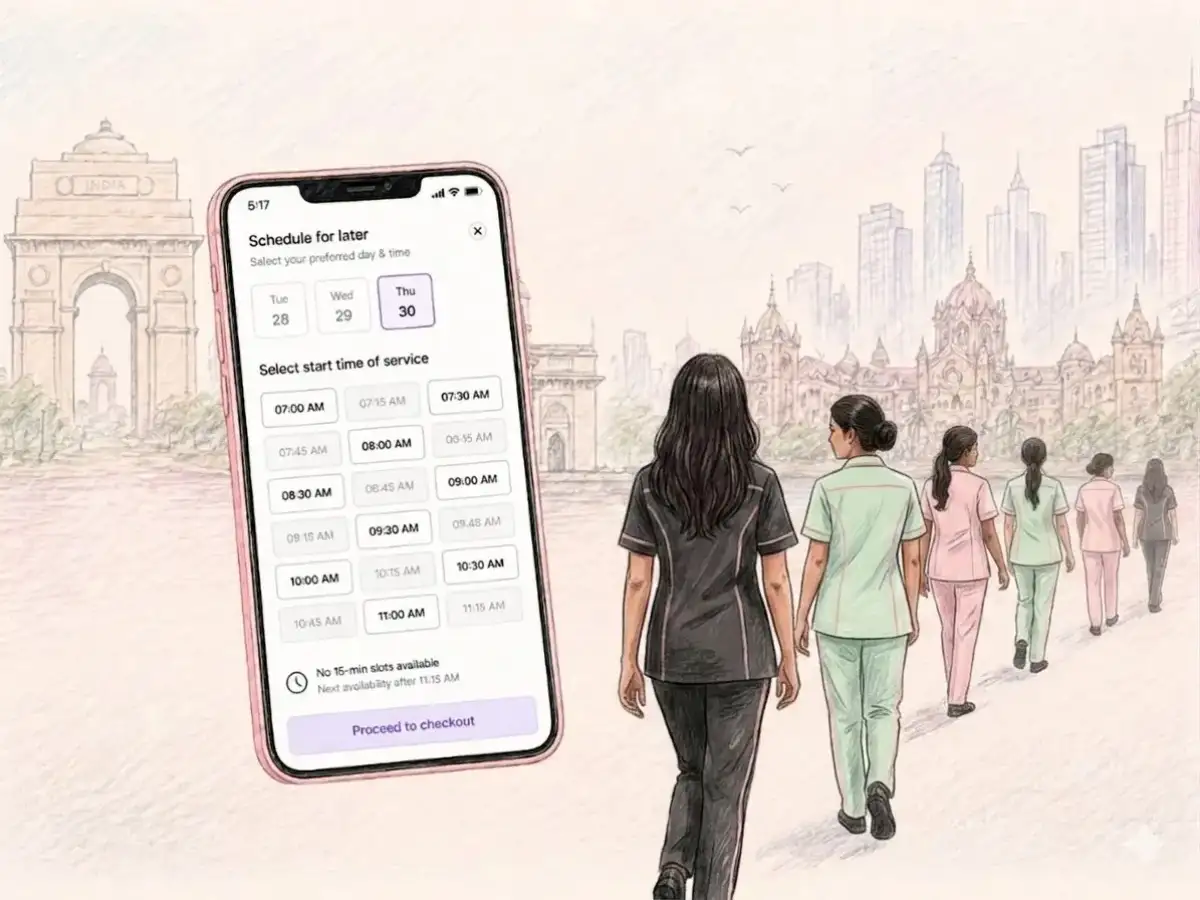
For years, India’s home services economy operated on informal trust. A recommendation from the apartment WhatsApp group. A local technician whose number had been passed down between neighbours. A service call arranged through familiarity rather than systems.
That equation may be starting to change. A recent customer survey conducted by ProNearMe Private Limited, which operates home services platform ProNearMe across Delhi-NCR, Mumbai and Bengaluru, suggests Indian consumers are increasingly willing to pay more for something that was traditionally expected to come at no additional cost: trust.

The finding points to a broader shift in consumer behaviour, one that may have implications well beyond household repairs and maintenance.
Paying more, but buying certainty
The survey covered 1,000 homeowners in Delhi-NCR earlier this year, with women accounting for roughly two-thirds of respondents. According to the company’s findings, 61% of women surveyed said they had moved from local, area-based technicians to verified service platforms during the past two years. The same figure stood at 18% in 2022.
The headline number suggests a sharp acceleration in adoption, but what stands out more is what appears to be driving it. Price is not the answer.
Verified service providers continue to charge a premium over local alternatives. In many cases, customers are paying roughly 10% to 18% more for comparable work.
Yet demand continues to move in that direction According to ProNearMe founder Simranjeet Singh, the willingness to absorb higher costs reflects changing expectations rather than affordability alone.
“That is a three-fold jump in adoption inside two years from a segment that traditional retail surveys have not tracked closely,” Singh says.
The product is not the repair, it is the process
The survey suggests consumers are increasingly paying for a package of assurances rather than the service itself.
Verified identity checks. Transparent pricing before arrival. Customer support if something goes wrong. Digital records. Visibility into who is entering the home.
None of these elements individually represent breakthrough technology. But together, they appear to create something consumers increasingly value: predictability.
“Frankly, none of this is new technology,” Singh says. “What has changed is that the urban woman managing her household solo, or remotely, is now willing to pay the premium for the assembly of those pieces.”
That distinction matters. In industries where products become harder to differentiate, trust itself can become the premium offering.
Women appear to be leading the shift
One of the more notable signals in the survey is who appears to be driving adoption. Women represented both the majority of respondents and, according to the company, the majority of household service bookings on its platform.
The findings suggest decision-making around household services is increasingly linked to reliability, accountability and peace of mind rather than securing the lowest possible cost.
That may explain why formal platforms are gaining traction even without aggressive category-wide marketing. The customer appears to be changing before the market fully recognises it.
The overlooked opportunity: Remote household management
Buried inside the survey data was another trend with longer-term implications. Around one in seven older women in the sample reportedly had service bookings paid through cards billed outside India.
The numbers remain small, but the behaviour points to an emerging use case: family members managing household services remotely for parents living elsewhere. In this model, the person paying and the person receiving the service are often not the same individual.
Trust, therefore, shifts from being a personal relationship to becoming an operational guarantee. That dynamic could create new opportunities around eldercare, household management and recurring service subscriptions.
What this means for India’s services economy
India’s home services sector remains heavily unorganised and local operators are unlikely to disappear anytime soon.But the survey suggests the migration may already be underway among higher-value customers.
As platforms scale and pricing differences narrow, the appeal of verified services could extend beyond premium households. For operators, the lesson may be straightforward: consumers are no longer paying only for outcomes. Increasingly, they are paying to reduce uncertainty. And in that market, trust may no longer be free.