
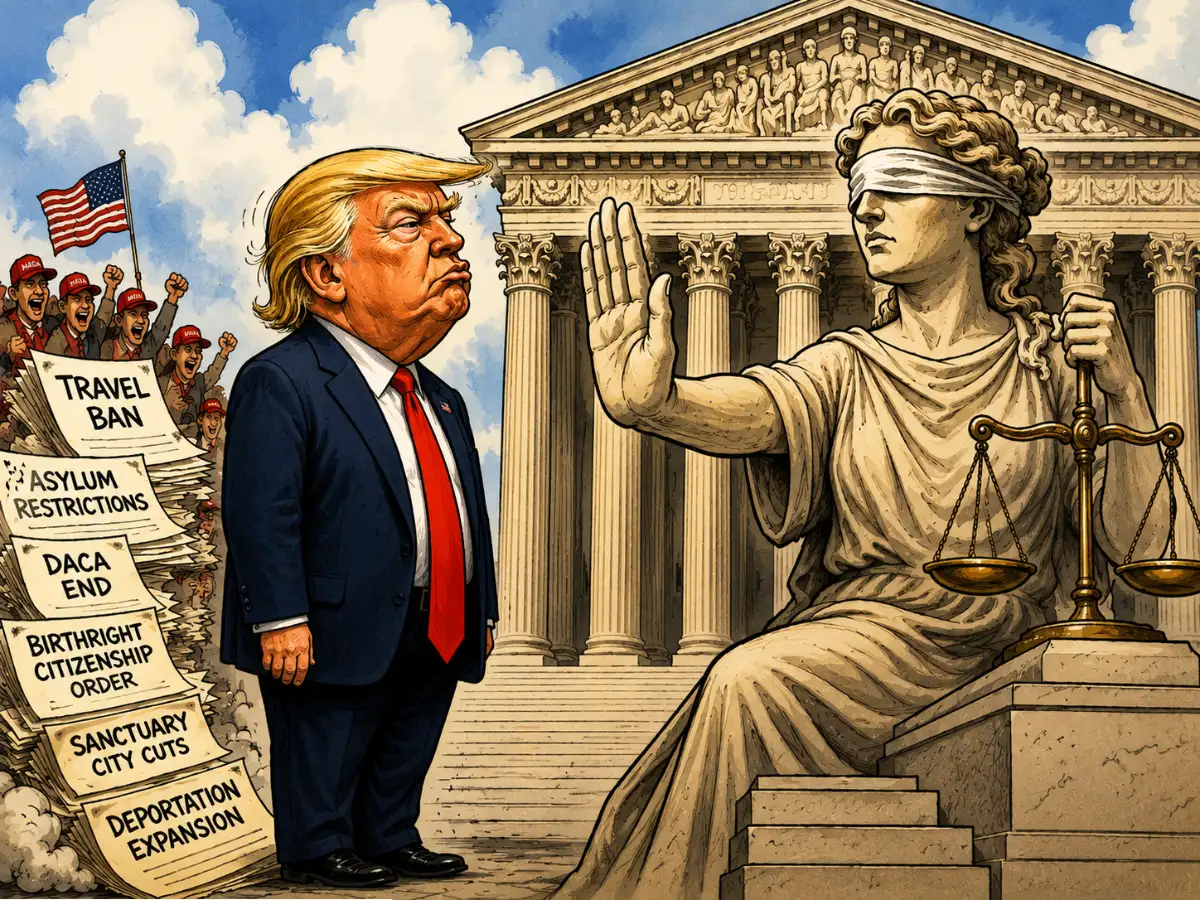
Donald Trump entered office promising the biggest immigration crackdown in modern American history. He fought Congress, governors, mayors, advocacy groups and foreign governments. But the institution that repeatedly slowed, blocked or overturned his plans was much closer to home: the American judiciary.
Immigration became one of the most litigated areas of Trump's presidency. While the administration argued that border security required aggressive executive action, judges repeatedly examined whether those actions complied with federal statutes, constitutional protections and administrative procedures. The resulting legal battles reshaped much of Trump's immigration agenda.

From airport travel bans and asylum restrictions to DACA, sanctuary cities and birthright citizenship, judges have repeatedly told Trump that presidential power has limits. The result is one of the most remarkable constitutional battles in modern US politics: a president determined to test executive authority and a court system determined to define its boundaries.
Trump appointed 234 federal judges, including three Supreme Court justices, according to Federal Judicial Center records.
Yet several of the immigration rulings that frustrated his administration came from courts that included Republican-appointed judges.
The immigration agenda that hit a legal wall
Trump built his immigration strategy around a simple belief: the executive branch should have broad authority to control who enters and remains in the United States.
The courts have often agreed that presidents possess significant immigration powers. But judges have repeatedly ruled that those powers are not unlimited and cannot override federal statutes, constitutional protections or administrative procedures.
That clash has produced a long list of courtroom defeats.
Also Read| The traditional path to a US passport looks less certain than it did a decade ago
Dreamers survive the first big blow
One of Trump's biggest immigration goals during his first term was ending Deferred Action for Childhood Arrivals (DACA), the Obama-era program protecting undocumented immigrants brought to the US as children.
The administration announced the program's termination in 2017. Three years later, the Supreme Court ruled that the administration's attempt to end DACA was unlawful because it failed to properly justify the decision under federal administrative law. The court did not rule on whether DACA itself was legal, but it blocked Trump's effort to end it.
Official USCIS data showed about 515,570 active DACA recipients in FY2025 Q3. That number explains why the case became one of the biggest immigration fights of the Trump era. For many immigration advocates, it was proof that even a president's signature policy could be stopped by procedural requirements.
Sanctuary Cities: Federal funds meet federalism
Trump also sought to pressure so-called sanctuary cities by threatening to withhold federal funding from jurisdictions that refused to fully cooperate with federal immigration enforcement.
Federal courts quickly intervened.
Judges ruled that the administration could not unilaterally impose new funding conditions on cities and counties. The decisions represented an important victory for local governments and a reminder that spending powers largely belong to Congress, not the White House.
The message was clear: immigration enforcement might be federal policy, but Washington could not simply command local governments to fall in line.
The Asylum Wars: 'No entry' meets 'not so fast'
Few areas generated more litigation than asylum policy.
Trump repeatedly argued that the asylum system encouraged illegal migration and needed stricter controls. Judges repeatedly responded that immigration law already spells out who may apply for asylum and under what conditions.
In 2025, a federal judge blocked a sweeping order that largely shut down asylum access at the southern border. Later, a federal appeals court concluded that the administration's suspension of asylum access exceeded presidential authority under existing immigration law.
The courts did not necessarily dispute the administration's concerns about border management. Instead, judges focused on a narrower question: whether the president could bypass statutes written by Congress.
Their answer was largely no.
Birthright Citizenship: The Fourteenth Amendment enters the chat
Perhaps no Trump immigration proposal generated more immediate legal resistance than his effort to restrict birthright citizenship. In 2025, Trump signed Executive Order 14160 to limit birthright citizenship for some children born in the US.
Federal courts blocked it. The Ninth Circuit said the order was invalid and unconstitutional because it tried to deny citizenship to children born on US soil to parents who were temporarily or unlawfully present.
Litigation over the order remains ongoing. However, federal courts have repeatedly blocked its enforcement, with the Ninth Circuit concluding that the administration's interpretation conflicts with longstanding constitutional principles surrounding citizenship.
The fight has become a broader debate over whether executive orders can reshape constitutional doctrine.
Also Read| America’s formula for attracting Indian tech talent is hard to copy, but nations are still trying
Alien Enemies Act: A 1798 law gets dragged into 2025
Trump also tried to use the Alien Enemies Act for fast removals.
The Supreme Court allowed parts of litigation to move differently, but it also made clear that people targeted for removal must receive notice and a chance to challenge deportation.
That ruling did not give Trump a blank cheque. It put due process back at the centre of the fight.
The one time Trump beat the courts
Trump's travel bans offer a more complicated story. The travel ban became the exception that proved the rule: when Trump rewrote the policy to satisfy legal requirements, the courts let it stand. When he did not, judges often stepped in.
For all of Trump's courtroom setbacks, the travel ban showed that judges were not uniformly opposed to his immigration agenda.
Just days after taking office in 2017, Trump signed an executive order restricting entry from several Muslim-majority countries. The move triggered chaos at airports, protests across the country and a flood of lawsuits. Federal judges quickly blocked the order, saying the administration had failed to demonstrate that the policy complied with the law and constitutional protections.
But the White House did not abandon the effort.
Instead, administration lawyers repeatedly revised the policy, narrowed its scope, expanded the national-security justification and built a more detailed administrative record. After multiple legal battles, the dispute reached the Supreme Court.
In June 2018, the Supreme Court upheld a revised version of the travel ban in a 5-4 decision. Chief Justice John Roberts wrote that the president possesses broad authority under federal immigration law to suspend the entry of foreign nationals when he determines that their entry would be detrimental to US interests.
The ruling marked Trump's biggest immigration victory before the nation's highest court. It also revealed an important pattern that would define many future legal battles. Courts were often willing to accept aggressive immigration restrictions when they were firmly rooted in statutory authority and supported by a detailed administrative process. Where judges repeatedly pushed back was when the administration attempted to bypass Congress, ignore procedural requirements or stretch executive power beyond existing law.
The 39-country freeze
A federal judge also struck down a Trump policy that froze final decisions on asylum, work permits, green cards and citizenship applications for nationals of 39 countries.
The judge found the policy legally baseless and called it arbitrary and capricious.
This showed that the courtroom fight was not only about illegal immigration. It also covered legal immigration channels.
H-1B Fee: A $100,000 idea hits a judge
Trump's immigration battles were not limited to undocumented migrants and asylum seekers. Some of his most controversial proposals targeted legal immigration as well.
Last week, a federal judge in Boston struck down a Trump administration policy that would have imposed a $100,000 fee on certain H-1B visa applications, a move aimed at reducing employers' reliance on foreign workers. The administration argued that the fee would encourage companies to hire Americans instead.
The court ruled that the administration lacked the authority to impose such a fee without congressional approval. The decision echoed a recurring theme in Trump's immigration cases: judges often focused less on the policy goal and more on whether the White House had the legal power to pursue it.
The ruling drew attention in India because Indian professionals account for the majority of H-1B visa holders, making the programme one of the most important pathways for skilled migration to the United States. For Trump's critics, the case was another example of courts acting as a check on executive power. For supporters, it was another instance of judges blocking an effort to reshape America's immigration system.
Also Read| Trump's $100,000 H-1B visa fee is unlawful, US judge rules
The census citizenship question
Trump's effort to add a citizenship question to the 2020 Census was officially about data collection.
Critics argued it would discourage immigrant participation and reduce representation in immigrant-heavy communities.
The Supreme Court ultimately blocked the administration's plan, finding that the government's explanation for the change was inadequate. The ruling became one of the clearest examples of courts scrutinizing not just policy outcomes but the reasoning behind them.
The legal limits of executive power
Trump has often portrayed judges as obstacles to border security.
The judiciary sees its role differently.
Federal courts are not deciding whether immigration restrictions are politically popular. Their task is determining whether those restrictions comply with statutes, constitutional protections and administrative procedures.
That distinction explains why courts have sometimes upheld Trump policies and sometimes struck them down. The decisive question is usually not immigration itself. It is whether the administration followed the law while pursuing its goals.
Trump's immigration record, by the cases
| Policy / Action | Court Outcome | Status |
|---|---|---|
| End DACA | Supreme Court blocked the rescission in 2020 | Trump loss |
| Sanctuary-city funding crackdown | Federal courts blocked funding threats | Trump loss |
| Asylum ban for illegal border crossings | Federal courts struck down policy | Trump loss |
| Census citizenship question | Supreme Court blocked addition to 2020 Census | Trump loss |
| Birthright citizenship restrictions | Blocked by lower courts; litigation ongoing | Currently blocked |
| Alien Enemies Act deportation push | Courts imposed due-process limits | Partial loss |
| Expedited deportation expansion | Federal court blocked policy | Trump loss |
| 39-country immigration-benefits freeze | Federal judge struck down policy | Trump loss |
| $100,000 H-1B visa fee | Federal judge ruled fee unlawful | Trump loss |
| Travel Ban (revised version) | Supreme Court upheld in 2018 | Trump win |







