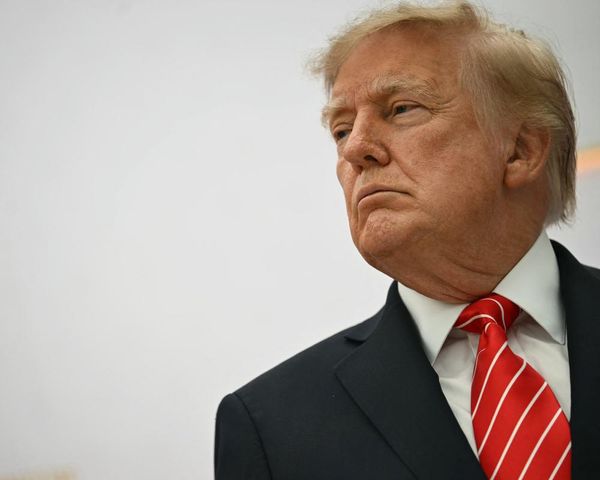
On Friday, President Donald Trump sued The Wall Street Journal for reporting that he contributed to a 2003 collection of letters marking the 50th birthday of financier Jeffrey Epstein, who was later charged with sex trafficking involving underage girls. Although it is well established that Trump was friendly with Epstein when that leather-bound set of birthday wishes was produced, Trump insists he did not write the "bawdy" letter described by the Journal, which he calls a "scam" and a "fake story."
Trump presented his defamation lawsuit, which he filed in the U.S. District Court for the Southern District of Florida, as part of his broader campaign to rein in news outlets that he thinks have wronged him in one way or another. "I'm gonna sue The Wall Street Journal just like I sued everyone else," he told the paper when he was asked to comment on the story. "The Press has to learn to be truthful, and not rely on sources that probably don't even exist," Trump wrote on Truth Social, bragging that he had "already beaten George Stephanopoulos/ABC, 60 Minutes/CBS, and others."
The litigation to which Trump alluded covers a wide range. His defamation claim against ABC, for instance, was at least plausible, since it was based on demonstrably inaccurate reporting. But his lawsuit against CBS, which averred that the network committed consumer fraud by editing a pre-election 60 Minutes interview with former Vice President Kamala Harris in a way that made her seem slightly more cogent, was utterly frivolous. At this point, it is hard to say where Trump's complaint about the Journal's story falls on that spectrum. But in his determination to punish journalists who offend him, Trump typically has not paid much attention to the distinction between actionable torts and constitutionally protected speech.