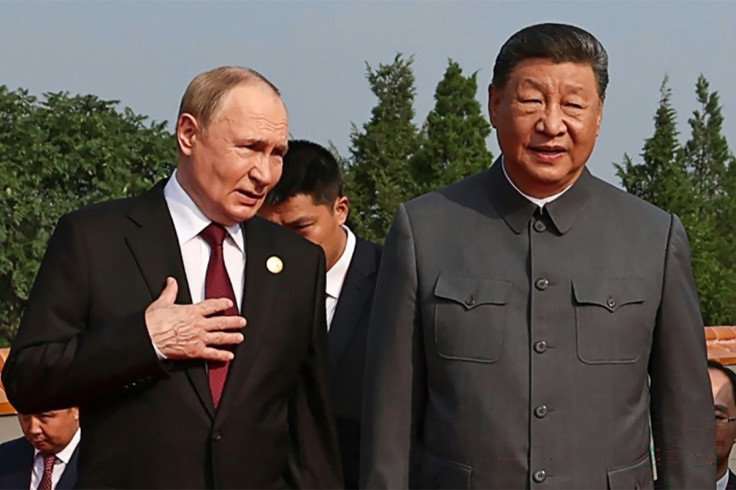
US President Donald Trump and Russian President Vladimir Putin's arrival in Beijing sparked controversy due to the absence of Chinese President Xi Jinping.
In a display of meticulously staged pageantry, Beijing has pulled out all the stops for the arrival of its high-profile international guests. However, beneath the carefully choreographed optics lie a telling diplomatic snub that speaks volumes about the shifting dynamics of global power.
Both Trump and Putin were granted the full red-carpet treatment upon touching down on the Chinese capital. The tarmac was lined with rows of senior Chinese officials and diplomats, whilst crowds of schoolchildren were deployed to wave flags in the crisp Beijing air. Yet, despite the grand military honours, there was one glaring omission from the welcome parties: Xi Jinping was nowhere to be seen.
Check out the video below:
Why Xi Didn't Welcome both Trump and Putin
In accordance with Beijing's strict diplomatic protocol, President Xi refrained from personally greeting either leader at the airport. During his respective visit, Trump was met instead by the Chinese Premier, whereas Putin was received by Foreign Minister Wang Yi.
Controversy aside, all eyes are now fixed on Wednesday's high-level summit between Xi and Putin. The meeting is widely anticipated to showcase an abundance of political camaraderie, warmth, and strategic alignment at a juncture of profound international volatility.
As Russia's grueling war in Ukraine drags on, China's backing has become indispensable to the Kremlin. However, Putin arrives in Beijing at a time when Russia's broader geopolitical safety net is unraveling.
Xi Took a Jab at the US
According to Xi, he has called for closer strategic ties with Moscow in the face of 'rampant' global instability. During their discussions, President Xi took a subtle jab at the United States. He described a rapidly changing and increasingly fractured global landscape, per CNN.
'The international situation is marked by intertwined turbulence and transformation, while unilateral hegemonic currents are running rampant,' Xi said.
The remark reflects Beijing's standard diplomatic rhetoric. Chinese officials frequently use these terms to criticize American foreign policy and military overreach.
Xi Wants Conflicts to End
In response to these global pressures, Xi urged both nations to deepen their alliance. According to Chinese state media, he declared that China and Russia must enhance their 'comprehensive strategic coordination.'
The bilateral talks also focused heavily on the conflict in the Middle East. President Xi directly addressed the ongoing US-Israeli war against Iran. The Chinese leader warned of severe economic consequences if the fighting continues.
He noted that an 'early end' to the conflict is vital for global stability. Specifically, he highlighted the need to protect energy supplies, secure international trade, and prevent further disruption to global supply chains.
Appeal for Immediate Diplomacy
Ultimately, Xi issued a strong appeal for immediate diplomacy to prevent the war from spreading further.
'A comprehensive cessation of war brooks no delay, restarting hostilities is even less desirable, and persisting with negotiations is particularly important,' he emphasised.
With Russia's traditional regional allies severely weakened, the power balance within the Beijing-Moscow axis is visibly tilting. Analysts suggest that the relationship has evolved beyond a partnership of equals. Instead, China is increasingly asserting itself as the indisputable senior power.
Wednesday's highly anticipated summit is expected to provide the clearest visual evidence yet of this new reality, offering a clear illustration of how the equilibrium between these two autocratic powers has fundamentally changed.