Iran's parliament speaker Mohammad Bagher Ghalibaf said on Wednesday that the United States' naval blockade of the country’s ports aimed to create division and "make us collapse from within."
He said US President Donald Trump "divides the country into two groups: hardliners and moderates, and then immediately talks about a naval blockade to force Iran into submission through economic pressure and internal discord," state TV reported.
With the killing of numerous Iranian leaders in US-Israeli strikes, including supreme leader Ayatollah Ali Khamenei, there has been widespread speculation over the balance of power within the Islamic republic.
Ghalibaf, a powerful figure, has grown in prominence since the start of the war and was the lead negotiator in the so far only round of direct US-Iranian talks.
"The enemy has entered a new phase and wants to activate economic pressure and internal division through naval blockade and media hype to weaken or even make us collapse from within," he said on Wednesday.
He called for "maintaining unity" as the only solution.

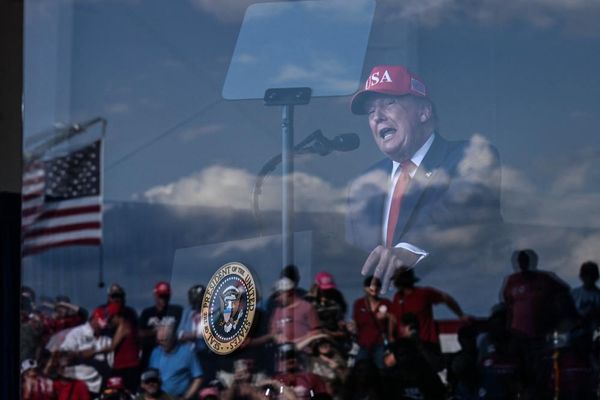
Ghalibaf's comments come on the same day that Trump warned Iran to "get smart soon" and agree to a peace deal as efforts by Washington and Tehran to end hostilities appeared to still be at an impasse.
"Iran can't get their act together. They don't know how to sign a nonnuclear deal. They better get smart soon!" Trump wrote in a post on his Truth Social platform, alongside an illustration of Trump holding an assault rifle, with the caption "No more Mr Nice Guy".
A second round of peace talks was due to take place in Islamabad at the weekend, but Trump abruptly ordered his envoys not to attend.
Speaking to Fox News, Trump said, "I've told my people a little while ago they were getting ready to leave, and I said, 'Nope, you're not making an 18-hour flight to go there.'"
"We have all the cards. They can call us anytime they want, but you're not going to be making any more 18 hour flights to sit around talking about nothing," he added.
He also told US media outlet Axios that the cancellation of the talks did not mean a resumption of hostilities, insisting that "we have not thought about it yet."

US special envoy Steve Witkoff and Jared Kushner were to head to Pakistan on Saturday for an "in-person conversation" in order to "hopefully move the ball forward towards a deal," the White House said on Friday.
However, Iranian state-run media insisted that direct talks were never on the table to begin with, as Foreign Minister Abbas Araghchi wrapped up his own diplomatic visit to Islamabad ahead of Trump's announcement.
Araghchi met with Pakistani military chief Asim Munir, a key figure in the mediation effort, Prime Minister Shehbaz Sharif and Foreign Minister Ishaq Dar.
A first round of negotiations between Iran and the US took place in Pakistan earlier this month but both sides failed to reach a deal.
Plans for long blockade
Meanwhile, Trump has told US national security officials to prepare for a long blockade of Iran's ports in order to compel Tehran to give up its nuclear programme, according to US media reports.
Trump, according to the Wall Street Journal report on Wednesday, does not believe that Iran is negotiating in good faith and hopes it can be forced to suspend uranium enrichment for 20 years and accept tight restrictions thereafter.
Citing unnamed officials, the WSJ said Trump had decided during a Monday meeting in the White House situation room that both resuming bombing and walking away from the conflict were too risky.
Instead, he reportedly told officials that the US Navy would continue to squeeze Iran's key oil exports until Tehran agrees to all of Washington's demands.

Iran effectively closed the crucial Strait of Hormuz when the war broke out on 28 February. Normally one-fifth of the world's oil and liquefied natural gas transits the waterway. Its closure has sent energy prices skyrocketing around the world.
On 13 April, the US Navy imposed its own blockade on Iranian ports which US Central Command said would apply to "the entirety of the Iranian coastline."
That blockade is already being felt in Iran with currency-tracking websites saying on Wednesday that the rial had plummeted to a record low against the dollar.
On the black market, the rial was trading at around 1.80 million against the US dollar, the Bonbast and AlanChand exchange websites reported.
When the war started, one US dollar was worth about 1.70 million rials.
Iran officially has several fixed exchange rates, but the two websites are generally used as benchmarks for unofficial rates.