Get all your news in one place.
100's of premium titles.
One app.
Start reading
The Independent UK
The Independent UK
Alex Woodward

Trump wants to ban gender-affirming care for trans inmates — for ‘security’ reasons

Donald Trump’s administration is once again returning to the Supreme Court to target gender-affirming healthcare for transgender Americans. This time, the president wants to prevent trans people in the nation’s prisons from getting access.

Court rulings that grant trans inmates access to gender-affirming care, according to the government, threaten “institutional security.”

The phrase echoes the president’s ongoing reliance on “national security” as a last-ditch legal defense as he battles lawsuits against his ballroom, a ban on media outlets from covering the White House, and construction of a 250-foot victory arch, among others.

The administration’s 41st emergency petition to the nation’s high court now calls on the justices to overturn court orders that blocked prison officials from providing trans inmates with affirming healthcare, a policy that is “necessary to maintain institutional security,” according to the government.

A federal judge’s order that blocks the policy “causes irreparable harm to the government and to the public,” Monday’s filing says.

“The administration’s policy is a direct threat to the well-being of transgender people in federal custody and an open violation of their fundamental rights,” according to a joint statement from the Transgender Law Center and ACLU, which are representing plaintiffs in the case.

“The withholding of medically necessary health care, including gender-affirming health care, from people in prison violates their Constitutional right to serve their sentence free of cruel and unusual punishment,” they said. “We will continue to defend the rights of our clients and all incarcerated people.”

On his first day in office, Trump issued an executive order to restore “biological truth to the federal government,” a measure that has sought to erase the concept of gender from the federal government by ordering agencies to only recognize male or female sexes as assigned at birth.

The president ordered prisons to deny “any medical procedure, treatment, or drug for the purpose of conforming an inmate’s appearance to that of the opposite sex.” The policy also blocked trans inmates from buying clothing or commissary items that prison officials claimed are inconsistent with a person’s sex at birth.

Trump’s far-reaching executive orders targeting trans people claim that an ideologically driven movement to “deny the biological reality of sex” has a “corrosive impact not just on women but on the validity of the entire American system.”

Trans women make up only a small fraction of the federal prison population in women’s facilities — roughly 20 people, according to the Bureau of Prisons. The remainder, roughly 2,200 trans inmates in federal prisons, are detained in facilities that match their sex at birth, according to court filings.

Several lawsuits were filed to reverse Trump-directed prison policies that stripped inmates of affirming healthcare and forced trans women into men’s facilities.

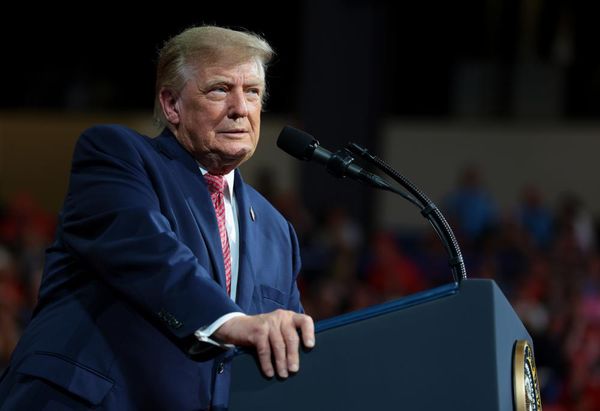
The Trump administration is frequently relying on ‘security’ issues to beat back lawsuits against the president’s pet projects, including his ballroom and media ban — and now gender-affirming care for trans inmtes (Getty)

Kingdom v Trump, which is now in front of the Supreme Court, stems from a case brought by two trans men and one trans woman who were diagnosed with gender dysphoria by Bureau of Prisons medical providers and prescribed hormone therapy by health care staff.

But under Trump, that care was suspended, triggering a lawsuit.

The loss of hormone therapy for a trans woman who has been prescribed injections since 2016 caused her to experience “anxiety, hopelessness, panic attacks, and suicidal ideation,” according to court filings.

Trans men who were denied ongoing testosterone treatments said they feared their menstrual cycles would return.

Plaintiffs argue Trump’s policy violates the Eighth Amendment’s prohibition on cruel and unusual punishment.

Last year, 83-year-old Ronald Reagan-appointed Judge Royce Lamberth said Trump’s attempt to deny inmates gender-affirming care isn’t based on any “reasoned” analysis. “Nothing in the thin record” of the case shows that the administration “consciously took stock of — much less studied — the potentially debilitating effects” of stripping trans people of their healthcare, he argued.

Lamberth said trans people receiving hormone treatments “do not seem interested in propagating any particular ‘ideology.’”

Trans inmates rely on those treatments to “lessen the personal anguish caused by their gender dysphoria, a benefit on which they have relied for years” under longstanding Bureau of Prisons policy, according to the judge.

He wrote that the administration did not provide “any serious explanation” or “any effort whatsoever” to explain how gender-affirming care damages “scientific inquiry, public safety, morale, trust in government.”

Trump has issued several executive orders against trans Americans, including prison policies strip inmates of affirming healthcare and force trans women into men’s facilities (Getty)

In the government’s emergency appeal to the Supreme Court, the Trump administration argues that the judge should have deferred to the Bureau of Prisons’ own expertise.

The judge’s suggestion that prison officials “provide additional factual support for those concerns” is ‘misguided,” according to Solicitor General D. John Sauer.

“Considerations of ‘institutional security’ are ‘peculiarly within the province and professional expertise of corrections officials, and, in the absence of substantial evidence in the record to indicate that the officials have exaggerated their response to these considerations, courts should ordinarily defer to their expert judgment in such matters,’” Sauer wrote.

Security concerns “outweigh” any benefits to providing affirming healthcare, he wrote.

“Any demand for additional evidence of security concerns cannot be reconciled with the ‘wide-ranging deference’ to which [the Bureau of Prisons’] expert judgment is entitled,” Sauer wrote. “Nor can it be reconciled with the ‘deference’ owed to agencies’ policy judgments in general.”

Sign up to read this article
Read news from 100's of titles, curated specifically for you.
Already a member? Sign in here
Related Stories
Top stories on inkl right now
One subscription that gives you access to news from hundreds of sites
Already a member? Sign in here
Our Picks
Fourteen days free
Download the app
One app. One membership.
100+ trusted global sources.