President Donald Trump’s obsession with Joe Biden and the results of the 2020 election seeped into his discussions with Ukraine’s leader over ending the war in Russia and colored his commentary to reporters afterwards.
The Sunday meeting between Trump and Ukrainian President Volodymyr Zelensky ended largely as other conversations between the president and various sides of the Ukraine-Russia conflict had ended before it: With both parties touting how “close” they are to the finish line.
Once again that finish line simultaneously appears to be “close” and, still, far off in the distance.
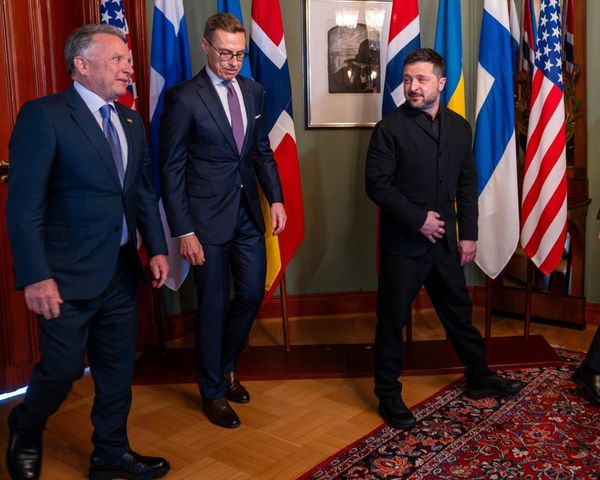
The two leaders met at Trump’s Mar-a-Lago compound in Florida for an extended discussion that appeared to last for several hours behind closed doors. Trump, speaking to reporters afterwards with Zelensky, explained that there remain “thorny issues” that could not be worked out in a single day — appearing to admit that his claim that he could end the war in that exact time period was impossible.
And as the president spoke alongside his Ukrainian counterpart it was clear just how much of a verbal minefield Zelensky was walking into. Trump’s thoughts constantly veered back to the long-defunct Robert Mueller investigation into his 2016 campaign as well as his baseless insistence that the 2020 election was stolen from him.
“I've said and nobody's disputed it, that if the election weren't rigged and stolen [in] 2020, you wouldn't have had this war,” Trump ranted to reporters as Zelensky stood awkwardly beside him.
“And it didn’t happen, for four years ... I spoke with president Putin. I got along with him very well, despite the Russia, Russia, Russia hoax, which was a total hoax,” he said.
Trump’s fixation was also evident as he brushed off concerns about a massive Russian strike on Kyiv a day earlier which killed two people and drew accusations that Vladimir Putin had no interest in ending the war. His remarks to reporters, in turn, elicited the same vibes as that fateful 2018 press conference with Putin where Trump denied the finding of U.S. intelligence agencies regarding Russian political interference in the United States.
“I could say that Ukraine has leveled some pretty strong attacks also,” Trump countered to a reporter who asked on Sunday about a strike one day earlier that appeared to hit a Kyiv apartment block, engulfing buildings in flames.
“Russia wants Ukraine to succeed,” Trump claimed, eliciting a surprised jerk of the head from Ukraine’s president.
He went on to claim that he spoke to Putin about rebuilding Ukraine after the war, adding: “President Putin was very generous in his feeling toward Ukraine succeeding, including supplying energy at very low prices.”

There was little discussion, again, about the kind of pressure that Trump would level against Russia to press Putin to make a deal if the Russian leader balked at the U.S.-negotiated terms Ukraine would offer.
The focus remained on divisions between the vision outlined by Trump and his negotiating team headed up by Steve Witkoff, Jared Kushner and Marco Rubio and what Ukraine was willing to accept, which seemed to still indicate daylight between the sides on the issues of Ukraine’s security guarantee and particularly Ukrainian recognition of the Russian-occupied Donbas.
But actual details about what remains to be ironed out were sparse in the immediate aftermath of the Mar-a-Lago talks.
Trump also spoke Sunday with Putin over the phone, directly, before his conversation with Zelensky. He then told reporters he would be calling Putin against after his meeting with Zelensky.
He repeated his belief that the Russian president was serious in his aims for peace.
But when asked directly what would happen if the two sides couldn’t reach an agreement within the coming weeks, Trump could only say that the carnage would continue — and made no promise to take further steps to end the war himself.
Even as he tried to boast once again Sunday about his supposed record of peacemaking, and with 2025 coming to a close, it is becoming increasingly possible that Trump’s very public refusal to give up his hurt feelings over the investigation into his 2016 campaign’s alleged ties to Russia has tainted his view of a problem he vowed to solve. It could make a solution — or the political will to enact it — all the more difficult.