
When he gave his first midterm State of the Union address back in 2018, President Donald Trump extended a hand to congressional Democrats. But analysts doubt they’ll see a sequel to that Tuesday night.
Trump will step to the dais in the House chamber just after 9 p.m. EST next week after spending his first 13 months back in office sidestepping and mostly ignoring the legislative branch while also bulldozing past the norms and traditions that have maintained some balance between the branches.
That address is expected to differ sharply from the speech he gave on Jan. 30, 2018, when he told lawmakers, “I am extending an open hand to work with members of both parties, Democrats and Republicans, to protect our citizens, of every background, color, and creed.”
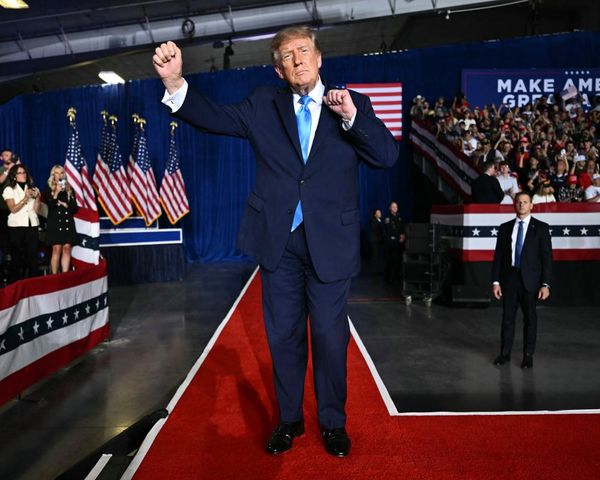
Still early in his first term and learning the ways of Washington, Trump 1.0 was eager to put more legislative wins on the board. But this time is different, with Trump 2.0 boasting multiple times in public that he secured much of his second-term domestic agenda via the massive tax and spending bill Republicans passed last year.
In fact, Trump has said he does not need any additional major legislation from Congress over his final three years in office. That declaration, coupled with November’s midterms with control of both chambers up for grabs, likely will make Tuesday’s address more of a political speech than a sweeping policy address.
“It is going to be a very good and powerful speech,” White House press secretary Karoline Leavitt told reporters Wednesday. “The president is still digging his way out of the mess that was created by Joe Biden’s administration.”
The speech will likely include references to the Supreme Court’s bombshell 6-3 ruling Friday striking down his claimed authority to implement sweeping tariffs. Whatever the president says Tuesday evening about his Plan B on most of his tariffs likely will only be the start of a lengthy battle to sort out the legally wrought matter of a chief executive’s authority to act unilaterally on the trade tactic. The United States government took in $288.5 billion in tariff revenue in 2025, a sharp uptick from 2024 ($98.3 billion), according to data compiled by the Bipartisan Policy Center.
U.S. Trade Representative Jamieson Greer said last month that administration officials would move quickly to replace the emergency tariffs with other import fees if the high court cast them aside. “The reality is the president is going to have tariffs as part of his trade policy going forward,” Greer told The New York Times, saying White House economic advisers presented the president with “a lot of different options” at the start of this term.
“The ultimate goal for the president will be to change the conversation. He’s going to try to, yes, fire up Republican voters — especially low-propensity voters. But he’s going to want to break through Democrats’ echo chamber,” said Republican strategist Ford O’Connell, who expects a lengthy address. “And when else before Election Day are you going to have that many eyeballs tuning in?
“He’s going to bring all the receipts on economy and affordability. He’s going to hit hard on gas prices, and having stabilized Joe Biden’s inflation crisis and on crime — with a murder rate that’s the lowest in 100 years,” O’Connell added during a Thursday telephone interview.
“I think you’re going to hear about the SAVE Act,” O’Connell said, referring to a voter ID bill. “But there will be a lot about aspects of affordability we don’t focus on a lot: housing, drug prices. And banning stock trading by Congress — that pisses everyone off.”
Aaron Cutler, a former aide to House GOP leadership, said in a Thursday email that “the president connects best with the American people directly so is probably going to be speaking to them directly on Tuesday,” adding that Trump “feeds off the energy of the national stage and the history of the evening, and I’m sure he is going to come in forceful.”
One former GOP Senate leadership aide said viewers should “expect a campaign speech and likely a long one,” adding in a Wednesday email: “I truly wonder if there won’t be several members, particularly on the Democratic side, absent from the floor.”
“He will tout the ‘One Big Beautiful Bill Act’ and the fact that Americans will see big tax cuts and bigger refunds this spring because of it,” the former aide added. “He will not mention that, according to the Congressional Budget Office’s most recent report, it also added $1.4 trillion to the debt.”
Financial fears
Amid sagging poll numbers about his handling of the economy and high prices, Trump will face pressure to lay out his plan for easing Americans’ financial worries.
“Voters definitely do not seem satisfied. … I think people are just super annoyed at the level of prices,” Wendy Edelberg, a former chief economist for the Congressional Budget Office said last week. “There were a bunch of things that became a lot more expensive from 2020 to 2024, and I think people are a little scarred. Rents for new leases skyrocketed. Food prices skyrocketed. Owning a home became out of reach. Some of those factors were temporary and they’ve come down.
“Child care, if you want really high quality child care, is exceedingly expensive,” Edelberg said on a Feb. 12 podcast for the Brookings Institution, where she is a senior fellow. “The cost of health insurance has been rising year after year after year for a very long time. These are structural factors that really frustrate people, but I think have now been caught up in this affordability conversation.”
To that end, Trump’s message on affordability during a stop in northwest Georgia on Thursday was that Democrats’ focus on affordability was a “con job.”
“Airfares, hotels, car payments, rent, sports events, groceries, everything’s down, everything’s down, dairy, eggs, potatoes and chicken. Core inflation is now the lowest of any time in more than seven years,” Trump said during a Thursday campaign stop in Rome, Ga. “The last three months, we’ve had the lowest inflation we have had in over a decade, the last three months, it’s 1.4 percent. We had record inflation. You don’t have it anymore. I’m going to make a State of the Union address on Tuesday. I hope you’re going to watch, and we’re going to be talking about it.” (The administration’s own data, however, suggests the inflation rate is higher.)

“What he should say Tuesday night is that, yes, inflation has come down and unemployment remains relatively low. He will take credit and give no credit to Jay Powell for managing this soft landing into the spring,” the former GOP Senate leadership aide said, referring to the Federal Reserve chair, whom Trump regularly criticizes.
“If he is honest with the American public, he should recognize, however, that there remains much uncertainty in the economy and that certain sectors, e.g., housing, electricity, and health care costs continue to and will likely continue to be a major issue,” the former aide added.
Cutler said Trump does have some economic highlights on which he could focus, including gas prices, retirement account growth, unemployment declines and falling crime rates.
Tehran talk
Trump’s economic policies and inability to pare stubbornly high prices has frustrated voters across the board. His foreign policy, which has been more aggressive than anticipated, has frustrated his “America First” base.
Just last week, Trump spent ample time focused on foreign affairs, a mainstay of any second presidential term. That included making a number of declarations and spending a large chunk of time meeting with or talking to other world leaders as Democratic and Republican senators tried in vain to avert a Department of Homeland Security shutdown.
The commander in chief spent nearly three hours behind closed doors on Feb. 11 with Israeli Prime Minister Benjamin Netanyahu. Yet, in a candid social media post as Netanyahu departed the executive mansion, Trump admitted “there was nothing definitive reached other than I insisted that negotiations with Iran continue to see whether or not a Deal can be consummated. If it can, I let the Prime Minister know that will be a preference.”
The telling assessment revealed cracks in his working relationship with Netanyahu, who has pushed for a broader agreement with Iranian leaders that they likely would reject.
Republican hawks in Congress will be listening for Trump’s tone on Israel, which they view as perhaps America’s most important ally — and also on Iran, which Trump has toggled between threatening with new military strikes and predicting a deal on its nuclear program.
Ironically, Trump has floated a possible pact similar to the Obama-era agreement from which he removed the United States during his first term. Should he announce something like that Tuesday night, some GOP hawks might opt to remain seated.
Trump said Friday the best thing that could happen in Iran is for new leadership to take over. But he did not specify how that could happen.
“It seems like that would be the best thing that could happen,” he told reporters as he departed Fort Bragg in North Carolina. “For 47 years, they’ve been talking and talking and talking. In the meantime, we’ve lost a lot of lives while they talk. Legs blown off, arms blown off, faces blown off. We’ve been going on for a long time. So let’s see what happens.”
Asked who he would want to take over in Tehran, Trump initially replied, “I don’t want to talk about that,” but then added: “There are people.”
Appearing to refer to the Islamic Republic’s nuclear program — which he previously declared “obliterated” following U.S. bomber strikes he ordered last year — Trump said “we don’t want enrichment.”
Senate Foreign Relations Committee member Pete Ricketts said many members would like to avoid a military confrontation with the Islamic Republic.
“We’ve been negotiating with Iran for a long time, and they have always tried to block us with regard to getting them to stop the nuclear enrichment. I think we’ve got the best chance now we’ve had in years. We’ve got a strong president. Iran is very weak,” the Nebraska Republican told Fox News on Sunday. “So, we’ve got a lot of opportunity to be able to try and drive this home. It’s really important that we don’t allow Iran to have a nuclear weapon.”
Trump on Thursday said it would become clear “over the next, probably, 10 days” if a new nuclear deal with Iran is possible — or if new U.S. military strikes on the Islamic Republic are necessary. Notably, he described Iran’s nuclear capability as “decimated” after the previous strikes, an apparent downgrade from his former “totally obliterated” assessment.
The post Trump speech expected to be heavy on politics, lower on policy appeared first on Roll Call.