Get all your news in one place.
100's of premium titles.
One app.
Start reading
International Business Times UK
Chelsie Napiza

Trump Signs Executive Order Endorsing Psychedelic Psilocybin and Ibogaine; Asks 'Can I Have Some, Please?'

Maren Morris Calls Trump 'Dementia-Ridden' in Viral Rant (Credit: Real Donald Trump Instagram Account)

President Donald Trump signed a sweeping executive order on 18 April 2026 directing federal agencies to fast-track the review, funding and potential reclassification of psychedelic drugs including psilocybin and ibogaine as treatments for serious mental illness.

The order, titled 'Accelerating Medical Treatments for Serious Mental Illness,' instructs the Food and Drug Administration to issue National Priority Vouchers to qualifying psychedelic compounds already granted Breakthrough Therapy designation, allowing their review to proceed in a matter of weeks rather than years.

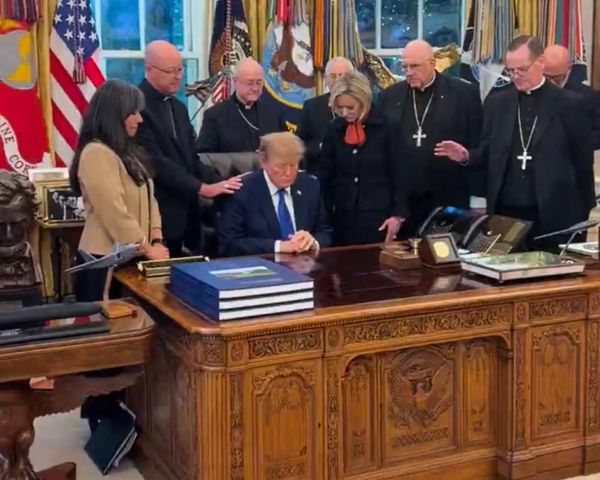
It also allocates at least £39 million or $50 million through the Advanced Research Projects Agency for Health to support state-level psychedelic research programmes. The announcement, delivered in the Oval Office alongside Health Secretary Robert F. Kennedy Jr., CMS administrator Dr. Mehmet Oz, veteran and author Marcus Luttrell and podcast host Joe Rogan, drew laughter when the president turned to the room and said, 'Can I have some, please?'

What the Executive Order Mandates

The order operates across five principal directives. The FDA Commissioner must provide Commissioner's National Priority Vouchers to psychedelics that have already cleared Breakthrough Therapy designation, a status the FDA reserves for drugs showing preliminary clinical evidence of substantial improvement over existing therapies.

Separately, the FDA and the Drug Enforcement Administration are directed to create an access pathway for eligible patients under the Right to Try Act (21 U.S.C. 360bbb-0a), which allows terminally ill patients to access investigational treatments that have not yet received full FDA approval. The order specifies that this pathway must cover ibogaine compounds and requires the DEA to issue Schedule I handling authorisations to treating physicians and researchers where necessary.

The Attorney General is further instructed to initiate rescheduling reviews for any psychedelic product that has successfully completed Phase 3 clinical trials and received FDA approval, so that reclassification under the Controlled Substances Act can proceed 'as quickly as practicable.'

Psilocybin, the active compound in so-called magic mushrooms, and ibogaine, derived from the West African iboga plant, both remain classified as Schedule I substances under federal law, meaning the DEA considers them to have no currently accepted medical use and a high potential for abuse.

The order does not reschedule either compound. It initiates a federal review process and clears bureaucratic pathways while the underlying clinical evidence is gathered and assessed.

Veterans, Suicide Rates and the Public Health Case Behind the Order

The order's preamble grounds the policy in a documented public health crisis. It cites figures showing that more than 14 million American adults live with a serious mental illness, defined as a diagnosable disorder that substantially interferes with daily functioning, and that about 8 million are already on prescription medication. National suicide rates rose 37% between 2000 and 2018. While the administration claims a 5% reduction during Trump's first term, it acknowledges that rates rebounded to their highest recorded level in 2022.

Veterans bear a disproportionate share of the burden. The order states that more than 6,000 veteran suicides occur in the United States each year, a rate more than twice that of the non-veteran adult population.

Marcus Luttrell, the retired Navy SEAL and author of Lone Survivor who attended the signing, said during the Oval Office ceremony: 'You're going to save a lot of lives through it. It absolutely changed my life for the better.' The Department of Veterans Affairs is already participating in at least five psychedelic drug trials across New York, California and Oregon, according to reporting by KPBS.

The administration's fact sheet points to research programmes at Stanford University, Harvard University and Johns Hopkins University as evidence of credible scientific interest. In 2025, Texas launched a research consortium to accelerate ibogaine clinical trials, which the White House cites as a model for the state-federal partnership the order seeks to replicate nationally.

The Science on Psilocybin and Ibogaine

Federal psychedelic research has a fractured history. Studies in the 1950s reported early evidence of therapeutic potential in treating addiction and psychiatric conditions, but the US government largely shut down such research in the 1960s as recreational use proliferated. The current wave of clinical investigation only resumed in earnest in the late 2010s. A 2025 study published in the Journal of the American Medical Association found that a single dose of LSD provided months of relief from anxiety and depression, though LSD is distinct from the two compounds named in this order.

The National Institute of Mental Health records that at least 21 million American adults have experienced a major depressive episode, and about one in ten Americans carry a diagnosis of generalised anxiety disorder, according to data published by the Research Triangle Institute. These figures form the epidemiological backdrop against which the order is framed.

Ibogaine, however, carries documented cardiovascular risks, including cardiac arrhythmia, that have stalled its regulatory path in multiple jurisdictions. The Food and Drug Administration's 2024 rejection of MDMA-assisted therapy for post-traumatic stress disorder, following an advisory panel vote citing insufficient safety and efficacy data, is a recent precedent that complicates projections of swift approval for any psychedelic.

Food and Drug Administration commissioner Mary Makary stated that the priority vouchers to be issued next week could, in principle, compress review timelines to a matter of weeks. Whether that timetable proves realistic given the outstanding safety questions on ibogaine remains to be seen.

Sign up to read this article
Read news from 100's of titles, curated specifically for you.
Already a member? Sign in here
Related Stories
Top stories on inkl right now
One subscription that gives you access to news from hundreds of sites
Already a member? Sign in here
Our Picks
Fourteen days free
Download the app
One app. One membership.
100+ trusted global sources.