Get all your news in one place.
100's of premium titles.
One app.
Start reading
Latin Times
Latin Times
Politics
Miguel Paiva

Trump Seals Massive Saudi Arms Deal While Weighing All-Out Iran Strike — 'Annihilate' or Negotiate?

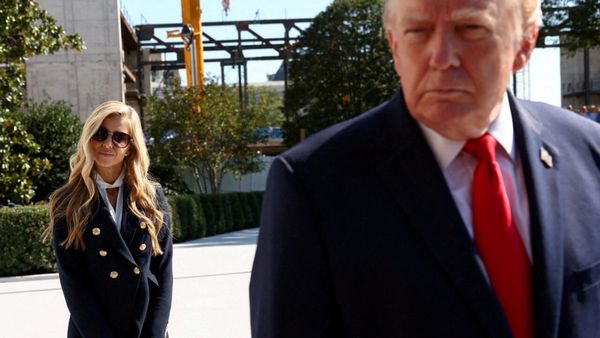
US President Donald Trump speaks during a Rose Garden dinner at the White House in Washington, DC, on September 17, 2026. (Credit: Photo by Mandel NGAN / AFP via Getty Images)

The Briefing:

  • Trump said he is weighing an all-out offensive against Iran — "Do I want to go in and annihilate them or do I not?" — on the same day his State Department cleared the sale of 48 F-35 fighters to Saudi Arabia.
  • The package is worth $24.3 billion for 48 jets and 49 engines — roughly $506 million per aircraft, about five and a half times what the Pentagon pays for one off the line.
  • Trump meets six Gulf leaders in New York on Tuesday the 22nd, the same day the UN General Assembly opens its general debate. Brent is trading near $104.

Donald Trump put into words what his advisers have spent weeks arguing behind closed doors. "Do I want to go in and annihilate them or do I not?" he told Axios, framing the choice he faces on Iran. Hours later his own State Department signed off on selling Saudi Arabia the most advanced combat aircraft in the American inventory.

A Decision With No Deadline and a Summit on the Same Tuesday

The president set no timetable. Asked whether he would move before or after November's midterm elections, he declined to commit. The only step he specified is the one that comes first: on Tuesday he hosts the leaders of Saudi Arabia, the UAE, Qatar, Bahrain, Kuwait and Oman in New York. He said he wants to learn where those governments stand — partners Washington has, by his account, spent years shielding.

That Tuesday is Sept. 22, the very day the UN General Assembly opens its general debate. The overlap captures the moment: at one end of Manhattan, a president weighing an offensive; at the other, 193 delegations calling for restraint.

Neither War Nor Peace: the Stalemate His Own Officials Describe

The war has run past 200 days. It began on Feb. 28 with joint US and Israeli strikes, and two attempts to stop it have failed. The first, a two-week pause brokered by Pakistan on April 7, unraveled almost at once. The second, the Islamabad Memorandum signed June 17, promised 60 days to negotiate peace: Trump declared it finished on July 7 and it formally expired on Aug. 17. Tehran suspended its commitments and now speaks to Washington only through Oman and Pakistan.

What remains is a US naval blockade of Iranian ports, widening sanctions and a strait turned into a cash register. On Sept. 17 the Treasury sanctioned the crypto exchange BitBank for moving hundreds of millions of dollars in bitcoin to the Revolutionary Guard between June and July. The money came from the maritime authority Iran created to charge ships for safe passage.

In ordinary times Hormuz carries about one-fifth of the world's oil. Under blockade, actual transit is running near 11 million barrels a day. It also remains lethal: on Sunday the 13th an Iranian cargo ship was hit by a projectile off Qeshm Island. One crew member died and four were hurt. The provincial governor blamed a "terrorist enemy"; asked whether the United States had struck the vessel, Trump said he would rather not say.

The Contrast: Riyadh Gets the Jet Washington Almost Never Sells

While the White House weighs bombing Tehran, it is handing its neighbor Lockheed Martin's crown jewel. The notification covers 48 F-35As, 49 Pratt & Whitney F135 engines — one of them a spare — encrypted communications gear, precision navigation, electronic warfare support, spares, training, software and technical documentation. Weapons are not included; munitions move through separate notifications.

The State Department argued the deal will not shift the regional military balance and cast it as reinforcing a major non-NATO ally. It is the first time an Arab country has been cleared for a fifth-generation stealth fighter.

For Riyadh the math is not theoretical. Iran struck Saudi soil from the war's opening day: the Ras Tanura refinery, the Shaybah field, the SAMREF plant. The official toll stands at three civilians killed and 23 wounded. Last week brought the costliest blow yet, when drones launched from Iraq's Maysan province hit pumping stations on the East-West pipeline, the 7-million-barrel-a-day artery that lets the kingdom bypass Hormuz altogether. Aramco shut it on Sept. 11, and regional officials estimate three to five weeks of repairs, with the line running partially in the meantime.

The Saudi response explains this week's market move. Riyadh offered to pump more crude through Hormuz to cover the gap, and oil fell for a third straight session: Brent slipped about 1% to $104 and WTI edged toward $101.

What an F-35 Actually Costs: the Number That Misleads

Divide $24.3 billion by 48 aircraft and you get roughly $506 million apiece. The obvious comparison stings: the Pentagon just committed $24.29 billion for 296 airframes in Lots 18 and 19. For the same money, in other words, Washington buys six times as many jets.

The gap is not a Saudi markup. The two figures measure different things. Factory cost for an F-35A, engine included, landed at $92 million in those lots — $82.4 million for the airframe and roughly $9.6 million for the F135. What Riyadh is buying is a full program package: pilot and maintainer training, simulators, spares, encryption, electronic warfare mission data, software updates and years of sustainment, with foreign military sales administrative surcharges layered on top.

Two more caveats for reading the number. A congressional notification is an authorized ceiling, not a signed contract, and final values almost always come in lower. And the jet itself got more expensive: the F-35A rose 11.5% from the $82.5 million of Lots 15 through 17, which the manufacturer attributes to inflation in labor and raw materials plus the Technology Refresh 3 and Block 4 upgrades. The F-35B climbed 11.4% and the F-35C 8.5%.

The Obstacle: 30 Days in Congress and the China Problem

Clearance is not delivery. Congress has 30 days to block the sale through a joint resolution of disapproval, which any senator can force to a vote after ten days and which the president can veto. No such resolution has been filed against the F-35 package: the one Ed Markey and Jeff Merkley are pushing targets a separate conventional arms sale notified earlier this month.

The deeper objection is technological. US intelligence analysts warned in at least two assessments that sensitive components — the radar and surveillance sensors above all — could end up in Chinese hands, given how much Chinese technology sits inside Saudi telecom networks and how much access Beijing has to the kingdom's military facilities. Their recommendation: restrict F-35 sites to American and Saudi personnel only.

Israel, which spent years blocking comparable deals, did not object head-on this time, though it wanted Trump to tie the sale to normalization with Riyadh. The president encouraged that agreement with Mohammed bin Salman without making it a condition.

The Double Standard That Will Fuel the Debate

The contradiction is hard to paper over: the same administration weighing the annihilation of a state invokes regional stability to place 48 stealth fighters in the Persian Gulf, on the very day the General Assembly opens with appeals for de-escalation.

On the other side, Tehran keeps the door to talks ajar but demands sanctions relief and refuses to negotiate under military pressure. US officials concede that a major offensive is unlikely before November, turning the next six weeks into a window of uncertainty for energy markets.

The first Saudi F-35s, in any case, will not fly until early next decade. The Iran decision could come on Tuesday.

Sign up to read this article
Read news from 100's of titles, curated specifically for you.
Already a member? Sign in here
Related Stories
Top stories on inkl right now
One subscription that gives you access to news from hundreds of sites
Already a member? Sign in here

Our Picks
Fourteen days free
Download the app
One app. One membership.
100+ trusted global sources.