
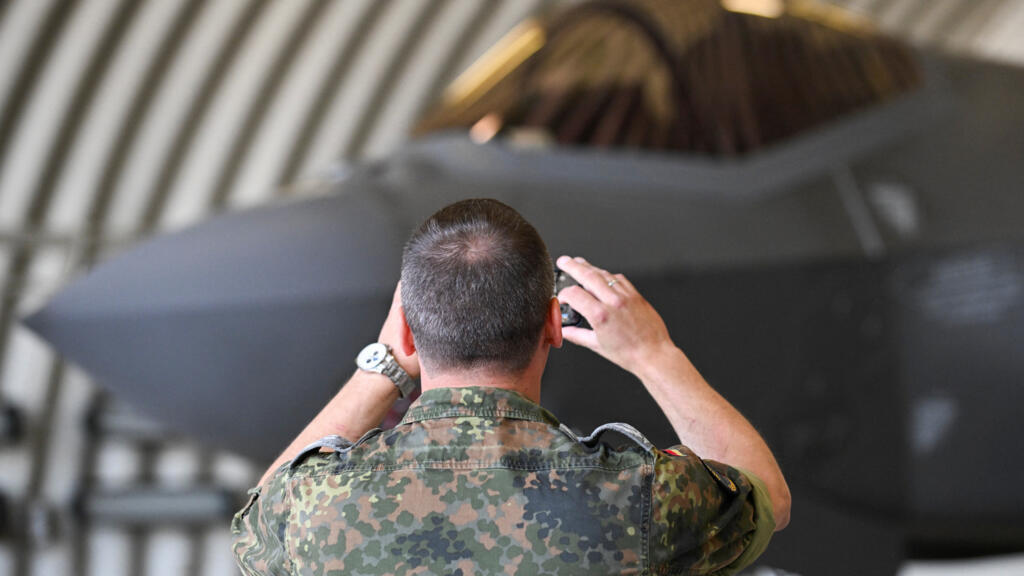
After years of negotiations, the Turkish military may finally be close to acquiring American F-35 fighter jets. United States President Donald Trump has suggested a deal could be near, despite Israel warning that the sale would threaten its security amidst rising tensions with Turkey.
“We’re thinking about it very seriously,” Trump said when asked by a reporter about the sale of F-35 fighter jets to Turkey during a visit this week by Israeli Prime Minister Benjamin Netanyahu.

The sale has been blocked for years due to Turkey’s purchase of the Russian S-400 missile system. A recent Bloomberg report suggested Ankara may be prepared to return the missiles, though Turkish officials have denied this.
Political commentator Asli Aydintasbas, a fellow at the Brookings Institution, says that the strengthening relationship between Trump and Turkish President Recep Tayyip Erdogan means both sides are working to resolve the impasse.
“He [Trump] himself is working with Turkey through his very effective ambassador, Tom Barrack, to find a solution,” said Aydintasbas. “There will be stiff opposition from the Greek lobby, Israelis and other regional players. But we've seen Trump skirt such opposition when it came to the Saudi Arabia F-35 sale.”
Military edge
Israeli security experts warn that Turkey’s acquisition of F-35 jets poses a greater security risk to Israel than the Saudi deal due to the Turkish military’s expertise, which threatens to challenge Israel’s technological advantage.
Currently, Israel maintains a significant edge as the Turkish air force operates decade-old jets, a factor that is increasingly important amid rising regional tensions.
“There was definitely a concern in the spring that there might be a confrontation in the skies of Syria between Israel and Turkey,” said Gallia Lindenstrauss of the Institute for National Security Studies in Tel Aviv.
Syria in crossfire as Turkish-Israeli rivalry heats up over Assad’s successors
She stresses the risk of confrontation has significantly diminished thanks to “de-confliction talks”, brokered by Azerbaijan. A Syria “hotline” now exists between Israel and Turkey to prevent what Lindenstrauss describes as “accidents between the Israeli Air Force and the Turkish Air Force”.
Yet the need for such measures underscores how strained ties are. “The fact that it exists, of course, does point to the fact that things are not necessarily calm,” Lindenstrauss acknowledged.
Provocative alliances
Israel’s conflict in Gaza has heightened tensions with Turkey. On New Year’s Day, hundreds of thousands protested in Istanbul in support of Palestinians.

Tensions escalated further as Israel increased military cooperation last month with Greece and Cyprus. Both Greece and Cyprus have unresolved territorial disputes with Turkey in the Mediterranean and Aegean Seas.
“Israelis are provoking especially Greeks and Greek Cypriots,” said Murat Aslan of Seta, a Turkish pro-government think tank. “The Israeli pilots are educating and training Greek pilots. They are operating [drones] across the Aegean Sea. And they sold many complex missile systems. So that means Israelis are provoking Greece just to challenge Turkey here in the Aegean Sea.”
In his New Year's address, Erdogan said he was closely monitoring what he describes as threats and provocations against Turkey and Turkish Cypriots. Aslan predicts Ankara will not remain passive. “If there is a pattern in the west of Turkey that Greeks and Israelis are cooperating, for the sake of Turkish security interests, for sure there will be a reaction,” he warned.
Israel talks defence with Greece and Cyprus, as Turkey issues Netanyahu warrant
Greece, which is also acquiring the F-35, has joined Israel in opposing Turkey’s purchase of the jet, warning it would alter the balance of power.
While Trump has expressed support for the Turkish sale, analyst Aydintasbas notes the US president is learning the limitations of his power when it comes to Israel.
“Trump is going through what a lot of US presidents have experienced: frustration, and a question – ‘wait a minute, who's the superpower here?’” she said. “Because of the power dynamic in the US-Israeli relationship, it sometimes does point to a situation in which Israelis, though the weaker side technically, end up having the upper hand because of their enormous influence in the public space.”
Aydintasbas predicts that, despite Trump's friendship with and admiration for Erdogan, the US president will be unwilling to pay the political price of securing the Turkish jet sale. “This is an issue on which Trump is not willing to fight the US Congress... and essentially ignore the US law,” she said.
For the self-described master dealmaker, it may prove a deal too far.







