Three years after a landmark merger that fundamentally altered Thailand's telecom landscape, True Corporation is far from resting on its laurels.
The consolidation of CP Group's True and Telenor's dtac has focused primarily on rationalising assets, people and processes.

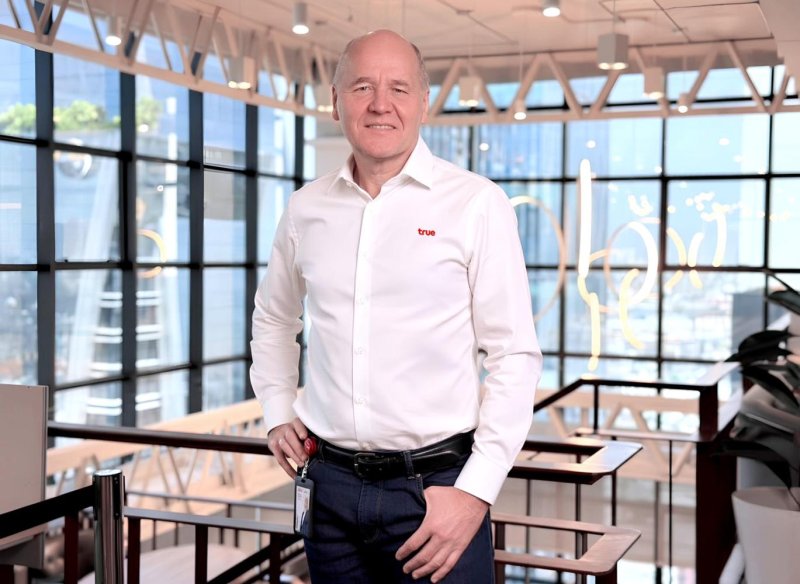
Sigve Brekke, group chief executive of True Corporation, said the challenge now is no less ambitious: transforming the company into a dominant, artificial intelligence (AI)-first technology powerhouse.
He told the Bangkok Post sustainable growth requires recognising and adapting to three big challenges facing modern telecom companies.
The first is breaking free from the legacy model of selling basic connectivity.
"You can choose. If you want, you can be a utility player. You can be an electricity company, and there is a business model for that," Mr Brekke said.
"But this is the same as the electricity you buy at home. You just sell electricity; you don't sell anything on top of that."
True's ambition is to capture its fair share of the broader digital economy by offering layered services.
He said he envisions True as a "trusted partner in my digital life", providing an integrated system where a single customer utilises True Mobile, True Online, True Money, and True Visions seamlessly.
"The company is shifting its consumer strategy from winning individuals to winning the whole family, offering integrated mobile and broadband services for households," Mr Brekke said.
The second challenge is perhaps more daunting: organisational transformation, which involves shifting a "manually born" company of 10,000 employees into an agile, AI-born operation, he said.
"Digital companies today are digitally born or AI-born," Mr Brekke said. "To change a big organisation … to act and think like a startup, that's super hard, and it has to do with mindset."
True is addressing this challenge head-on.
"We are entering a new phase of transformation as an AI-first organisation, while remaining firmly customer-centric," he said. "AI will embed intelligence across our networks, services and digital platforms, enabling more predictive and autonomous operations that improve both performance and customer experience."
The company plans to equip all of its employees with foundational AI skills.
"It will be impossible to work at True if you don't know the basics of AI a year from now," noted Mr Brekke.
This AI-first approach permeates the company's external strategy as well. He outlined a clear path for Thailand to take a leadership role in the AI era, emphasising the need for comprehensive development of infrastructure, high-quality data, talent and strong policy.
While Thailand has a strong digital infrastructure, Mr Brekke said further investment is needed. He highlighted the importance of data, stating "both the government and private sector must prioritise making data usable -- organising and structuring it to ensure it can be effectively applied across industries".
The third challenge is acknowledging true competition.
"Our main competitor today is not AIS. It is platform players such as Line, Shopee, TikTok, and Netflix on the TV side," said Mr Brekke.
Competing with these global players necessitates strategic partnerships.
"Going forward, a major change is more telecom operations will be achieved through partnerships, unlike in the past when operators did most things by themselves. You need to have long-term strategic partnerships, which means you need to be willing to share some of the upside with your partner," he said, highlighting True's partnerships with Microsoft and Google. "This means we will take their cloud services and resell them to our business-to-business [B2B] customers. We take cloud on top of connectivity and resell it".
Perhaps the most intriguing aspect of True's strategy is its bet on sovereign AI. The company is building AI models on top of open large language model providers, tailored to the Thai language and culture.
"Sooner or later, I think there will be more focus on locality," Mr Brekke said. "This means ensuring my data is stored in Thailand, my applications are based on Thai culture -- Thais for Thais."
Despite the heavy focus on technological advancement, he remains pragmatic about financial realities. In the short term, the company's focus on AI is not expected to generate revenues, but rather consolidate expenses in terms of personnel, marketing and operating costs.
The B2B sector offers a strong growth opportunity for True, driven by the company's True AI hub. Mr Brekke said the company's evolution from a traditional telecom provider to a digital solutions provider will give more than 3 million Thai small businesses the ability to tap and scale new technologies such as big data analytics, AI, integrated platforms, cloud computing and 5G connectivity.
Investors are seeing results, as True's stock price is up 30% year-on-year. The company reported a record high quarterly net profit of 6.58 billion baht for the first quarter, quadruple that of the year before. While total revenue of 41.2 billion baht declined slightly from the year before, operating expenses fell nearly 30% year-on-year, helping earnings before interest, taxes, depreciation and amortisation to rise 10.9% to 28 billion baht for the quarter.
Shares of True closed on the Stock Exchange of Thailand at 14.40 baht yesterday, down 0.20, in trade worth 2.74 billion baht.