A "millionaires tax" was signed into law in Washington state this week, and one wealthy Washingtonian is celebrating.
"In 2029, Washington state will start collecting a 9.9% tax on income over $1 million," travel writer Rick Steves wrote in a social media post. "The 8,000,000 Washingtonians whose households make less than a million dollars a year will pay zero under this new tax and enjoy all the benefits of a better-funded state. And for the wealthy (like me and an estimated 30,000 others), every million dollars in taxable income that our households earn after the first million will cost us about $100,000."

As Steves wrote, the tax, which was signed into law on March 30, takes effect January 1, 2028, for tax payments due in April 2029.
Washington Gov. Bob Ferguson has said the tax revenue will help fund K-12 education, health care, higher education and governmental services, as well as expansions to the working families' tax credit, according to local KOMO News.
Steves, who lives in Edmonds, Washington, made some waves with his support for the tax, although it wasn't entirely surprising: Steves has long been an advocate for progressive and Democratic causes, and support for "millionaire taxes" tends to follow political lines.
Steves stands in somewhat limited company of wealthy people who have spoken out in support of being more highly taxed. Here's what he and others have said.
Rick Steves' support for Washington's millionaire tax
Posted by ricksteves on
Steves wrote extensively about the tax in his March 30 post. In it, he expressed that the tax wouldn't have a major impact on those paying it, but would benefit the public.
Seves added that he's been "investing my tax savings in my community" for about 15 years through donations to a local arts center and symphony as a "self-imposed wealth tax," and believes the state-wide tax will help local communities.
Steves said: "As a wealthy person myself, I see this tax as essentially free money for all Washingtonians. Everybody in my state gains. And speaking from personal experience, I know that anyone who earns enough to be subject to this tax is beyond the point where consuming more adds to their security, their well-being, or even, arguably, their happiness — meaning there will be basically zero human cost."
Warren Buffett's take on higher taxes
Investing icon Warren Buffett has long said he'd like to be taxed more heavily. While Washington state’s new tax targets personal income over $1 million, Buffett has called for eliminating loopholes that allow investors — those who often “make money with money” — to pay a smaller share of their income than people earning far less.
"These [tax breaks] and other blessings are showered upon us by legislators in Washington who feel compelled to protect us, much as if we were spotted owls or some other endangered species," he wrote in a 2011 New York Times opinion piece.
In fact, after that piece, then-President Barack Obama proposed a tax policy known as "the Buffett Rule," reflecting Buffett's principle that "no household making over $1 million annually should pay a smaller share of their income in taxes than middle-class families pay."
"My friends and I have been coddled long enough by a billionaire-friendly Congress. It's time for our government to get serious about shared sacrifice," Buffett wrote.

More recently, ProPublica published an investigation in 2021 that dove into Buffett's tax records and claimed his effective tax rate from 2014 to 2018 was 0.1%.
As part of a longer response to the investigation, Buffett wrote: "I continue to believe that the tax code should be changed substantially. I hope that the earned-income tax credit is greatly expanded and additionally believe that huge dynastic wealth is not desirable for our society. Perhaps annual payout requirements should be increased for foundations. Some time ago, I testified before Senator Baucus in favor of increasing and tightening estate taxes. (My persuasive powers proved to be limited.)"
He added, about his 2011 opinion piece, "I remain OK with what I said, though its effect in Washington was zero."
Jamie Dimon calls this a 'no-brainer'

JPMorgan Chase CEO Jamie Dimon has a somewhat nuanced view on raising taxes, which he's expressed over the years.
"If you said, 'Raise taxes and directly give it to the people who need it'? I'd do it," he said at the World Economic Forum earlier this year. "But that's not what happens. It goes to interest groups and they give it to their friends and all that, which is why the people consider it a 'swamp.'"
In 2024, speaking, like Buffett, of wanting to raise the earned income tax credit, Dimon said, "This is like a no-brainer to lift up society, and I would pay for it by taxing the wealthy a little bit more."
So while he's said he's open to increasing taxes on higher earners, he's balanced it with the idea that he would want those funds to go directly to helping lower earners and communities, an outcome of which he's skeptical.
Just recently, too, in an appearance on Fox News, Dimon acknowledged that "individual taxes, state taxes, corporate taxes," in addition to "quality of life," "drives people out" of places, pointing to New York and California.
The Patriotic Millionaires on taxes
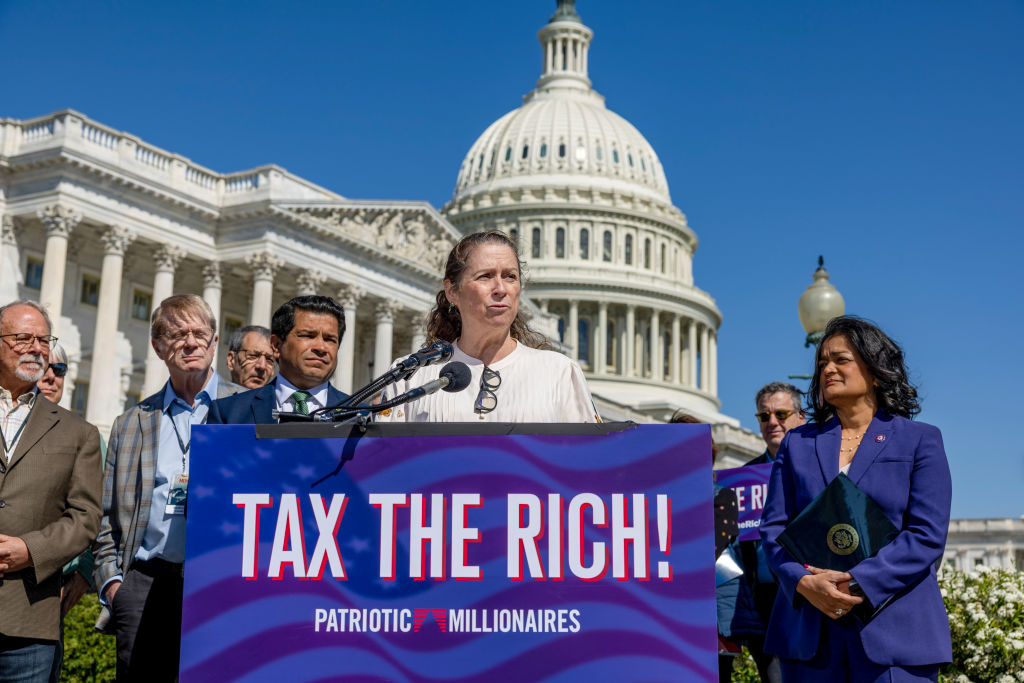
There is an actual group of wealthy folks dedicated to the idea of "taxing the rich."
Patriotic Millionaires was started in 2010 to advocate for higher taxes on high earners. Of course, members of this group have spoken out regularly in their advocacy. The chair of the group is Morris Pearl, who was a managing director at BlackRock.
"What I'm talking about is what policies will not just help me personally, but that I think will be good for our country and my kids' generation," he told The Atlantic in 2016. "I don't want to live in a country where a few people do amazingly well and everyone else does poorly, because anyone, including me and my kids, may end up not being one of the winners."
Earlier this year, Pearl wrote a piece for The Indypendent about raising taxes on millionaires in New York. In it, he said: "As a successful investor, I reject the idea that investors need tax breaks as incentives to invest, create jobs, and grow the economy. That's fundamentally untrue. Even if tax rates on investment income were very high, I would always choose to invest because, the last time I checked, the alternative — stuffing money under mattresses — doesn't produce the greatest returns."
Scott Ellis, a California millionaire in the group, wrote in a piece for Business Insider in January: "Once you get beyond $30 million — and almost no one ever gets there — you get to a point where your life is so good, you really can't materially improve your life anymore. We should implement a very aggressive annual 50% tax on all household wealth over $30 million. Excessive wealth turns into excessive power through huge campaign donations, which threatens and undermines democracy and capitalism."
Abigail Disney, the Disney heiress, is also a member of this group. "It turns out that it is that hard to believe that, that someone would actually do something for the greater good and not in their own self-interest," she told Time last year.